Old Maids: Unnatural Death by Dorothy Sayers
 |
 |
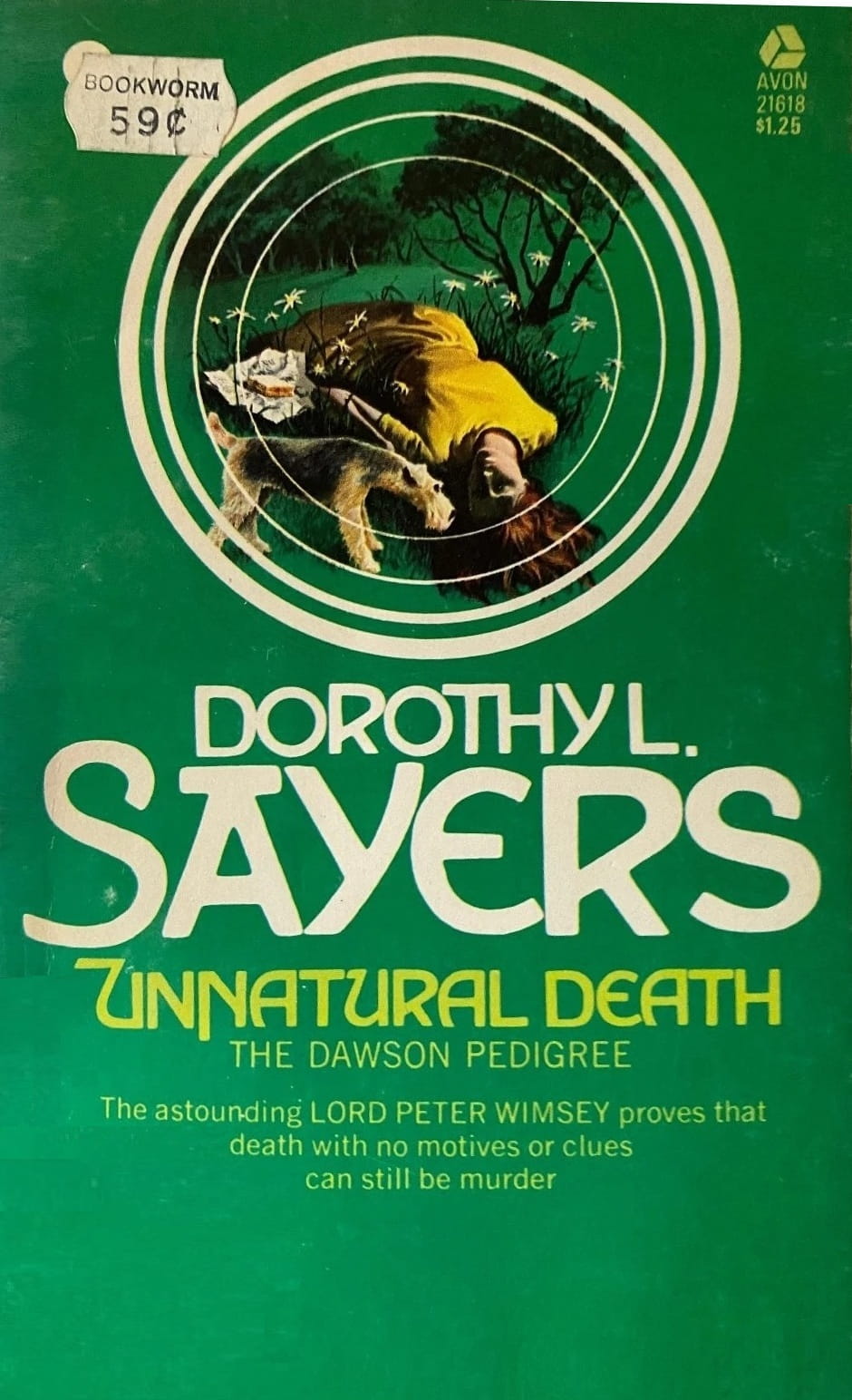
Unnatural Death by Dorothy Sayers (Avon Books, 1964)
“I know who you are now,” said Nurse Philliter, slowly. “You — you gave evidence against Sir Julian Freke. In fact, you traced the murder to him, didn’t you?”
In Unnatural Death, the third Wimsey novel, Sayers again makes medical issues vital to the plot and the mystery. In this case, Wimsey learns of his case entirely by accident: He and his close friend Charles Parker are talking about crime over dinner, and Wimsey tells Parker that, unlike police officers, who have a public duty to voice their suspicions, doctors have no such duty and can get in trouble by doing so.
This is overheard by a doctor seated at a nearby table, who tells them a story of his own experience with doing so: A rich old woman in his care died unexpectedly — she was suffering from a terminal cancer, but that was not the cause — and he found the death puzzling and asked to do a post-mortem, which found no cause of death, followed by a chemical analysis, which revealed nothing either.
[Click the images for unnatural-sized versions.]
This sets us up for a neat medical mystery, which in fact has a solution that’s fairly widely known now, but that apparently was obscure a century ago. The doctor tells the other two that the local gossip that followed from this ruined his practice, and he had to move away and start over elsewhere.
Intrigued, Wimsey offers to look into the case, but the doctor turns him down, remarking with satisfaction that Wimsey doesn’t know his name and won’t be able to pursue the matter. Wimsey decides to do so anyway, sends the doctor, Dr. Edward Carr, a short note, and says to Parker, “If you want to be immune from silly letters, Charles, don’t carry your monomark in your hat.”
 |
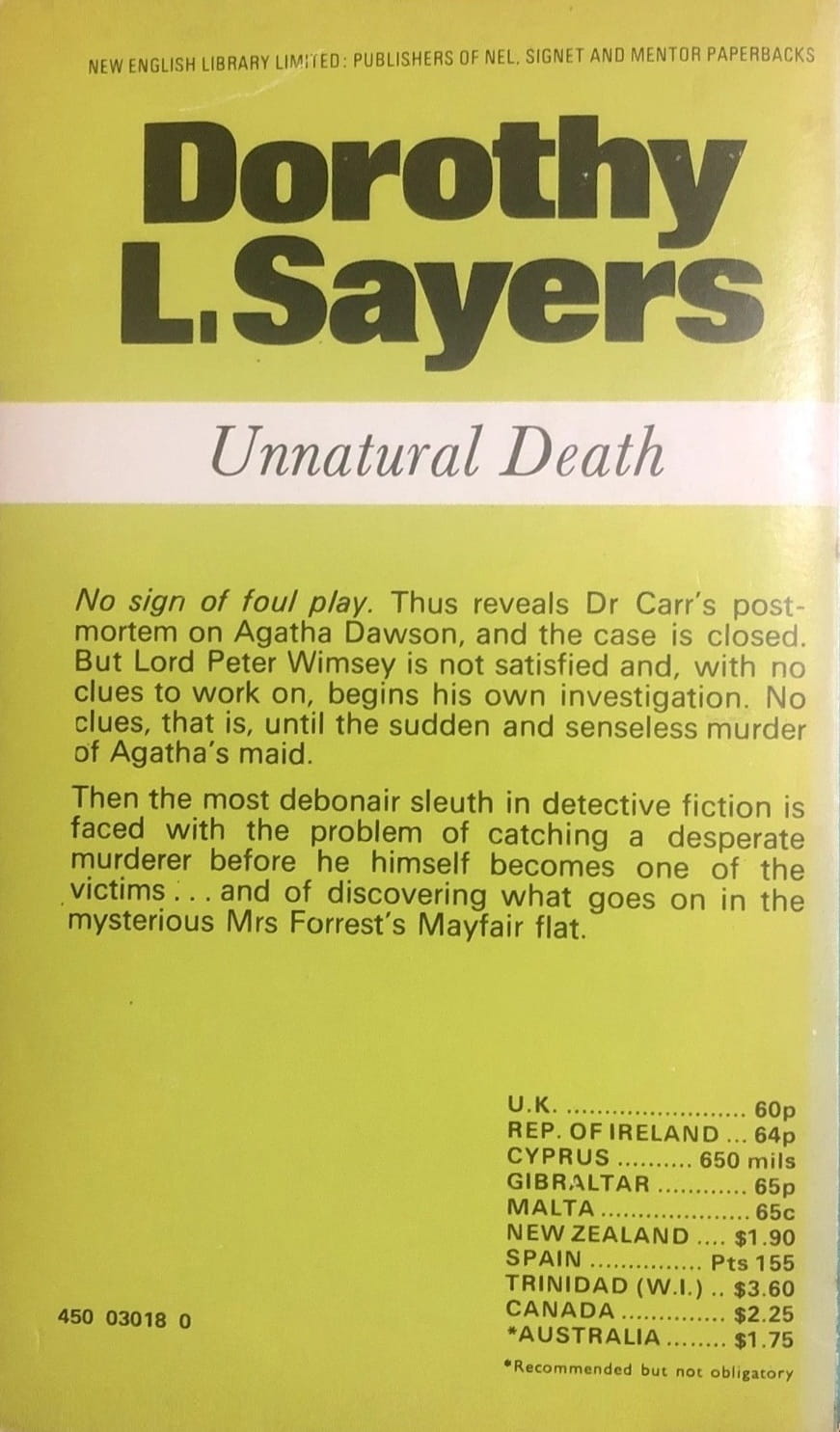 |
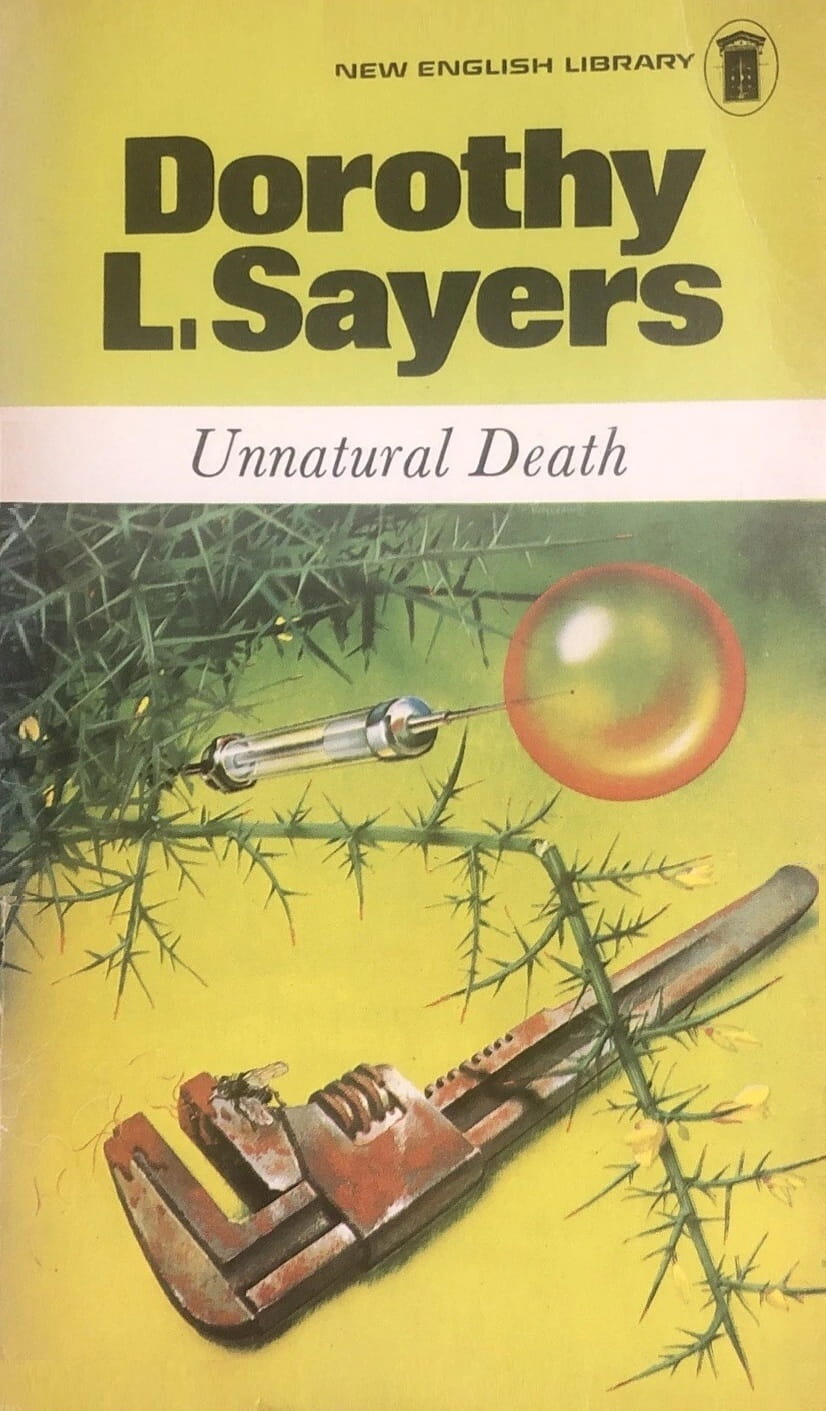
Unnatural Death by Dorothy Sayers (New English Library, 1976)
(According to Wiktionary, a monomark is a short alphanumeric sequence used as a postal address, brought into use by a British mail forwarding company two years before Unnatural Death was published. Naturally Lord Peter would have spotted and memorized the monomark!)
In an early chapter, Wimsey takes Parker to meet a woman whom he describes as a friend. Parker takes this to be a euphemism, and is embarrassed, privately ironic about how “they always seem to think it’s different,” and trying not to show the disapproval he feels. Then he and the readers meet “a thin, middle-aged woman, with a sharp, sallow face and very vivacious manner.”
 |
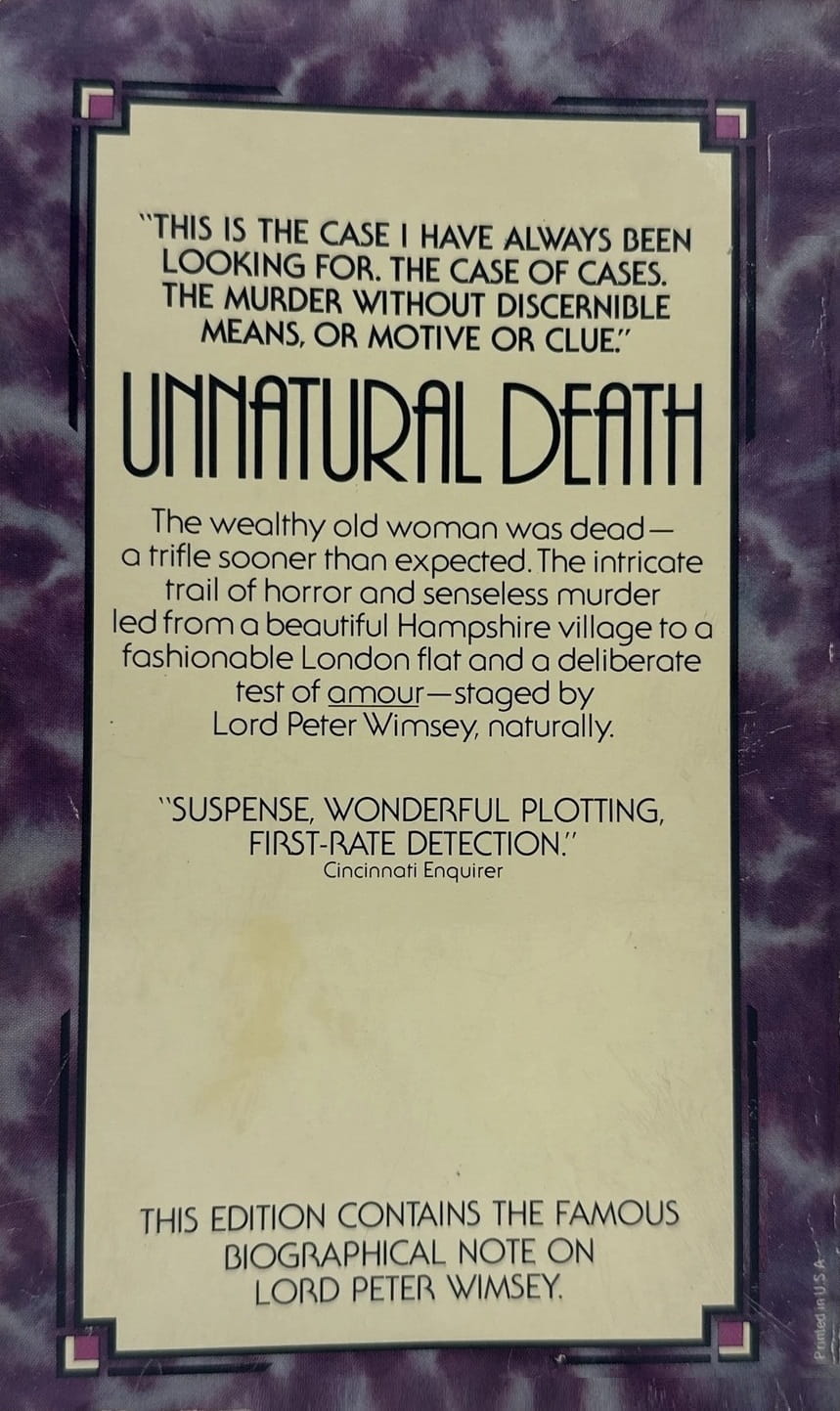 |
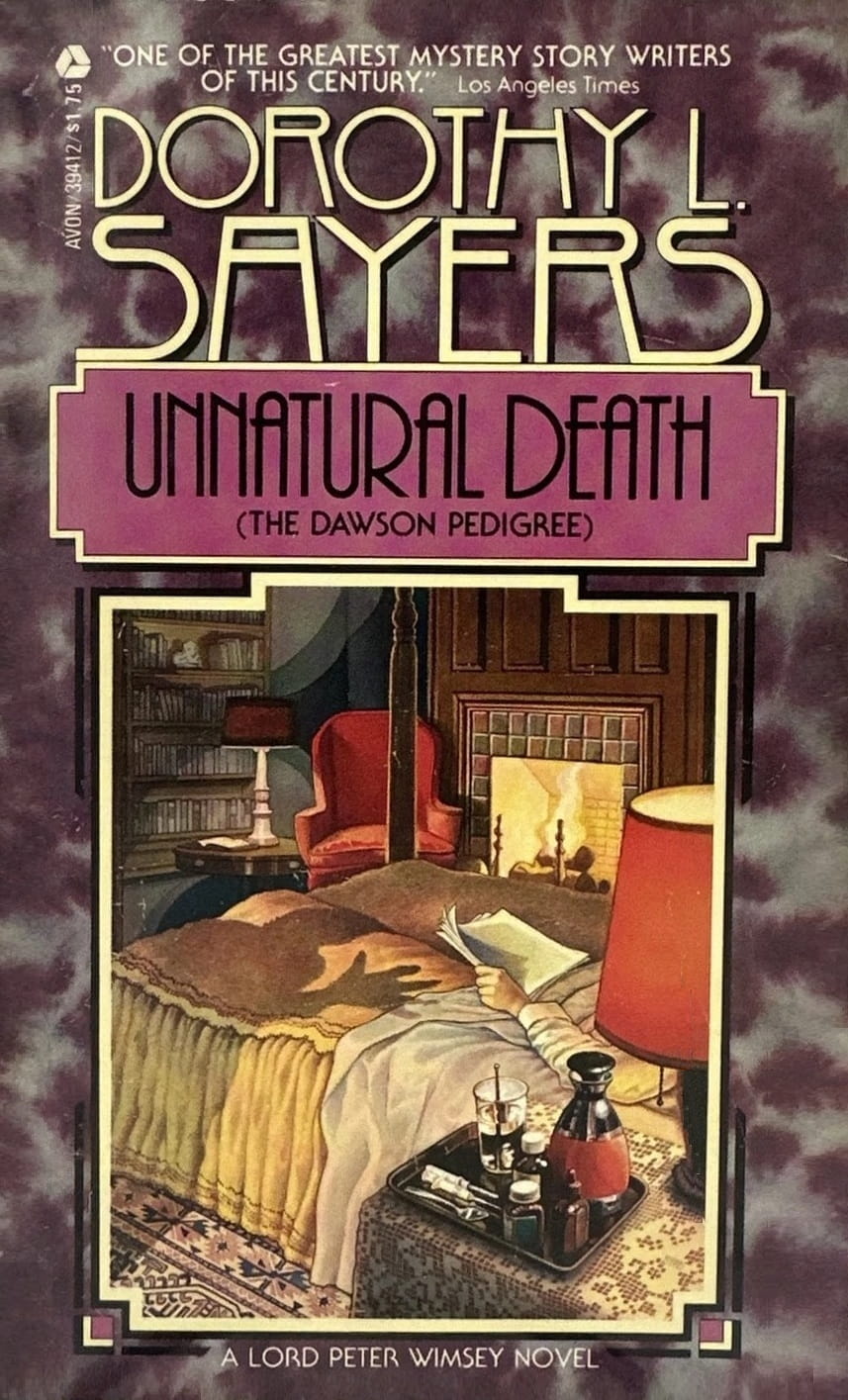
Unnatural Death (Avon Books, 1964)
Miss Climpson is, as Wimsey says, an old maid (an increasing problem in the years after the Great War) and, as Parker says, a sort of inquiry agent; in Wimsey’s words, “She asks questions which a young man could not put without a blush.”
In fact, she is part of an agency which Wimsey has created and is funding, which amounts to his version of the Baker Street Irregulars (with single women instead of street urchins!), and he sends her off to find which town Dr. Carr formerly practiced in and who was his deceased patient there — the first stage of her active role in the entire investigation.
At this point the story acquires a subtext that Sayers never makes explicit. The patient was Agatha Dawson — Miss Agatha Dawson, for she never married; she lived most of her life with her cousin, Miss Clara Whittaker, to whom she was deeply attached. Neither of them cared for marriage; Clara supported them as a successful horse breeder, and wanted nothing to do with men, except on matters of business.
After Clara’s death, her niece, Mary Whitaker, a trained nurse who steps in to manage Miss Dawson’s care, is also, to Miss Climpson’s eye, “not of the marrying sort,” and is much admired by a younger woman, Vera Findlater, of whom Miss Climpson thinks “It is natural for a schoolgirl… in a young woman of twenty-two it is thoroughly undesirable”; the two have plans to buy a chicken farm together.
Finally, Wimsey has two interviews with yet another woman, Miss Forrest, at the second of which she attempts to seduce him, but when he takes the lure and kisses her, she involuntarily shudders away in revulsion.
It’s a point in Sayers’s favor, I think, that she doesn’t have one stereotype of “the love that dare not speak its name” (however politely hinted at) but shows everything from lifelong devotion to naïveté to cynical manipulation. What’s unnatural, in this novel, is not one woman’s passion for another, but murder.
 |
 |
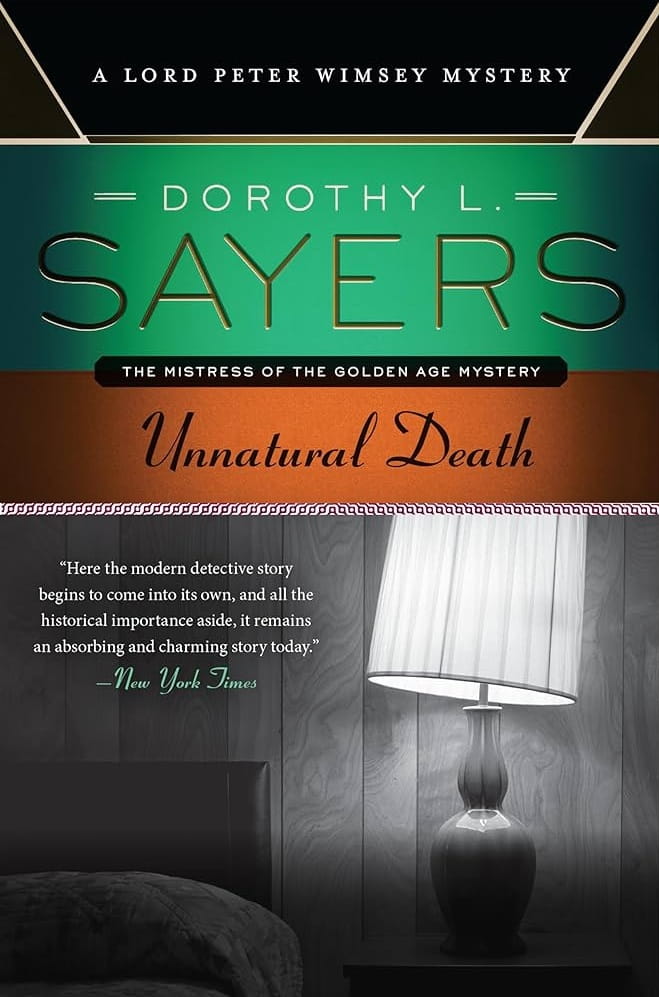
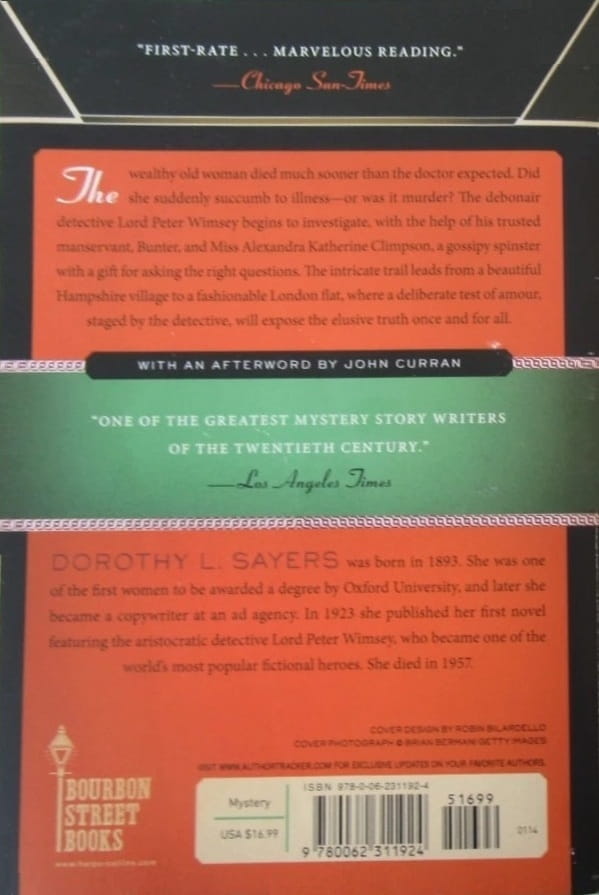
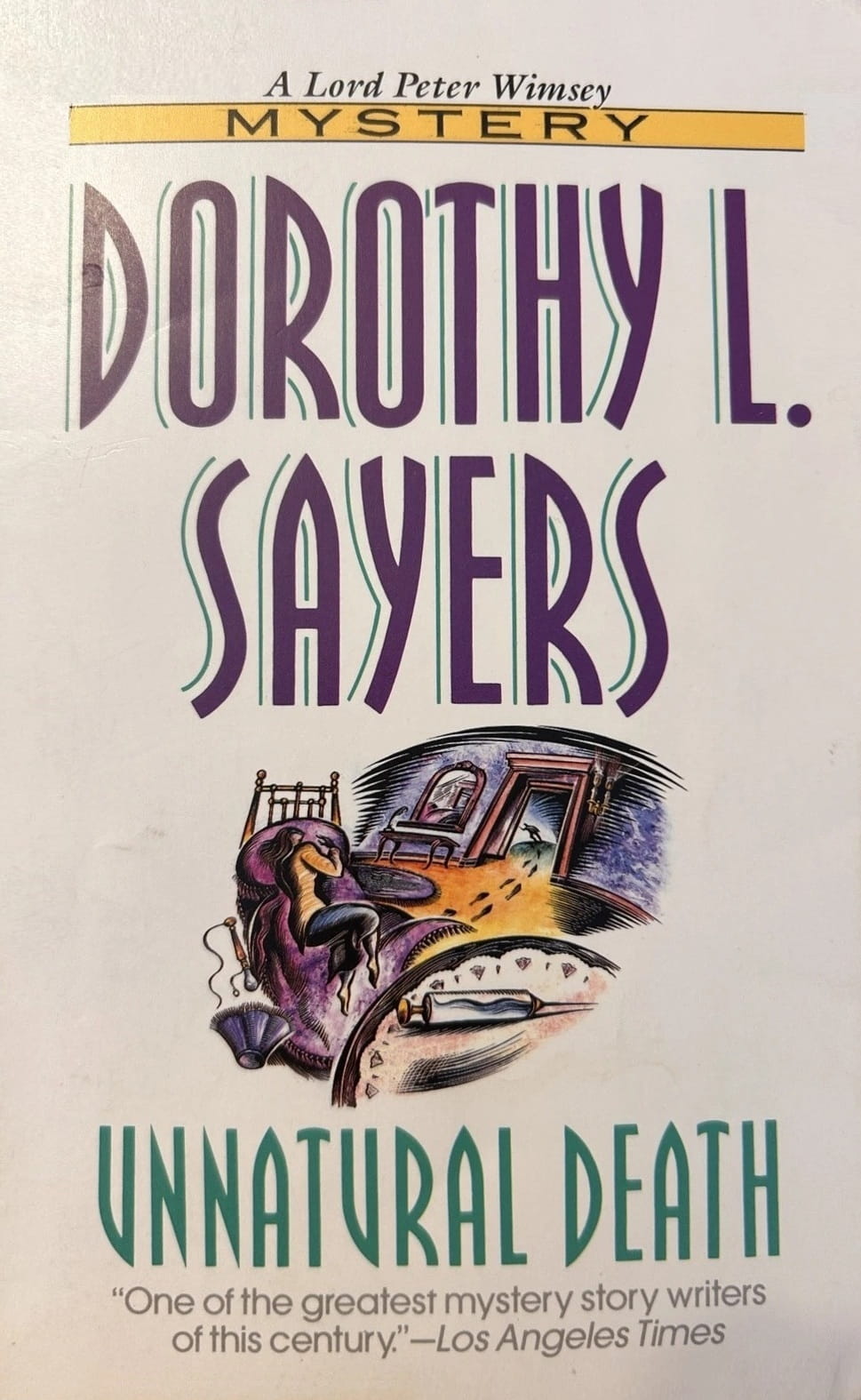
Unnatural Death (HarperCollins, 1995)
Finding out about the two cousins gives Wimsey and Parker a start on discovering the family relations (some American editions were titled The Dawson Pedigree), and also meeting the solicitor who took over from their retired former solicitor. This brings up some complex issues that follow from a recent change in the law (I imagine Sayers reading about the change and thinking that it could be a motive for murder) and that supply a motive.
The story supports one of Wimsey’s ideas: That one crime can lead to more crimes as the criminal tries to cover up the first. The investigation heats up with the death of Bertha Gotobed, formerly a servant of Miss Dawson, and with the death of Vera Findlater. All this builds up to a dramatic climactic scene and to the revelation of how the original death was brought about.
 |
 |
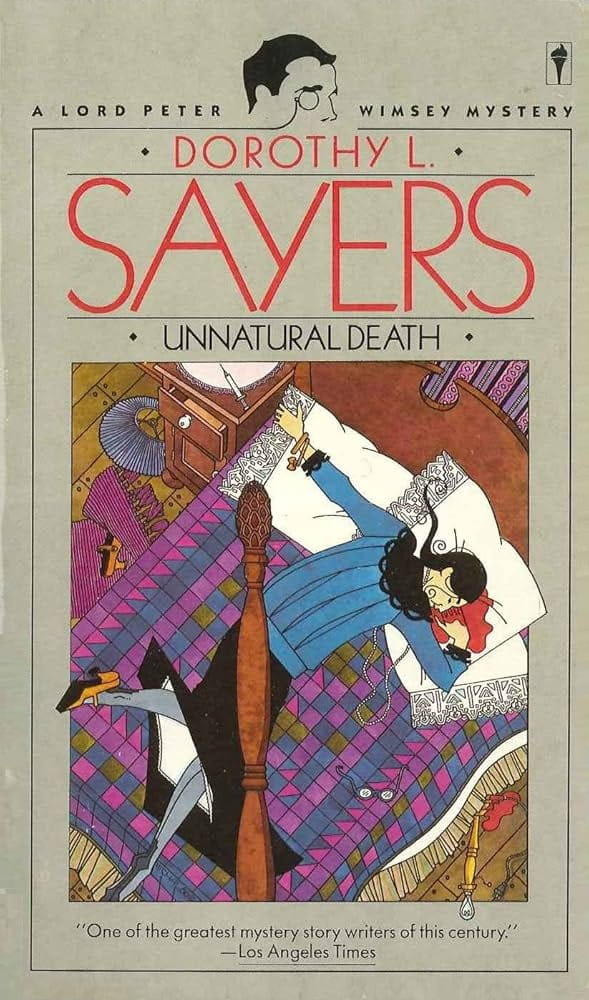
Unnatural Death (Perennial Mystery Library, 1987)
Sayers also shows Wimsey troubled by his own involvement in the case: asking the vicar of the town where Miss Dawson and Miss Whittaker lived for moral advice on a “hypothetical” case; thinking that his own investigations may have created the motive for two more murders; and in the end, “cold and sick” at the outcome. Inner conflict over his own vocation of criminal investigation makes him an increasingly complex character, and makes this a psychological novel as well as a murder mystery.
William H. Stoddard is a professional copy editor specializing in scholarly and scientific publications. As a secondary career, he has written more than two dozen books for Steve Jackson Games, starting in 2000 with GURPS Steampunk. He lives in Lawrence, Kansas with his wife, their cat (a ginger tabby), and a hundred shelf feet of books, including large amounts of science fiction, fantasy, and graphic novels.