A Fine Sword & Sorcery Anthology: The Spell of Seven, edited by L. Sprague de Camp
 |
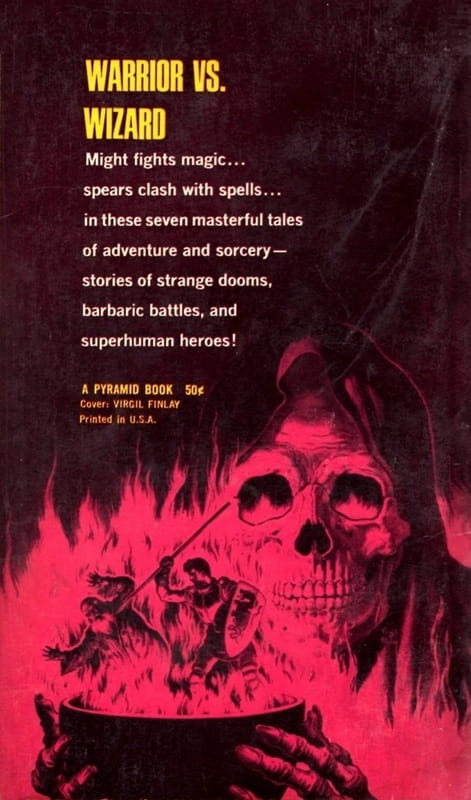 |
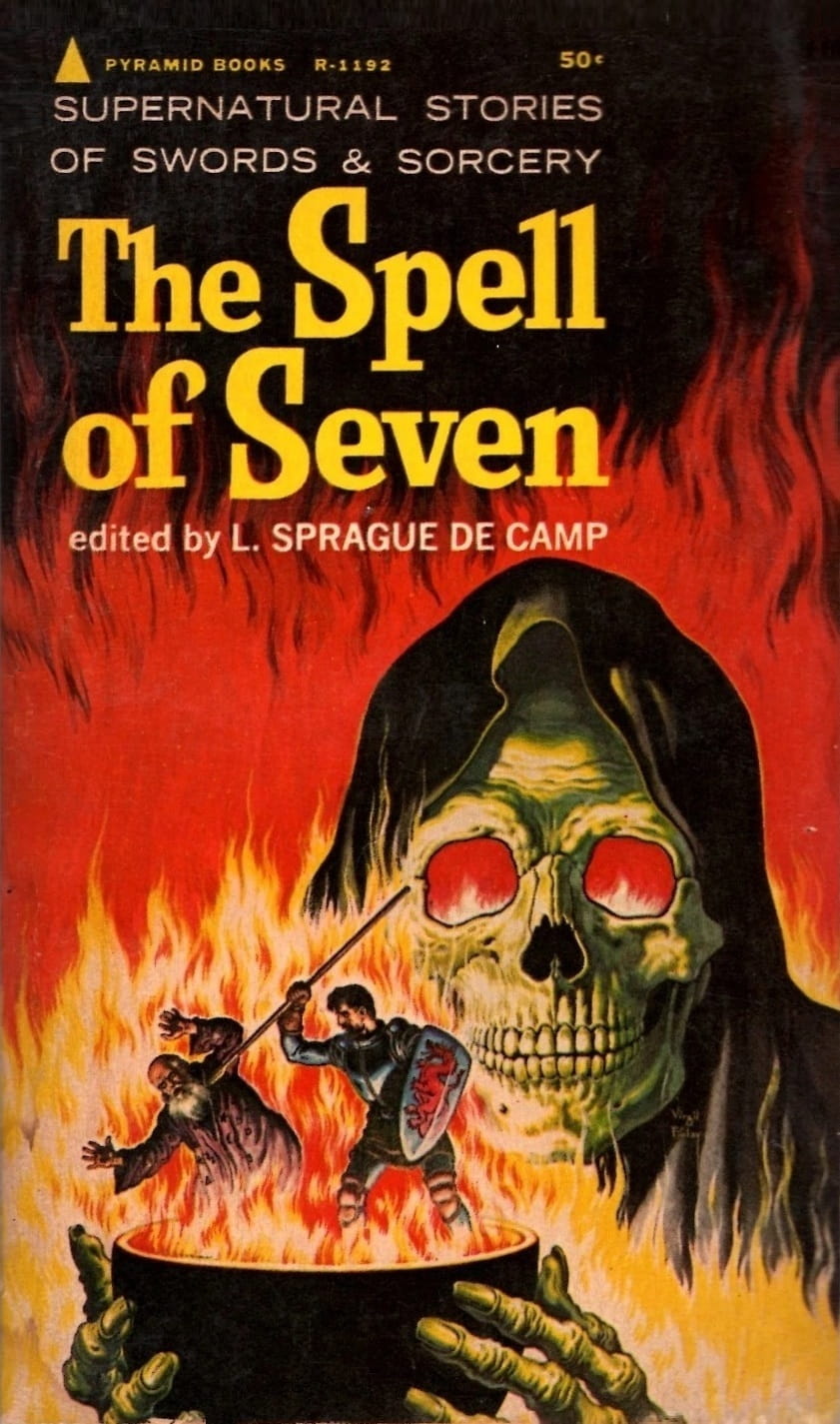
The Spell of Seven (Pyramid Books, June 1965). Cover by Virgil Finlay
L. Sprague de Camp was a major player in the paperback Sword & Sorcery boom of the 1960s. I had the good fortune to meet him and his wife; both were urbane and erudite. I was able to correspond with him while in the ranks of REHupa, the Robert E. Howard United Press Association. De Camp’s role in promoting Robert E. Howard — and his own work with it — is not without controversary, which I’ll address.
But not today. De Camp was also a popular and successful fiction writer, both fantasy and SF, and even nonfiction. I’ll address those aspects in time, but today I’ll just bring some of his editing work into focus. He edited a number of fine Sword & Sorcery anthologies, most of which featured REH. These include Swords & Sorcery, The Spell of Seven, Warlocks and Warriors, and The Fantastic Swordsmen. I have two copies of The Spell of Seven and will discuss it first.
[Click the images for sword & sorcery versions.]
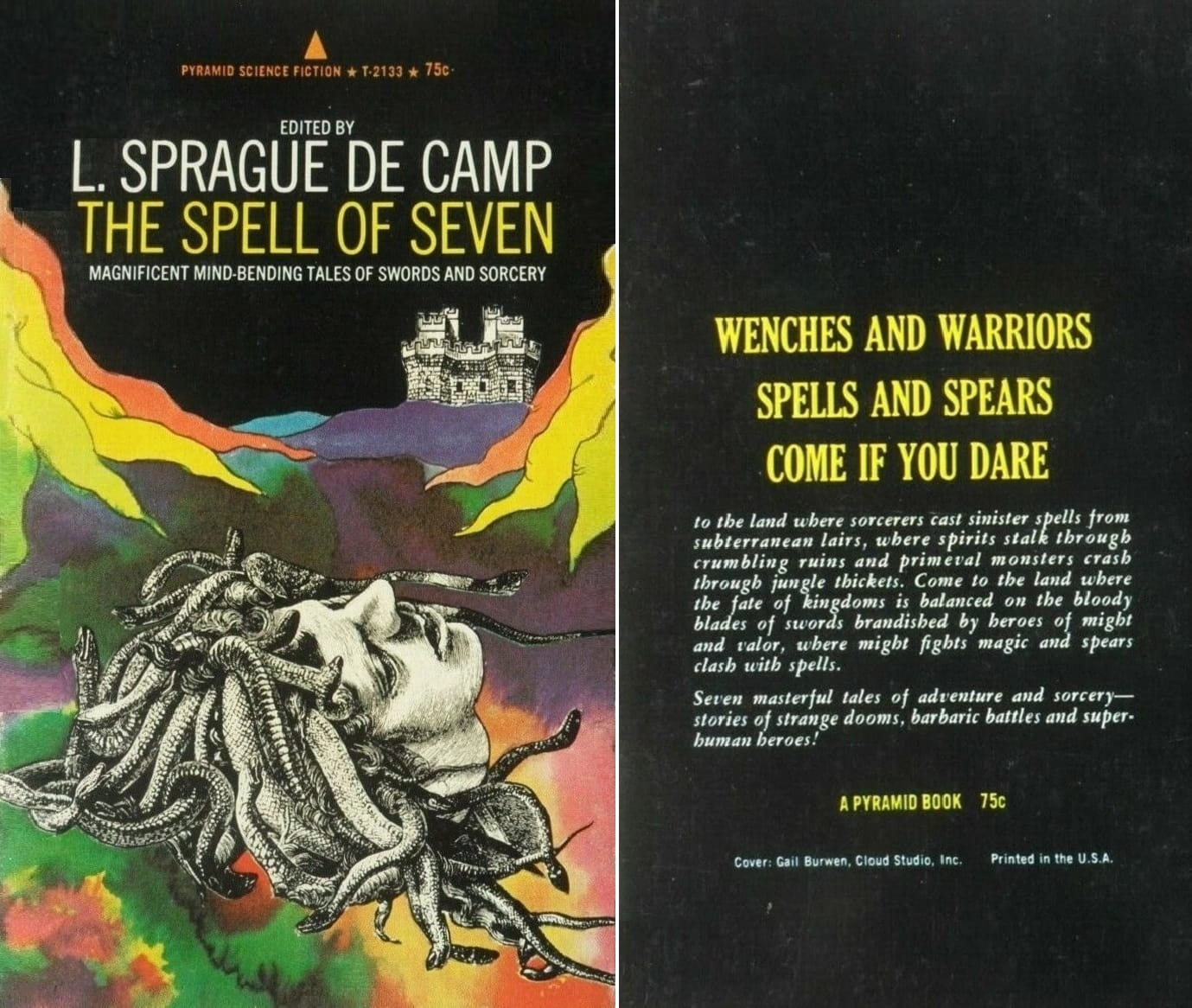
The book was published by Pyramid Books. The first printing is at the top, from 1965, with a skull and flames cover by Virgil Finlay. The second printing (above) was 1969, with a cover credited to Virgil Finlay but actually by Gail Burwen, I believe. Both versions have the same cool interior illustrations by Finlay.
The book contains seven stories, anchored by a fine Conan tale from Robert E. Howard called “Shadows in Zamboula.” It starts with an intro by de Camp called “Wizards and Warriors.” This has some interesting historical statements about heroic fantasy. It also emphasizes such fictions as purely escapist literature. I agree it makes great escapist literature, though I don’t believe that’s all it does.
Other stories in the book are “The Hungry Hercynian,” by de Camp, “Bazaar of the Bizarre,” one of the best known Mouser & Fafhrd stories by Fritz Leiber, “The Dark Eidolon,” a Zothique story by Clark Ashton Smith, “The Hoard of the Gibbelins” by Lord Dunsany, “Kings in Darkness” by Moorcock (an Elric piece that he rewrote and resold several times), and “Mazirian The Magician” by Jack Vance. All were entertaining.
Two final points I’ll make. First, the covers and introduction make no mention of Howard. This was before the first Lancer Conan book appeared with its fantastic Frazetta cover in 1966, and Howard’s name was not the purchasing draw it would become. Second, de Camp wrote intros to each story and his introduction to Howard contained the unfortunate phrase “maladjusted to the point of psychosis.”
This set the stage for a long history of folks referring to Howard as crazy, which I vehemently disagree with and have written and spoken about at length. I’ll address this topic more completely in later posts on REH.
Charles Gramlich administers The Swords & Planet League group on Facebook, where this post first appeared. His last article for us was a review of the 3-volume S&S anthology series Echoes of Valor. See all of his recent posts for Black Gate here.
Good stuff. I love the skull version of the cover. A great S&S cover.
Yes, that cover really engages the imagination.
Thanks, Charles, for calling attention to this seminal S&S anthology, which IMHO was even stronger than “Swords & Sorcery”. In 1965 it introduced me to Howard, Smith, Dunsany and my absolute favorite writer, Jack Vance, and I’d say the stories were as thought-provoking as they were ‘entertaining,’ to your point about de Camp’s myopic dismissal of heroic fantasy as ‘escapist literature.’ I look forward to your addressing that misinformed comment in a future post. 😉
yes, that comment by De Camp really rankled. I believe this collection was my introduction to Vance as well.
I guess there are three authors most associated with Weird Tales – Robert E. Howard, Clark Ashton Smith and Lovecraft. I’m not sure I’d describe any of the three as crazy, but all three were reluctant to leave the nest and two of them never really did (in fairness CAS was agoraphobic). For what it’s worth, I reckon a life spent under such constraints often results in a vivid inner world – critical for any author, but especially for one who writes speculative fiction.
All three showed strong elements of introversion, which is not a disorder in any way.
I didn’t know Smith was agoraphobic! Poor man. That’s a difficult condition, often progressively isolating to the subject.
There’ve been arguments about whether restriction or travel creates a richer creativity. It probably depends on the person experiencing either. Just grateful for anyone responding to their circumstances by getting creative and sharing!
Big time!
Smith and Lovecraft definitely had some unusual emotional sensitivities. Howard was probably the most normal of the 3 in that regard but he definitely showed some eccentricities, although not rising to any level of mental disorder.
There are some exceptional stories there. “The Bazaar of the Bizarre” is an all time favorite. And the Dunsany and Vance stories are nicely mordant in their elegant fashion.
Curiously, the Wikipedia entries for all three of those stories explicitly mention The Spell of Seven, though surely they all were much more widely reprinted.
I have seen all 3 elsewhere but maybe this was their first reprinting
All four of those de Camp anthologies were foundational. I have a copy with the skull cover; I don’t think I’ve ever seen the other, more groovy cover before.
Yep, I’ve covered most of the De camp anthologies and they really set the stage for the S&S boom as it expanded
As a mental health professional, I concur with your assessment of Howard.
Cool. I’m a psychologist by profession, though not a clinical guy. My background is experimental, specifically biopsych and learning. I have tended to approach Howard’s life from a behavioral perspective.