The Roots of Action/Horror
By E. E. Knight
Copyright 2008 by New Epoch Press. All rights reserved.
 The modern action/horror film emerged in the early to middle 1980s as one of the most bankable genres for attracting a youth audience. Films like James Cameron’s Aliens, and various John Carpenter efforts from Escape from New York and The Thing on blended two-fisted heroism with more traditional “who goes there” spookiness to great effect — and profit. They opened the door for later Blade and Underworld and Van Helsing-style moves, with some loss of characterization and plot to CGI special effects. But maybe I’m just getting old and grouchy.
You might fairly ask what makes them action/horror, as opposed to ordinary horror or action films? I will stipulate that most horror films have elements of action when the lurker in the dark is finally hunted down, and that some pure action movies offer gruesome moments of horror. To my mind there are three elements necessary for a movie to be categorized as action/horror:
1. As in traditional horror, the menace is something out of our ordinary understanding, beyond what anyone has encountered or experienced before. The menace threatens one of the most basic of needs, safety. Taking the audience beyond the borders of normal human experience allows some drama and suspense to build as the nature of the threat is explored.
2. The protagonist makes consistent and often violent effort against the menace. In traditional horror the protagonist is often just trying to comprehend the horror and then escape it. Even if there is a good deal of action, for example when the military fights the Martians in War of the Worlds or Clint Eastwood napalms the spider in Tarantula, it’s not truly action/horror if we wait for the military, torch-bearing villagers, or necrotic microorganisms to show up. A good action hero doesn’t call for backup.
3. There is an attempt on the part of the protagonist to restore order, justice, or the status quo. This requirement distinguishes action/horror from survival/horror, where the all the protagonist can hope to do is make it to the end credits, as in various slasher films, Romero’s zombie movies or the Vincent Price version of I Am Legend.
Thus the structure of action/horror might be compared to a crime drama, divided into three stages: investigation, arrest, and elimination from society. Though all three stages are bound to get a good deal messier than in a crime drama. Fans of action/horror know your first “arrest” rarely works.
I apologize in advance for leaving out certain vintage titles that may be a reader favorite. I’m enthusiastic about action/horror, especially in older films, but my knowledge isn’t encyclopedic. I struggled with several films, especially the original King Kong. I consider it the first great American Movie, in many ways — filled with action, special effects, romance, all coming fast and furious…but my problem with labeling it action/horror is that Anne Darrow and Jack Driscoll spend more time trying to escape Kong than defeat him. You could make a case that the movie is survival horror, I suppose, but that’s another column.
 The Thing From Another World (1951)
The original Howard Hawks version of John W. Campbell Jr.’s classic sf novella is approaching its sixth decade as one of the most riveting pieces of sf ever put on screen. It’s often ridiculed as the “James Arness as a carrot” movie, but that doesn’t due justice to the creepy, shadowy nature of many of the encounters between man and monster or the intelligence of the script. A ridiculous costume can sometimes be advantageous, though if you’ve ever seen The Creeping Terror you know that’s something of a double-edged sword.
In Thing‘s case, the protagonists are a mixed bunch of All-American Can-doers. The scientists, journalist, love interest, and test pilot are pure 50s (the gal has an interesting career requiring education and intelligence, like most women in 50s sf, at least in this genre the decade doesn’t deserve its rap where women are concerned-though I would have liked to see an instance where a woman’s position wasn’t that of “assistant” to a man).
The Investigation stage starts when a remote Arctic research station requests help in dealing with a mysterious phenomena. It turns out to be a crashed flying saucer, and there’s an entity aboard frozen in a block of ice. They take the popsicreature back to their station, and mistakenly put an electric blanket over the alien. Chaos ensues.
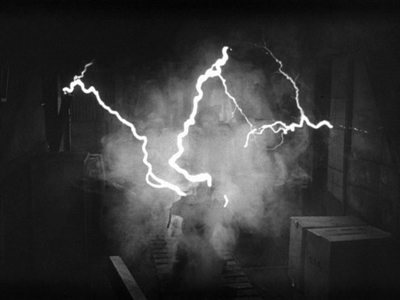 The Arrest phase is rather interesting. You almost get the feeling everyone is operating from some codebook retrieved from a safe and read out by Slim Pickens “if attempts at communication result in one or more personnel devoured, attempt the following: hacking, crushing, canine attack, burning, electrocution.” In a plot point later used by Alien, one of the scientists insists that even all their lives are of little import compared to the scientific leaps that can be made by studying the creature. The journalist sensibly replies that about the only thing they’re going to learn down that path is a quick way to die.
We also get the classic line “Watch the Skies!” from the post-Elimination ending, when the creature is destroyed using high-voltage wires. We reverently hope.
This movie laid the groundwork for any number of genre “ten little Indians” style movies, from Ridley Scott’s Alien to the slasher films to the new wave of exaggerated horrorporn, though I’m sure Howard Hawk’s intent was just to take a great SF novella and do it up good and scary in big screen black and white.
John Carpenter’s remake came early in the action/horror wave of the 80s, and is an improvement on the original in sticking closer to Campbell’s shape-shifting monster, though with a considerably darker ending. There are some creature effect moments that still shock us, twenty-five years later.
 Them! (1954)
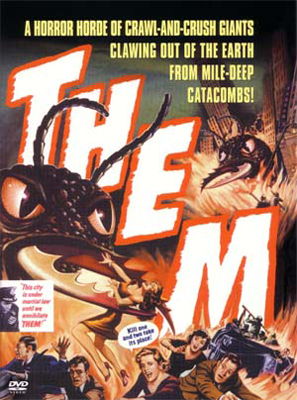
This is a fine little film, and the best of the 50s “big bug” pictures. It opens as such a straight police procedural you almost expect the Law & Order dahn-dunn sound effect between scenes. A vacationing FBI agent and his wife are missing, their trailer has been spectacularly demolished, and the assailants proved invulnerable to the agent’s weapon. There’s only one survivor, their daughter, but she has been shocked into a sort of ambulatory catatonia (James Cameron borrowed her right down to the doll for Aliens). The Investigation stage involves taking plaster impressions of strange footprints, gathering clues, taking photographs; all that’s missing is Jack Webb demanding “just the facts.”
Some suspense is added when the scientists from Washington D.C. show up, in the form of Santa Claus and his hot scientist daughter, because as the Investigation proceeds they keep their suspicions from the muscle. Speaking of whom, this time James Arness plays an FBI agent investigating the disappearance of a fellow G-man, and uses his big, good-natured lug screen presence to comforting effect.
Their suspicion is that the assailants are in fact giant ants. They encounter one in a dust storm, and so begins the Arrest stage.
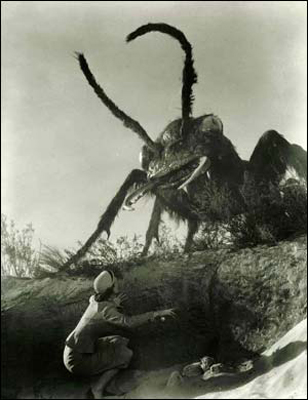 The rather refreshing aspect of Them! is its treatment of the ants in the Arrest stage of the movie. Perhaps because of special effects difficulties, the ants are never presented in the exaggerated menacing manner of, say, the spider in Tarantula. If anything, they’re filmed in a rather straightforward style, like enemy soldiers in a war picture (which is closer to the theme of the film anyway). They’re biological entities, eating and reproducing, and it’s the reproducing element that causes difficulties for our action/horror heroes. A typical 50s big-bug picture would end with the nest being blasted into oblivion by bombers, but the scientists know that the ants will reproduce, so they must go into the nest and look for eggs and find out if queens have hatched. This demand leads to some exciting tunnel-fighting sequences, both in the desert and in the storm sewers of Los Angeles in the film’s climax.
The Elimination stage is rather matter-of-fact, though not without loss among the film’s heroes. As it’s the 50s, nobody from Greenpeace shows up to offer a writ protecting Iantgay Aneatingmay Antus from extinction. The latest and last batch of just-hatched queens are found and flamethrowered rikki-tik. And the world is made safe for Jack Benny and Ed Sullivan to broadcast again.
The legacy of Them! includes several science out-of-control actioners like Eight Legged Freaks, Westworld and its Terminator kin, too-numerous-to-list SciFi channel B and C grade movies, and of course the pinnacle of the genre, Aliens.
 Jason and the Argonauts (1963)
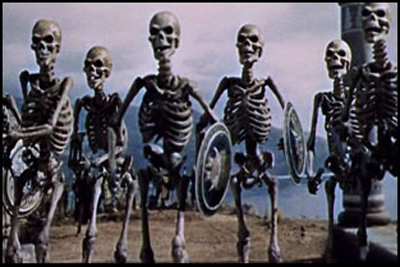
Excuse the gushiness, but I just love this movie. The horror aspect of Jason may seem laughable now, but to a ten-year-old Eric Eliot, peering through a lattice of stubby fingers at the bronze titan and the harpies and the skeletons on the family room nineteen incher, it was a terrifying experience. Unlike the others in our action/horror list, the threats faced by Jason and his crew of heroes are as diverse as the Greek pantheon, each menacing in its own way, especially when brought to life by Ray Harryhausen.
Of all the films discussed in this article, this movie, often written off as a children’s picture, has the most complex plot. There are betrayals between gods and men, dire divine warnings and assistance, and all manner of side-switching.
The entire Investigation stage of this film is essentially backstory. Unlike the other films, the real threat to Truth, Justice, and the Hellenic way rests not in the maw of some monster, but on the shoulders of a tyrant who would defy even the gods. He isn’t even defeated in the movie, though is plans are. In pursuit of power, the evil king slaughters all opposition in the city, going so far as to murder Jason’s sisters in the protecting temple of Hera. But with his new-found power comes a prophecy that one day he’ll be killed by a man wearing a single sandal.
Jason shows up some years later, saving the tyrant’s life. The evil king decides that the best way to be rid of him is to send him on an impossible mission, to steal the fabled golden fleece from a land at the other side of the world. Jason chooses to accept.
The movie establishes the quest at the end of the Investigation stage, and Jason and his picked crew set off on a series of mini-arcs as the Argonauts encounter various horrific challenges. In each investigation-arrest-elimination arc the Greeks use a potent combination of brains, courage, and brawn. The ending is rather unsatisfactory, as clearly this was to be the kickoff to a series that never lived up to the potential of the first movie.
It may seem an odd paring, but Jason and the Argonauts clearly inspired Evil Dead II and its companion movie, Army of Darkness, with their blend of stop-motion animation and live action, as well as adventuresome ensemble flicks featuring an elite band of heroes in the mode of Jurassic Park or Alien versus Predator.
 The Omega Man (1971)
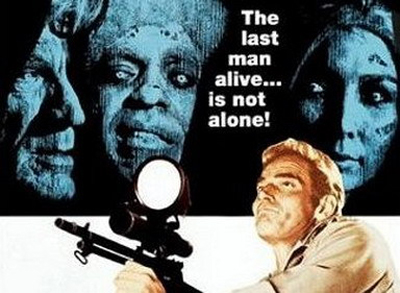
This is a movie that starts off survival/horror and morphs into action/horror, and there’s probably as much action as in all the others combined.
Richard Matheson’s classic of classics, I Am Legend, was the story of the last living man in a post-plague world overrun by shambling vampires. Legend had been adapted once before in the underrated Vincent Price version, which stuck much closer to the original story with the Dog and then the Girl coming into Neville’s lonely life and giving it a terrible meaning. The Heston remake has a good deal more runnin’ and gunnin’ — and as long as you’re willing to forget that such a magnificent novella exists as source material the movie can be enjoyed on its own terms. A lot of movies are products of their times and it’s easy to see that an audience of white males of Heston’s age might be looking out their urban townhome window in the late 60s and early 70s and wishing for barbed wire and an assault rifle with a night-scope, for the times they were a-changing.
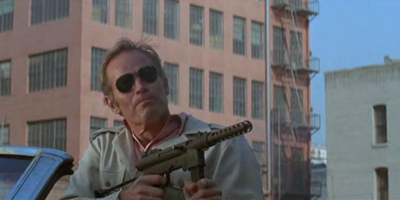
In this case, Charlton Heston (something of a one-man action/horror institution himself) as former Air Force Doc Robert Neville is apparently the sole untainted survivor of a plague that turned humanity into quasi-vampires who stalk the streets under a Luddite madman in the form of the always-reliable Anthony Zerbe playing a wacked-out Walther Cronkite. It’s pure survival/horror, and very good survival/horror at that, until he comes upon some other human survivors.
The special effects mostly involve stunts, makeup, and filming very early in the morning, quite effectively.
The Investigation segment of this story begins rather late into the film, when Heston discovers that his blood can cure the disease in another sufferer’s body. Everyone has the disease, it seems, some are just “turning” slower than others. The Arrest stage involves a conflict between Heston and the young sufferer he healed. Heston just wants to heal the remaining recognizable humans (mostly children), the boy wants to talk to the turned and let them know they can be healed. Things get ugly when the boy goes to visit the vampires, and Heston’s love interest suddenly turns. The climax comes at a final confrontation at Neville’s townhouse.
Luckily, and quite contrary to the spirit of the original story, we’re led to believe that the virus does get destroyed by Neville’s blood, offered up for the children. Heston, for so long Moses in moviegoers eyes, finally gets to be Christ. It’s an allegory of the Gospels acted out with submachine guns, basically.
Much of The Omega Man‘s legacy is in darker, moodier sf and action films, especially those involving a normal man dropped alone into a world gone mad to become its crusading savior. The 70s remake of Invasion of the Body Snatchers, and action/horror hits such as Escape From New York and The Running Man have the same feel.
 Race With The Devil (1975)
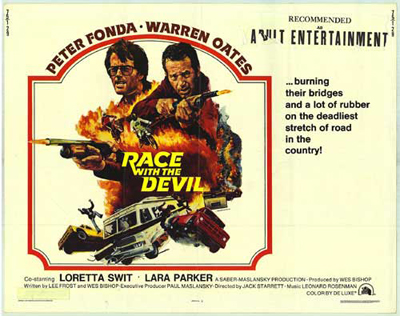
I’m surprised this movie isn’t better known. It’s an effective paranoid thriller, especially considering the modest budget of 1.6 million, boasting king of 70s road movies Peter Fonda as one of the protagonists. The story is a Deliverance-inspired tale about two vacationing couples passing through the Texas hill country in an RV who tangle with the wrong locals. While camping their first night they witness a strange ceremony across the river, a bonfire celebration under a bare hanging tree that climaxes with a nude orgy and human sacrifice.
After a close escape from the cultists, they report it to the local sheriff. But they find a warning on the broken back window of their RV cautioning them to be silent on the matter. While the men are with the police looking for clues, the wives do a little investigating on their own and realize they’re up against witchcraft. The sheriff maintains that they probably saw a bunch of drugged-up hippies sacrificing a dog. The foursome knows better, and decide to go to the nearest big city and report. Unfortunately for the RVers, a gap-toothed mechanic overhears their plan.
This movie keeps closer to the roots of true horror, in that the Investigation stage takes up most of the story as the scale of the threat to the vacationers grows ever larger. Is the little old lady, knitting in the gas station as she watches Peter Fonda try to use the phone, a friend of Sa-TAN?
The Arrest part of the movie is a scary and well-paced cross-country trip toward big-city law, with the four matched against various secret Satanists — or are they? The vacationers arm themselves and end up having to fight their way to Amarillo, with some spectacular vehicular action and stuntwork along the way. I only wish the ending had lived up to the promise of the rest of the movie.
Race With The Devil obviously inspired George Miller’s Road Warrior in the final RV chase scene. There’s a good deal of rural creepiness that will be familiar to fans of Children of the Corn type horror.
If you’re into action/horror, any of these films are worth a look. The special effects may seem hokey to an audience used to today’s ultra-smooth CGI, and the gore minimalist, but I promise you’ll find more sympathetic characters, punchier dialogue, and crafty storytelling in exchange.