Courtship Customs: Marrying Mr. Darcy by Erika Svanoe and Erik Evensen
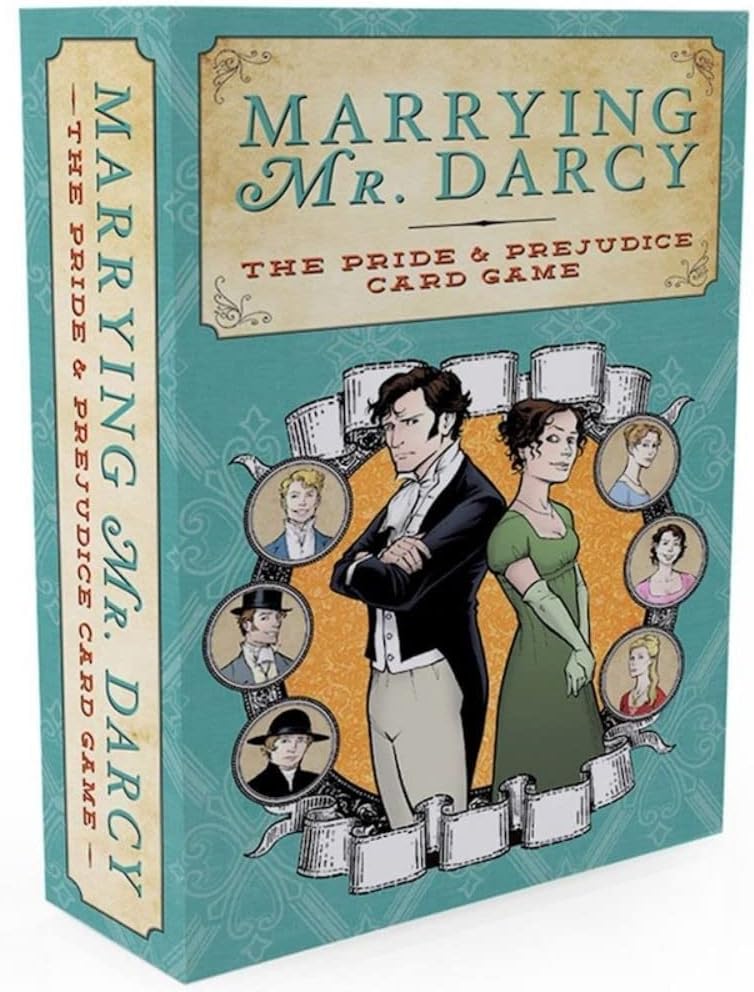
One of my local gaming friends told me about Marrying Mr. Darcy, and brought his copy to a recent session, where we played it. I thought it was a lot of fun and have acquired a copy.
This is a game based on Jane Austen’s classic novel Pride and Prejudice. I think it could be played without having read that book, by anyone who has some familiarity with the courtship customs of the past. On the other hand, such players will miss some of the jokes that add to the pleasure of the game.
[Click the images to engage with larger versions.]
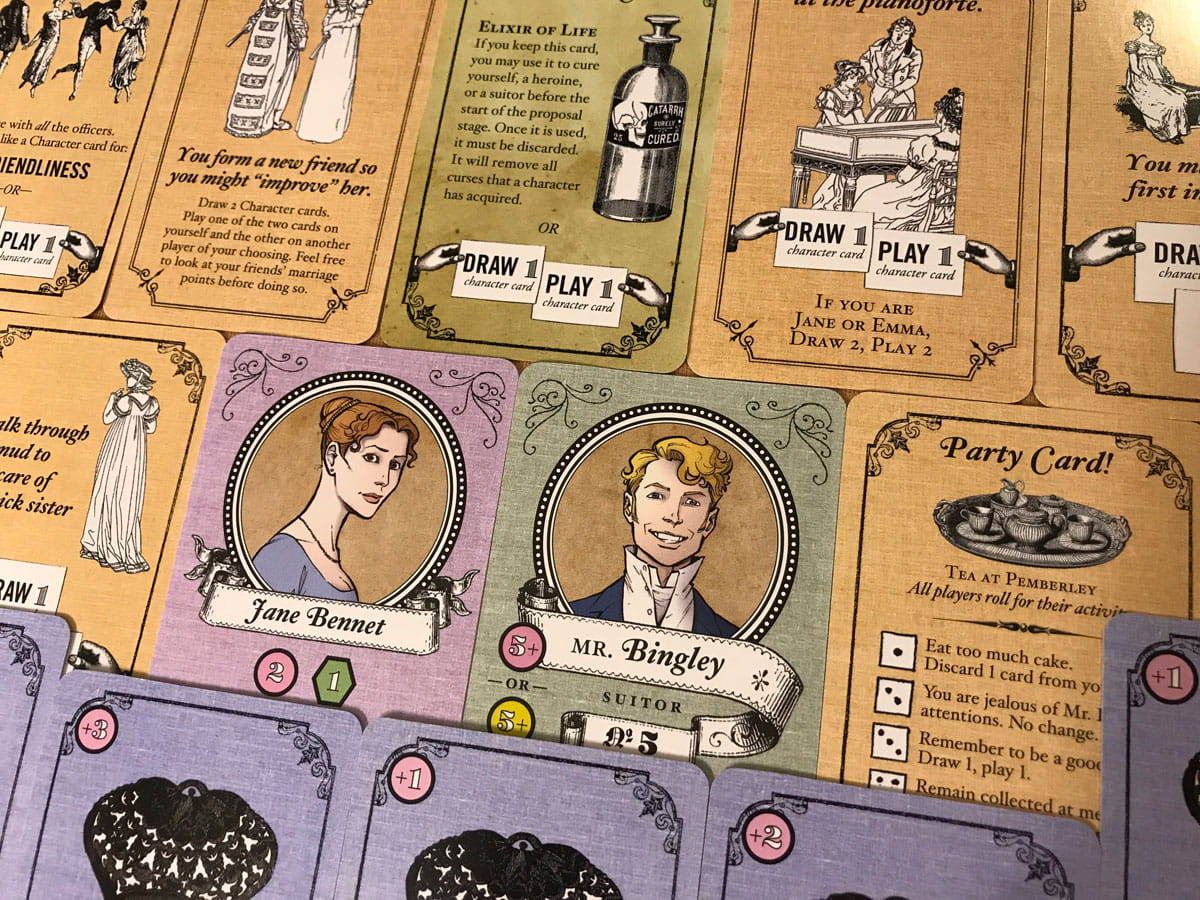
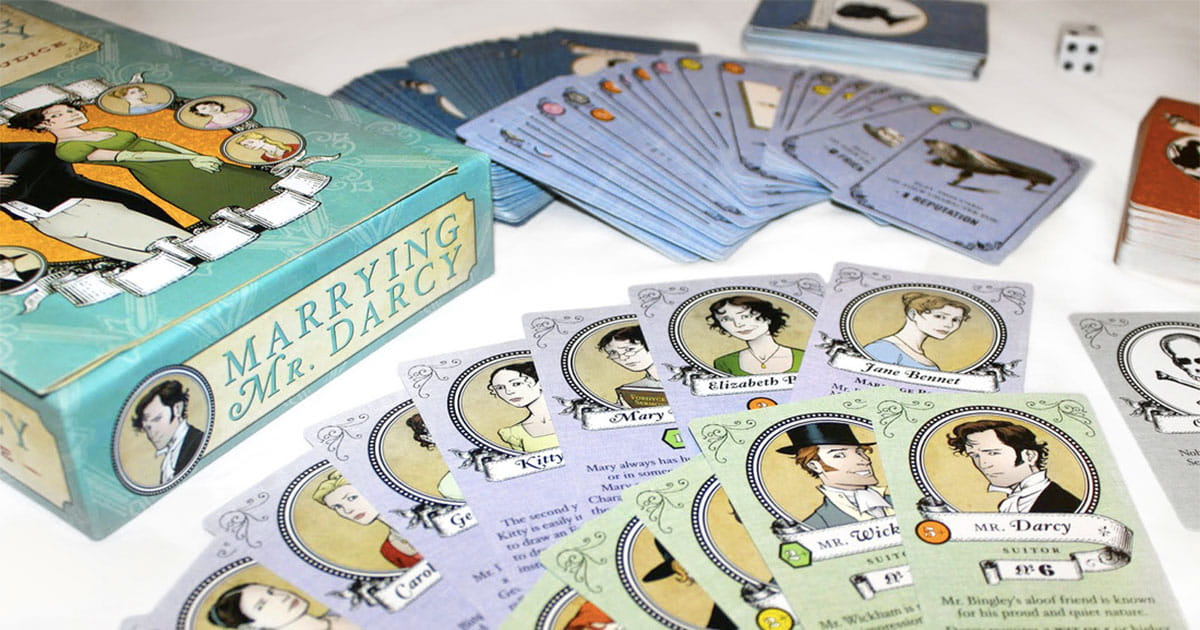
Up to six people can play Marrying Mr. Darcy. At the outset, players roll a die for first choice, and each chooses a young woman to play, from a set of eight, who are more or less all the named marriageable women in the novel: its heroine, Lizzie Bennet, and her four sisters, plus three others with disparate backgrounds. These women start out with certain personal traits; a dowry, which doesn’t count as a “personal trait,” but which many suitors are looking for; and a set of base scores to be earned by marrying different suitors.
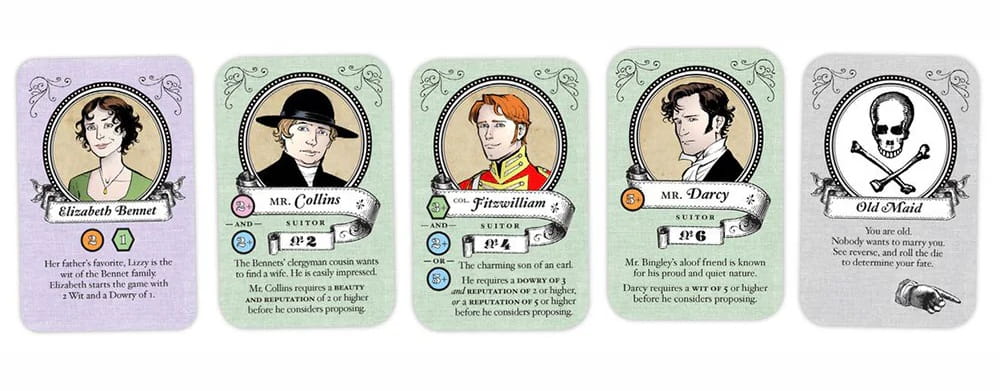
Darcy, the hero of the novel, for whom the game is named, is usually worth a fair number of points, but is only the top ranked choice for Lizzie, for example. Cards are put out for suitors, showing what traits each requires before he would consider proposing to a woman. Note that some of the women are sisters of some of the men, who won’t propose to them — though there’s an optional rule where the women turn out to have been adopted (a plot twist H.G. Wells actually used in Joan and Peter, written about a century later).
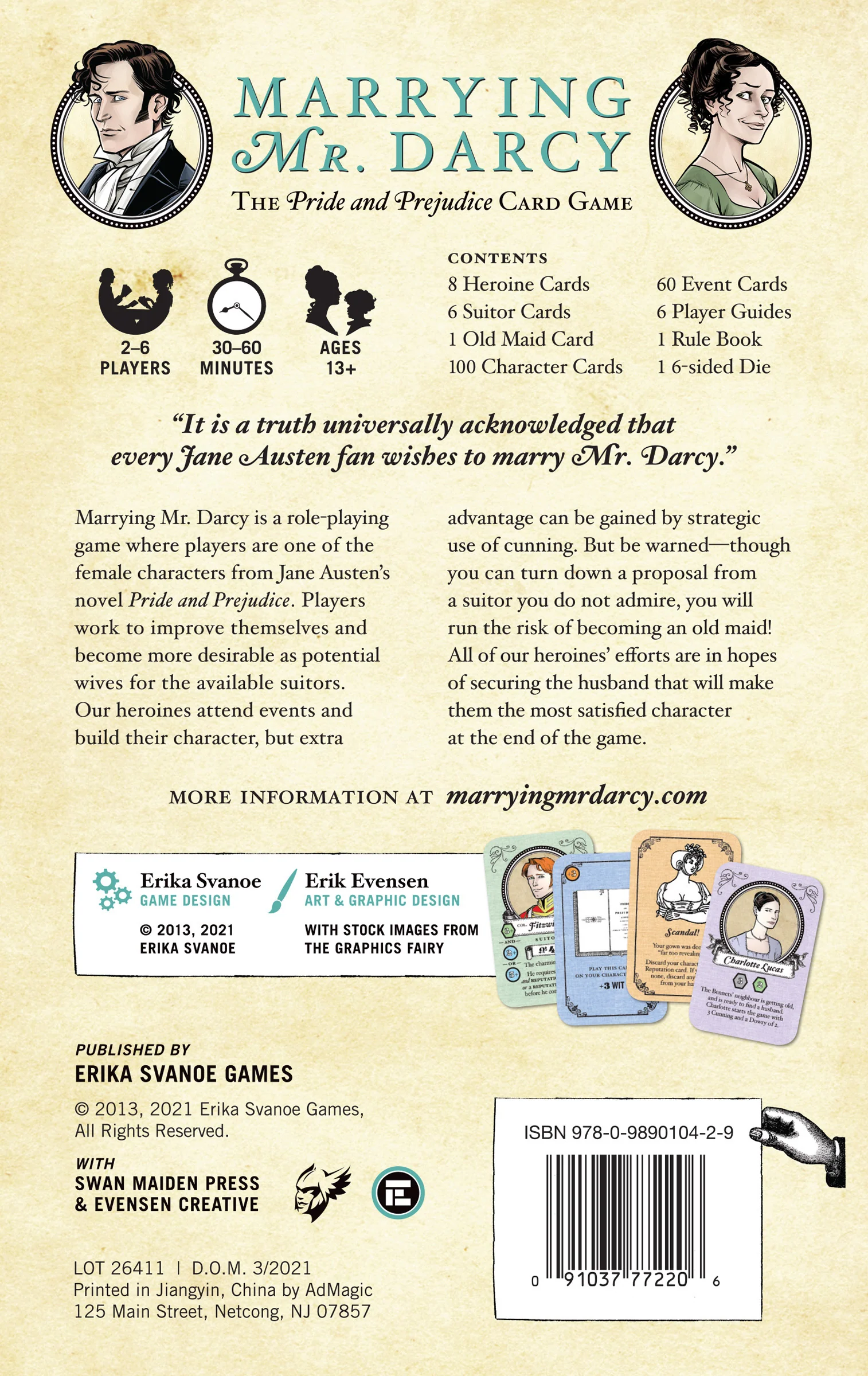
The first phase of play, courtship, involves drawing event cards, which represent something that could happen in the characters’ social milieu, such as a party, a family scandal, or simply learning to play a new piece at the pianoforte. I could think of an incident in the novel for nearly every “event.” Many event cards grant the ability to draw and/or play one or more character cards; they may also produce direct benefits or problems.
Character cards, in turn, often add to a characteristic. There are five of these. Four can be played face up: Beauty, Friendliness, Reputation, and Wit. These accumulate as played, giving each young woman the ability to appeal to various suitors; the strategy of the game involves knowing that Mr. Darcy, for example, favors young women with Wit, while Mr. Collins cares about Beauty and Reputation.
 |
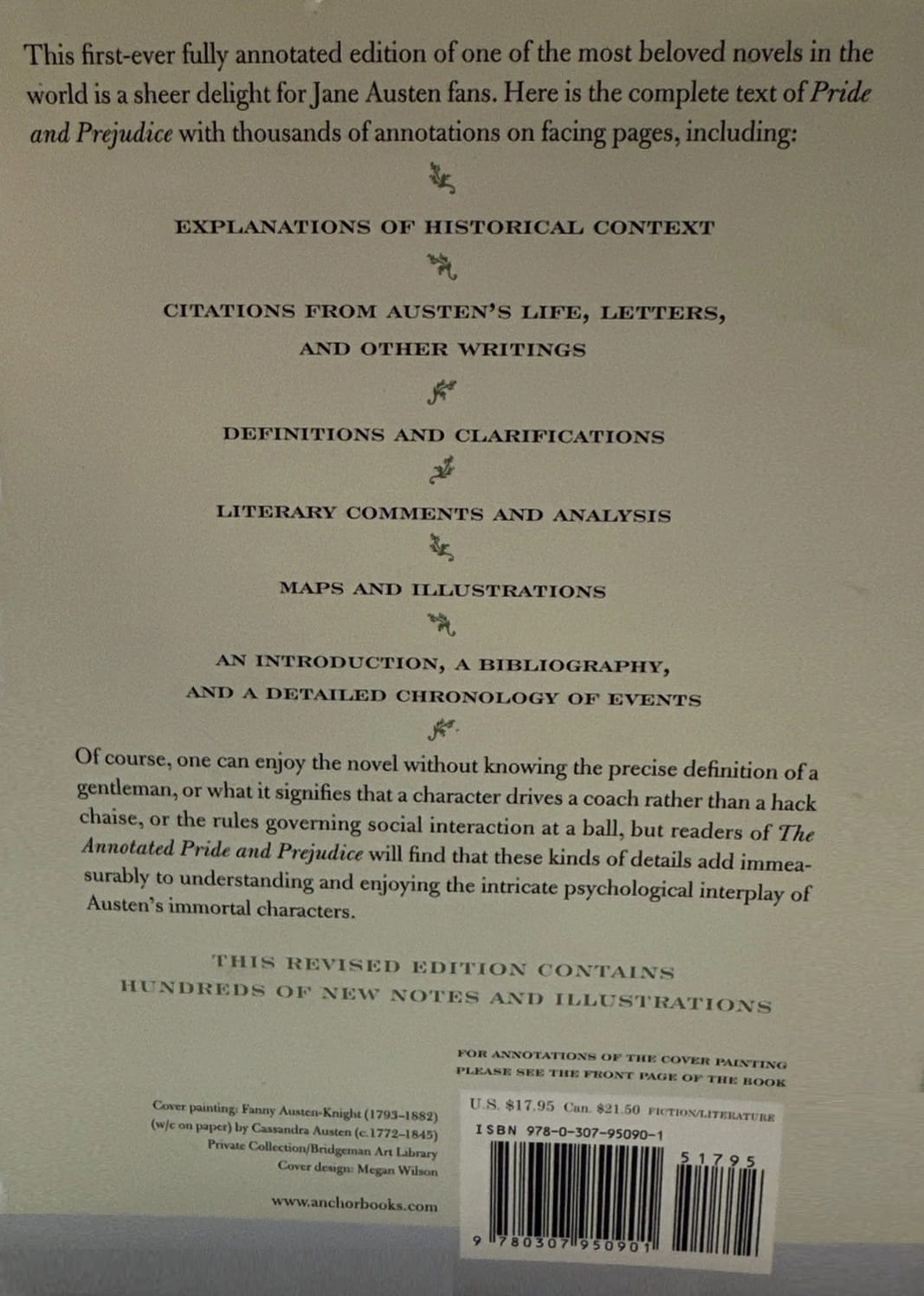 |
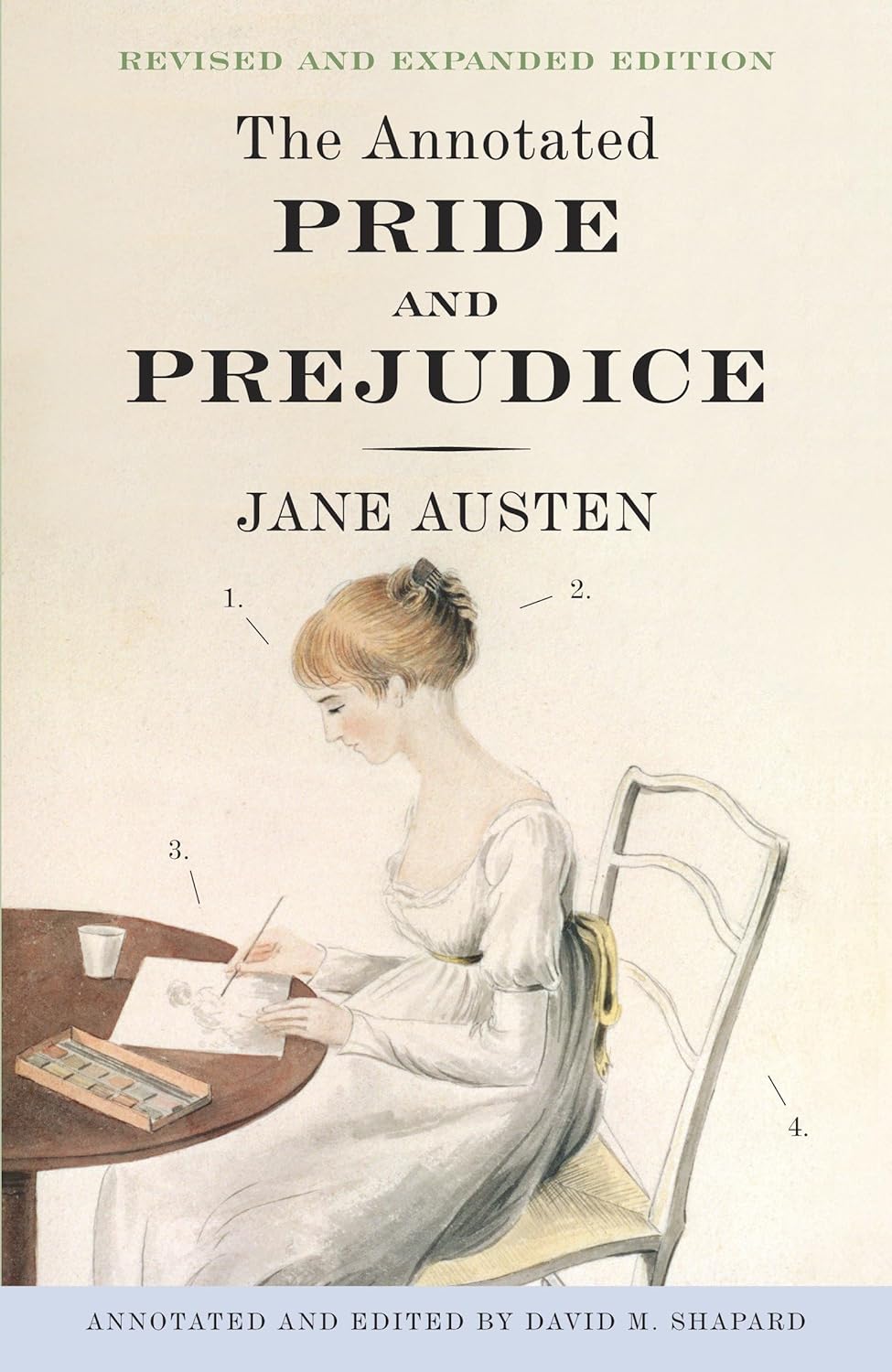
The Annotated Pride and Prejudice, by Jane Austen and David M. Shapard (Vintage, March 13, 2007)
Cunning is played face down, and can be used to undercut another young woman’s advantages by removing a card she has played face up, making her less able to compete for a suitor you want.
Character cards can also add to Dowry, which is not a characteristic but is important to some suitors. Reputation and Dowry, in particular, are important in ways that no longer apply in our era; players may need to have read some Austen or Heyer to be seized of the point that men usually expect a young woman to bring some of her family’s wealth into a marriage, and that they avoid a woman who might be feared to be unchaste or unfaithful — perhaps because her sister has eloped with a man she wasn’t married to (how did their family bring them up?).
In the second phase of play, proposal and marriage, players’ turns are decided by Cunning scores: The most cunning young woman goes first. (If two young women are tied, the one with the higher Dowry goes first.)
All the suitors whose standards a young woman meets are identified, and the dice are rolled for each one to see if he proposes. The player can either accept or reject each proposal; acceptance removes that suitor from the pool available to other young women.
A young woman who turns down all her suitors, or receives no proposals, acquires the Old Maid card — a social disaster, but one some young women might prefer to a really bad marriage!
The final score is the sum of a character’s scores on Beauty, Friendliness, Reputation, and Wit and the point value of her suitor for her. The highest score determines the winner; ties are broken by Dowry or by Cunning — so that these two traits can still matter, in a less obvious way than the characteristics.
Marrying Mr. Darcy can be played in an hour or a bit less. It can be quite an entertaining game, as characters raise their standing in the marital competition or suffer dramatic reversals; each game is effectively a new drama about the Bennets and their social milieu.
The cards are also attractively designed: Erik Evensen did a good job of suggesting that milieu. And between quickness and lightness, this was a perfect palate cleanser to be played after a complex, tactically challenging game, like having a salad after a main course. I look forward to playing it again.
William H. Stoddard is a professional copy editor specializing in scholarly and scientific publications. As a secondary career, he has written more than two dozen books for Steve Jackson Games, starting in 2000 with GURPS Steampunk. He lives in Lawrence, Kansas with his wife, their cat (a ginger tabby), and a hundred shelf feet of books, including large amounts of science fiction, fantasy, and graphic novels.
This sounds like a well-constructed game, and on one hand quite fun. But on the other hand, I feel like after playing my mind would be going, “What? WHAT? How would THAT happen? Charlotte Lucas with Col. FitzWilliam? LYDIA got Darcy? And Bingley’s a free agent, heading back to London for the next season? Hoooooww????”
I wonder how many P&P Variations this game has inspired.