A Skillful Handling of a Standard Mystery:Whose Body? by Dorothy Sayers
 |
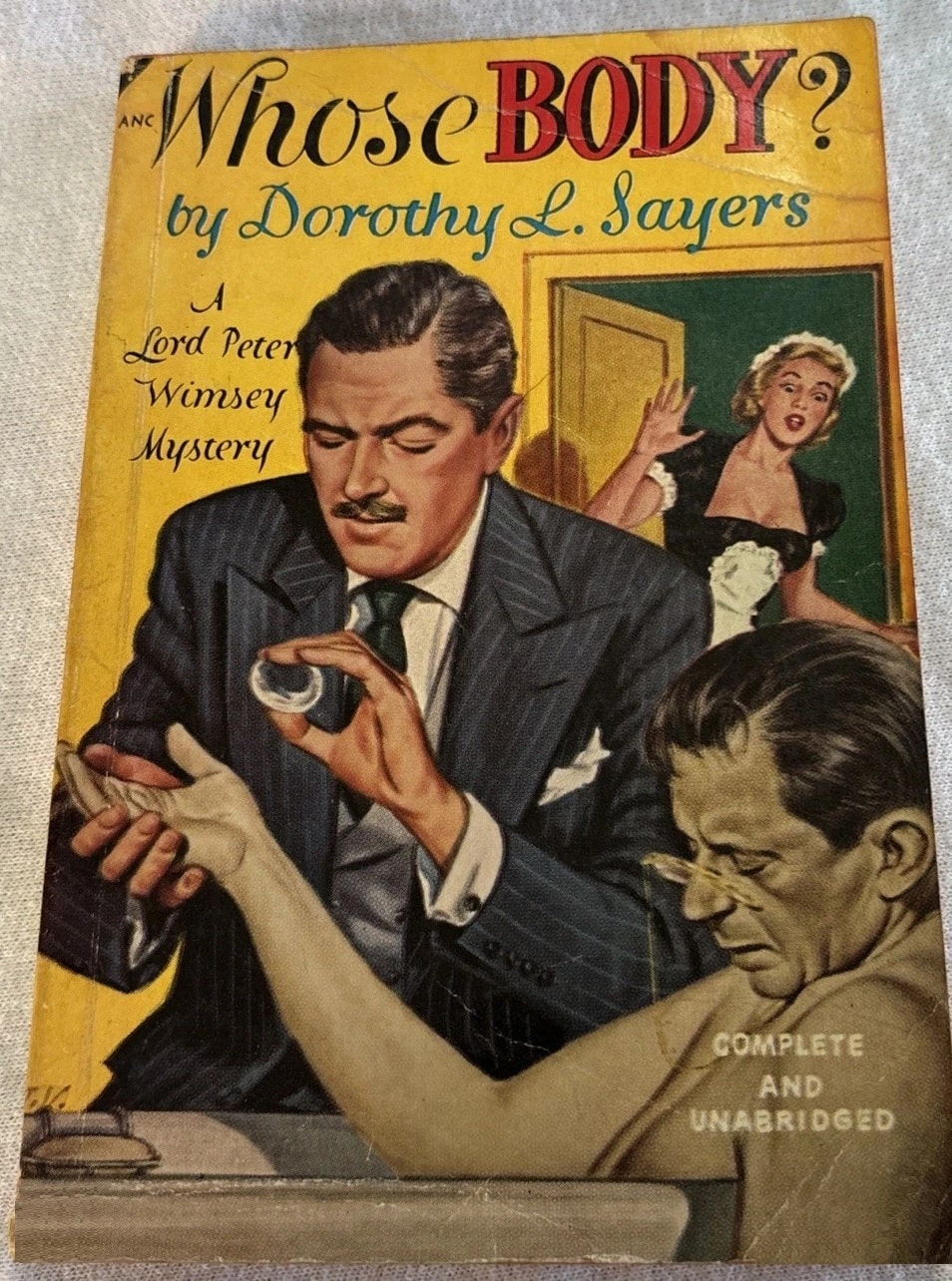 |
Whose Body? by Dorothy Sayers (Avon Books, 1948)
Mysteries aren’t my first choice in genre fiction; science fiction and fantasy appeal to me more consistently. Even so, I’ve read a fair number of mysteries, by authors from Dashiell Hammett to P.D. James. (I’ve also enjoyed science fiction and fantasy mysteries such as Randall Garrett’s Lord Darcy stories and Lois McMaster Bujold’s Memory.)
But two things happen to me over and over with mysteries: When I read a series by the same author, I lose interest before I’ve read the entire series, and I don’t come back to a series after I’ve put it down. The great exception on both counts is Dorothy Sayers’ Peter Wimsey novels. Of course I think that I come back to her because she’s especially good; at any rate her writing is to my personal taste. But my getting through the whole series, I think, has a more specific cause: Mystery writers tend to develop a formula for their novels, and at a certain point the investigations of V.I. Warshawski or Adam Dalgleish go stale for my mental palate; but it seems to me that Sayers, despite recurrent elements in the Wimsey novels, is taking up a different formula with each novel. They may not all be equally good, but they all offer the pleasure of novelty and experiment.
[Click the images for a larger body of work.]
Whose Body? — the original novel about Wimsey — already has many elements that will become recurrent, both in the details of Wimsey’s life and in his supporting cast. These aren’t the novelties I’m referring to; they’re more like standard spices and sauces adapted to a variety of dishes. The innovation is more in the kind of mystery they add flavor to. But of course, as the first in the series, Whose Body? doesn’t display a change of formula; rather, it shows a skillful handling of a fairly standard kind of mystery.
The starting situation is the kind of ingenious puzzle that classic mystery writers specialized in: A middle-aged architect has gotten up in the middle of the night to find an elderly man’s naked corpse in his bath. He calls the police, who send Sugg, a Scotland Yard detective who promptly decided that the architect is under suspicion, along with his housemaid and, eventually, his elderly mother, who is losing her hearing. They tell the story to the Dowager Duchess of Denver, who tells her son, Lord Peter Wimsey, who has successfully investigated a number of crimes.
At the same time, Lord Peter’s close friend, Charles Parker, also from Scotland Yard, has a problem of his own: Sir Reuben Levy, an elderly Jewish financier of very regular habits, is missing, after visiting his doctor, Sir Julian Freke, at night, after which his bed was slept in, though no one actually saw him after that. Naturally enough, Mr. Parker and Lord Peter both wonder if the two cases might somehow be connected, but the body in the bath can’t be Sir Reuben’s, for a variety of reasons. But both investigations go on, and continue to develop apparent connections.
At this point Lord Peter already has a lively supporting cast. Inspector Sugg is a Doylean cliché, the inept Scotland Yard detective — one that Sayers seems to have thought better of as her series progressed, as he appears in only one more novel, the second in the series, Clouds of Witness, in a minor and more creditable part. Charles Parker, a much more competent Scotland Yard detective, becomes Lord Peter’s closest friend, and works with him on several later cases, often doing the tedious parts of the investigations, an ingenious literary choice that avoids inflicting that tedium on the reader. He also gives Lord Peter someone to discuss cases with when the reader will benefit from hearing Lord Peter’s thoughts. In some later novels he does all sorts of favors for Lord Peter and his family, some of which would be thought improper now, a century later (which doesn’t mean such things never happen!)
Lord Peter’s valet, Mervyn Bunter, is with him in nearly every novel; he even accompanies him on his honeymoon in the final novel. Bunter is trusted enough to be sent to a rare book auction in Lord Peter’s place when this novel’s mystery turns up and takes precedence. He’s also a great help in investigation, with skills ranging from photography to acting the part of a disaffected man stealing from his master. There’s more to it than that, which will show up later.
Finally, the Dowager Duchess is an embodiment of what Sayers describes as “mother wit,” a fountain of malapropisms, and occasionally a force of nature; it’s probably just as well that she appears only from time to time, as her distinctive flavor could come to overpower the actual stories. It’s clear already in this volume that Lord Peter is her favorite child. (It also turns out, by a convenient coincidence, that the Duchess is an old friend of Levy’s wife, the former Christine Ford, who married Sir Reuben before he was wealthy, over the protests of her respectable family.)
 |
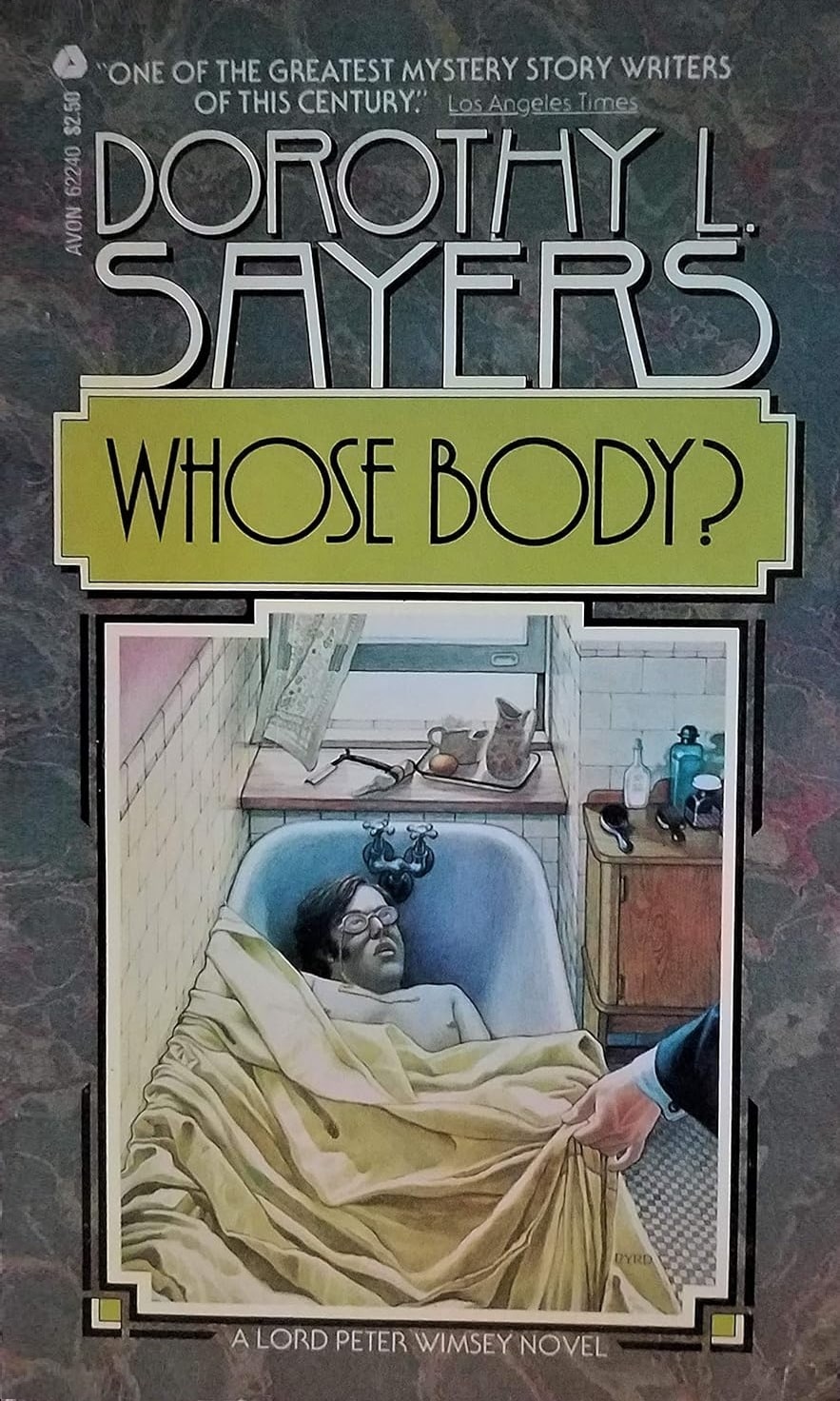 |
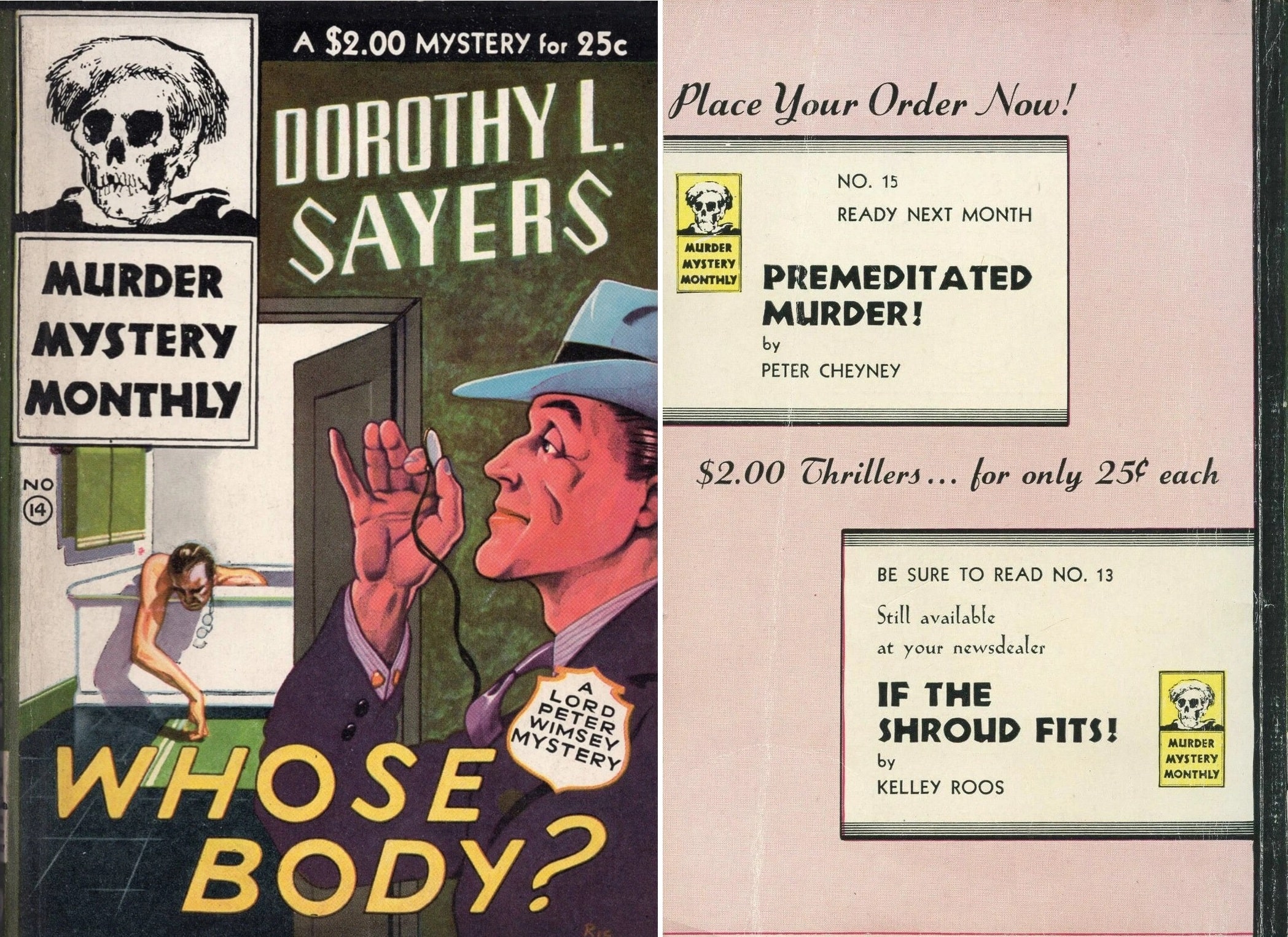
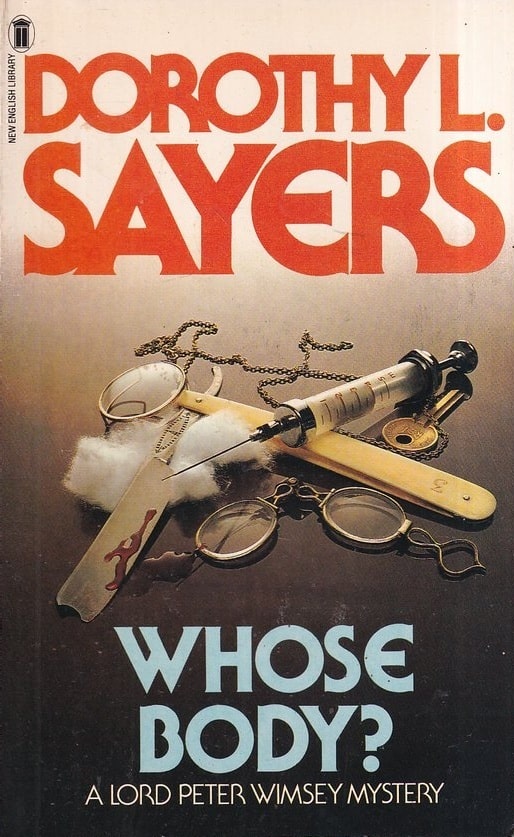
Left: New English Library, 1977. Right: Avon Books, 1978
And Lord Peter himself, the center of this cast?
His portrayal seems to include a good bit of wish fulfillment. His title, to start with; but more than titled, he’s wealthy, and untroubled by financial worries (in an era when, as Downton Abbey dramatizes, many aristocratic families had straitened budgets and some lost their ancient seats). He comes on the scene on his way to the rare book auction at which Bunter takes his place, and this other hobby (besides criminal investigation) displays both his wealth and his learning. It also shows that Bunter can be trusted to spend large sums on Lord Peter’s behalf!
In addition to the family estate, Duke’s Denver, Lord Peter, who gets along poorly with his brother-in-law and worse with his sister-in-law, has a “new, perfect and expensive” flat in the city. John Curran, who wrote the Afterword to my copy, comments that his address, 110A Piccadilly, alludes to Sherlock Holmes’s 221B Baker Street. Over the course of the series he’ll turn out to have a wide range of talents, not least a gift for languages: During the Great War he was able to pass himself off as a German behind enemy lines, and of course his French and Latin are perfect. He also can play Scarlatti competently on the piano (and says that a harpsichord would be better). Perhaps Sayers was writing this slightly tongue in cheek, making her hero just a little too perfect!
He also can play the role that’s now called “upper class twit,” a convenient disguise for putting suspects and witnesses off guard — he’s been compared to his contemporary Bertie Wooster, for whom it’s not a disguise — and that lets Sayers have fun with his dialogue. In Whose Body? he already has a friendly relationship, not just with Parker, but with Scotland Yard generally, and a reputation for criminal investigation, notably in the case of the Attenbury Emeralds, his first (never told by Sayers, though Jill Paton based one of her licensed sequels on it, which seems rather like spoiling the joke).

This novel has Wimsey using classic forensic methods, starting with close examination of the mysterious corpse and the bathroom where it was found. Of course Sugg and Parker did that too, and spotted many clues, but Wimsey notices details they missed, such as shaving soap in the corpse’s mouth, and thinks of interpretations they overlooked, such as red marks being fleabites. One notable point here is that the corpse is identified as “the body of a well-to-do Hebrew,” and later a corpse dissected by medical students was described by one of them as an “old Sheeny”: Sayers leaves the inference to the reader, but presumably it’s because both men had been circumcised, a distinctively Jewish practice in the United Kingdom in this era.
Wimsey and Parker elicit the information about the dissection subject from the medical student in the guise of innocent conversation (Sayers hints at this being based on the doctrine of anamnesis from Plato’s Meno). There’s quite a lot of medical evidence and discussion, including courtroom testimony from Sir Reuben’s doctor and the exhumation of a corpse for identification by distinctive marks. Wimsey also makes use of his personal wealth, notably by advertising the finding of a set of gold pince-nez with an unusual prescription found on the corpse, which turn out to have belonged to someone entirely different. All of this fits into the classic mystery story pattern, and mystery readers must have enjoyed it.
On the other hand, Wimsey isn’t a Sherlock Holmes working everything out by rational deduction in front of an admiring Watson! Rather, he immerses himself in the evidence — including some that isn’t obviously evidence before the fact — until it falls into place, in a fashion Sayers compares to looking at the anagram “COSSSSRI” until it suddenly presents itself as “SCISSORS” (much like the process of scientific discovery that Arthur Koestler later wrote about in The Act of Creation, citing Newton’s statement that he understood things “by brooding on them day and night”): In this case, realizing the point of a sentence in a book as the key to a criminal’s motivation. This leads to Wimsey’s having a flashback (as we would now call it) to his service in the Great War, and being given brandy and put to bed by his manservant:
“Thought we’d had the last of these attacks,” he said. “Been overdoin’ of himself. Asleep?” He peered at him anxiously. An affectionate note crept into his voice. “Bloody little fool!” said Sergeant Bunter.
In this scene Sayers gives more depth at once to her detective’s character, by showing the profound trauma that helped form it (of a sort much too familiar in the United Kingdom then), and to his relationship with Bunter, one much stronger than that of master and man. None of this is implausible, but Sayers is already providing a depth of characterization beyond ordinary stereotypes or comedic quirks.
The flash of insight, and the exhumation, are followed at once by an arrest. Sayers declines a common formula by having the murderer at the point of attempting suicide to avoid being tried and hanged, but having the police come in and arrest him just in time. In a bit of dark comedy, he leaves behind a message for Wimsey explaining the brilliance and daring of his scheme, whose composition delayed him just enough for the police to get there!
In our present-day terms, his confession sounds a lot like sociopathy, but Sayers presents it as the logical implication of a certain philosophical point of view (which is something of a parallel to C.S. Lewis’s later That Hideous Strength), and that’s another point where she’s doing something a little more substantive than usual — almost a mirror image of Dostoyevsky’s thriller plot in Crime and Punishment, whose protagonist wants to be a sociopath but can’t manage it.
Both the philosophy and the characterization are already providing a little surplus value for the reader beyond the skillful presentation of a mystery according to the canons that Sayers helped formalize. It’s no surprise that Sayers later gave a lecture, “Aristotle on Detective Fiction,” on the Poetics as a perfect theory of mystery stories, concluding, “and any writer who tries to make a detective story a work of art at all will do well if he writes it in such a way that Aristotle could have enjoyed it and approved it.” In this first novel that already seems to be Sayers’s aim.
“Oh, yes — you knew it all right — like Socrates’s slave.”
“Who’s he?”
“A person in a book I used to read as a boy.”
William H. Stoddard is a professional copy editor specializing in scholarly and scientific publications. As a secondary career, he has written more than two dozen books for Steve Jackson Games, starting in 2000 with GURPS Steampunk. He lives in Lawrence, Kansas with his wife, their cat (a ginger tabby), and a hundred shelf feet of books, including large amounts of science fiction, fantasy, and graphic novels.
Yes, they do have variety, something I hadn’t particularly noted before, except in the case of The Nine Tailors, which is so entirely different from all the rest. Other factors that contribute to the utter re-readability of the series are the way the principal characters develop and change over time, and the fact that they are such perfect comedies of manners.
I’ve read and enjoyed the Jill Paton Walsh continuations, though they run the gamut from spot on to not (quite) on. The exception is the last, The Late Scholar, in which she attempts an Oxford novel. It suffers greatly in comparison to the glories of Sayers’ own Oxford novel, Gaudy Night, particular in unnecessary proliferation of deaths, the unsubtle harkening back to the murder methods of previous cases, and the gratuitous insertion of actual Oxford personalities like Tolkien and Lewis into the plot. She couldn’t resist, I guess. But it’s all too much. Sayers’ book had none of that–not even an actual murder!–and made a much better story.
I should have picked Gaudy Night as “so entirely different from the rest,” but I agree that that’s also true of The Nine Tailors.
Just read Gaudy Night in December. It is very much Harriet Vane’s book, even when Lord Peter is around, he is distinctly on the outside, looking in (as it were). I am guessing that there is a lot of reminiscence by another Oxford alumna, Ms. Sayers herself, in the book, even as she altered names to protect the innocent (or the guilty).
“ In some later novels he does all sorts of favors for Lord Peter and his family,”
Well, he marries Lord Peter’s sister, so it is his family, as well.
I also think there are a number of “different” novels, besides The Nine Tailors. The novels with Harriet have her with as much screen time as him, for example. The Red Herrings is completely different , not even being set in London, and depending on train schedules. I think Murder Must Advertise is also different, in that it depends on a large cast of characters.
I think that today, having the family connection would disqualify him from any investigation relating to the family, even if his friendship with Lord Peter hadn’t done so.
I’ve read all Sayers’ Wimsey novels at least twice, and even played Wimsey in a 1930s theatrical LARP, so I’m very much hoping that over time you’ll go on to review the rest of the series. “Whose Body?” isn’t as good as the novels that follow, yet it still stands well above nearly all of its contemporary rivals. It’s delightful to follow Sayers’ growth as a writer through the later books.