The Sword & Planet of Roland Green: Blade by “Jeffrey Lord”
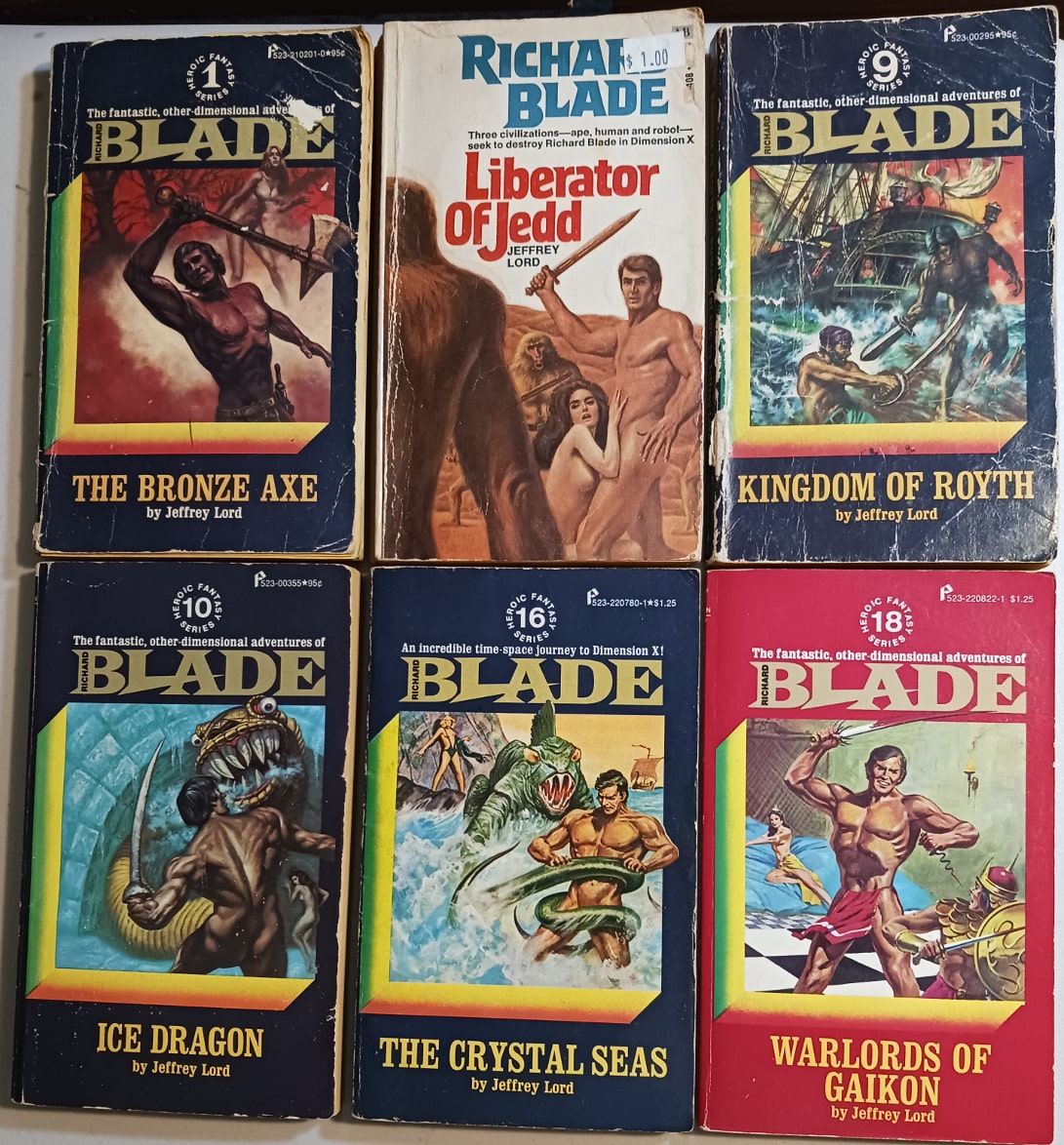
Jeffrey Lord was a house name used for a series of 37 fantasy/SF novels published between 1969 and 1984. They were billed as an “adult” fantasy series, meaning that they had sex in them. However the sex was pretty mild by today’s standards. The hero is Richard Blade, an agent who works for the British Intelligence service MI6. He’s a combination of James Bond and Conan, although he doesn’t have much of the anti-hero aspects of those characters. He’s pretty much of a white hat guy.
Despite the character and general setting being British, the books were published by Pinnacle Books, an American Publisher, and all written by American authors. The three authors involved were Manning Lee Stokes (1911- 1976), Roland J. Green (1944 – 2021), and Ray Nelson (1931 – 1922). Stokes wrote the first 8 and then Green (apparently) wrote the rest except for #30: Dimension of Horror, by Ray Nelson.
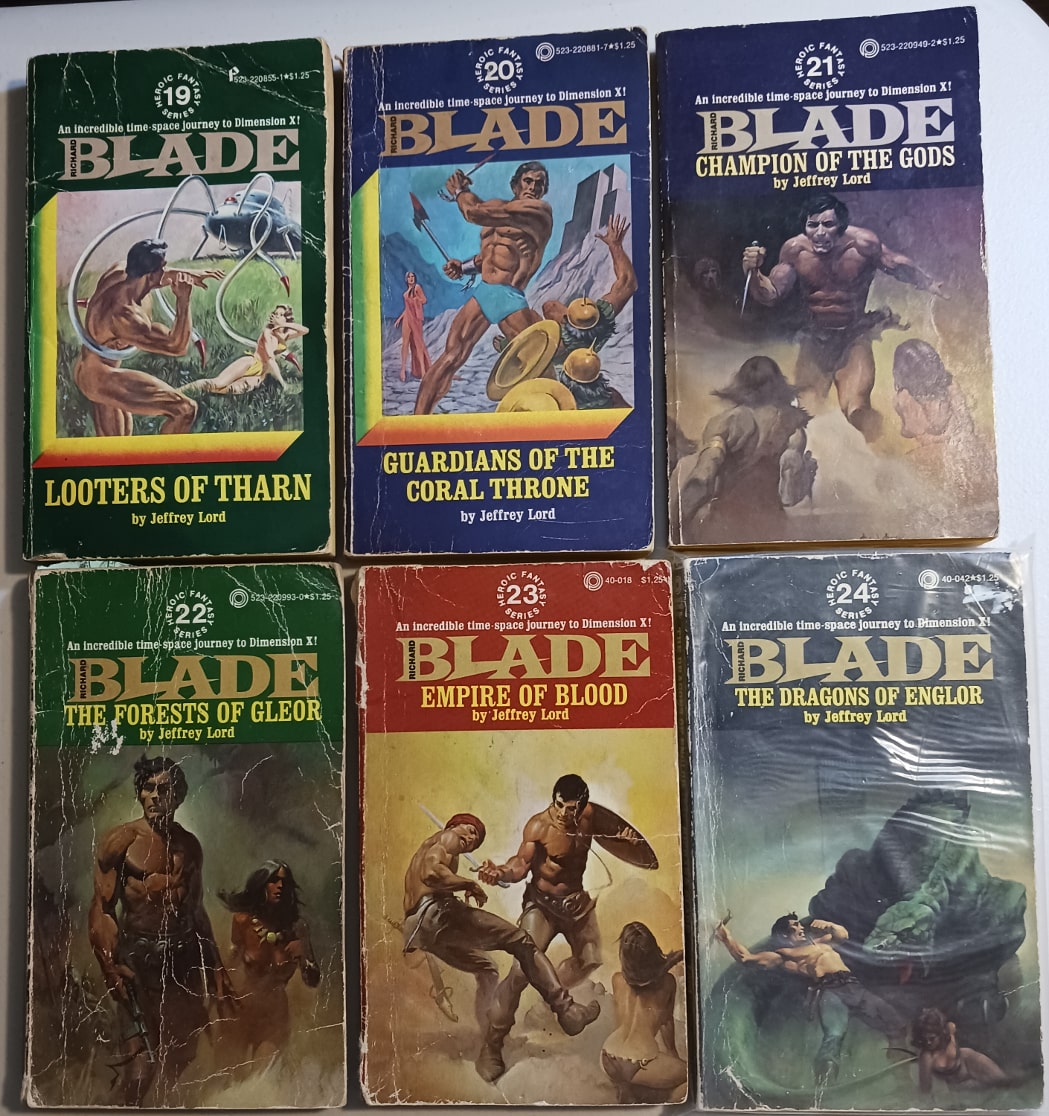
I’ve read most of the series and Nelson’s is unique because of the setting. In each book, Blade gets transported to another dimension where he appears without weapons or clothes and must survive and solve some local problem, which is basically a Macguffin for getting him into trouble. In most dimensions, Blade finds himself in more primitive environments where he has to use edged weapons to survive. But #30 takes place on Earth and there’s no swashbuckling.
Most of the Blade books fall into the genre of Sword & Planet, as you can kind of see from the cover illustrations, which typically feature swords. Treasure of the Stars #29 is an exception, being pretty much space opera. The covers can also be misleading, though. The cover of Ice Dragon, #10, suggests a fantasy setting but is very much SF.
I’ve only read two of Stokes’ volumes, 1 and 5, and neither was all that good, but I’ve liked quite a few of Roland Green’s efforts, such as Warlords of Gaikon #18, Guardians of the Coral Throne #20, Champion of the Gods #21, Gladiators of Hapanu #31, and Pirates of Gohar #32. Empire of Blood #23 has been my favorite so far. All these good ones were written by Green, although he also wrote a couple I didn’t much like.
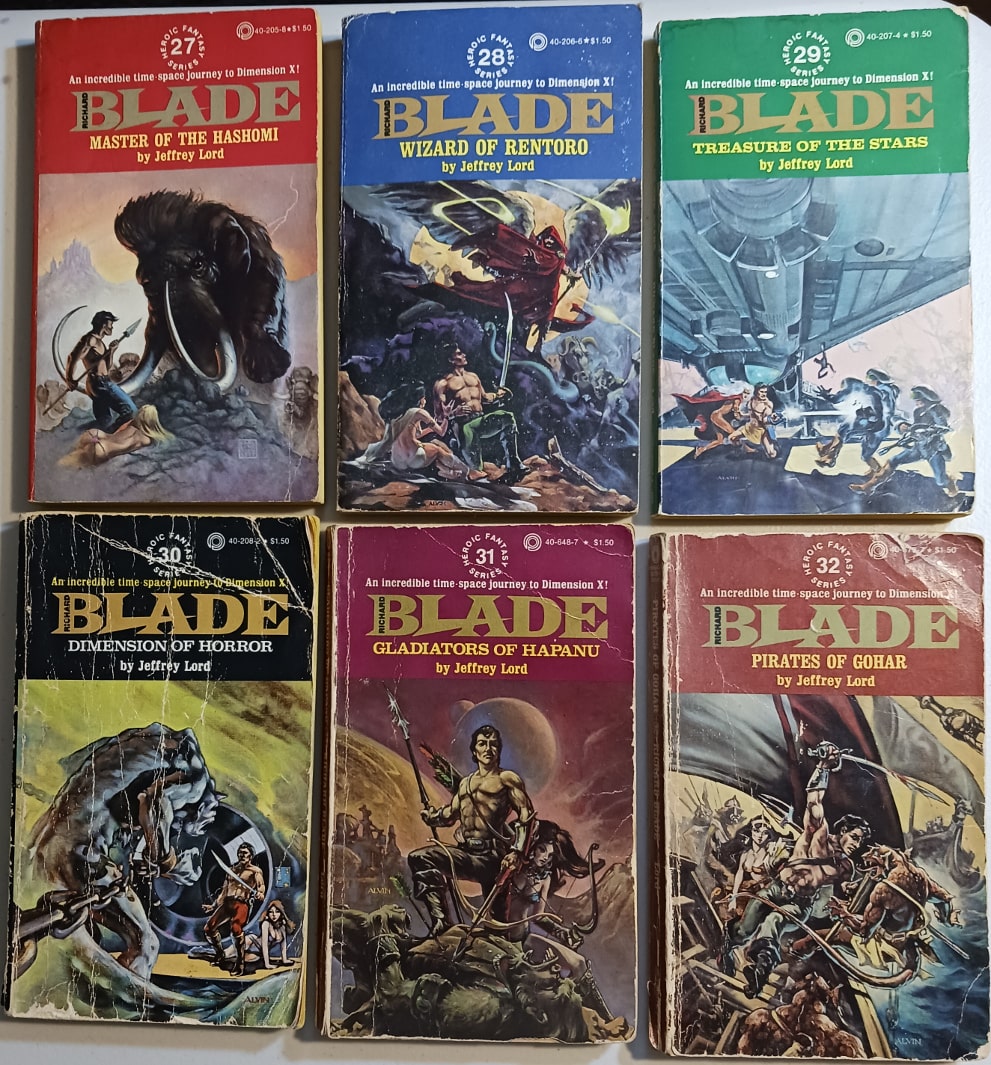
The cover illustrations are fairly simple but I like quite a few of these: Ken Kelly did some, and I generally like the ones by John Alvin, who I’ve not heard of before.
1. Tony Destefano
5, 9, 10. Unknown
6, 18, 19, 20. Tran Mawicke
21, 22, 23, 24. Ken Kelly
27. Carl Lundgren
28, 29, 30, 31, 32 John Alvin
I mentioned that the Blade series was called “adult” because it had sex. However, the books are actually quite sex positive as opposed to the sex negative presentation of male/female relationships in John Norman’s Gor books. Although Blade is described as a powerful male figure who most women desire, he is actually very much a gentleman with the opposite sex. There’s never any violence or threat made against women by Blade.
For example, in the book Ice Dragon #10, one particular sex scene illustrates this. Blade is given a slave woman to pleasure him, and she is clearly very frightened and has had awful past experiences. Blade carefully eases her fears and never applies any force. He allows her to make the decision on whether to proceed and also makes sure she is satisfied before allowing himself to take pleasure.
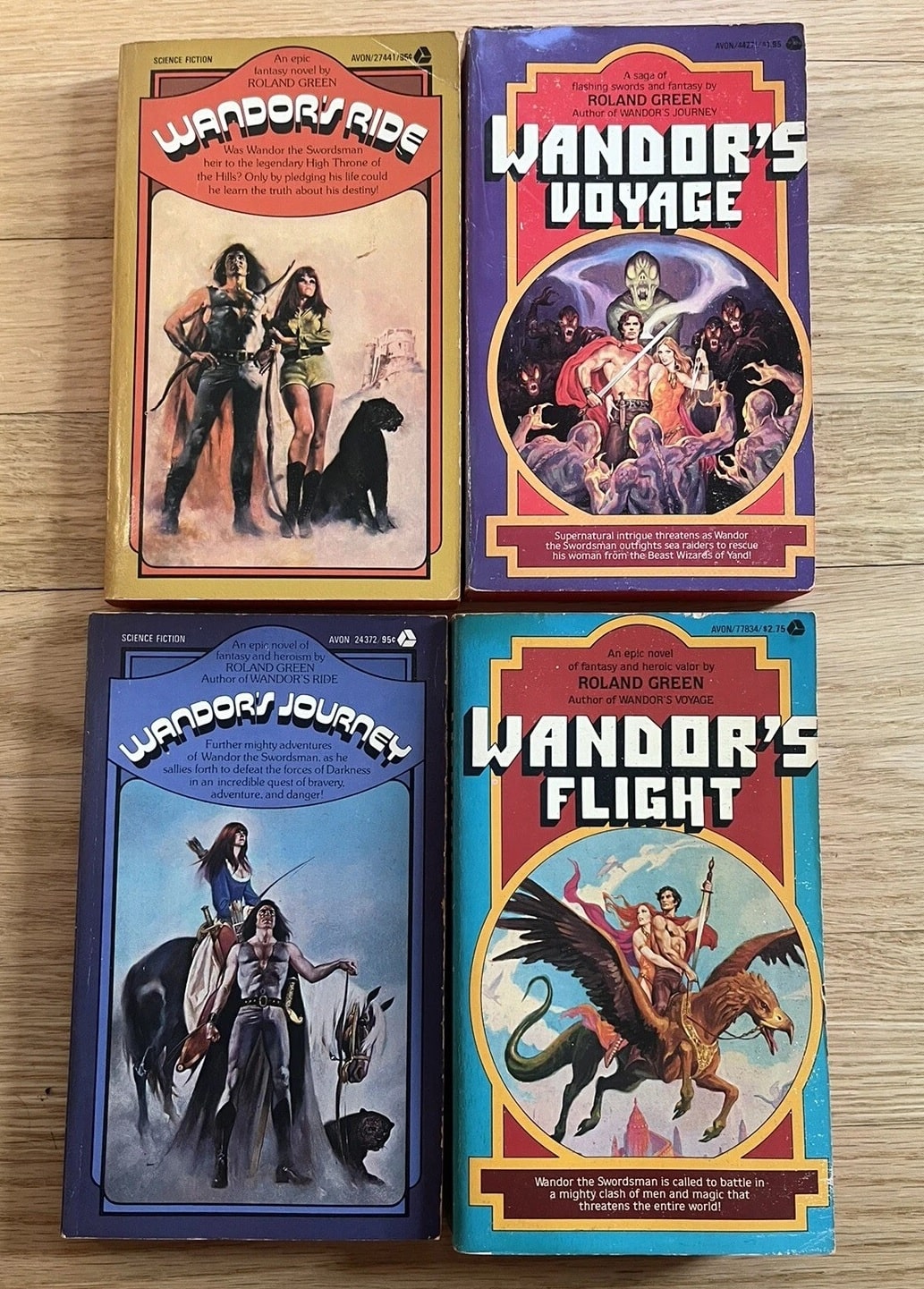
As a final note on the Blade series, let me say a couple of things about Roland Green. The first book I read by him was an original heroic fantasy work called Wandor’s Journey, published by Avon in 1975. Turns out this was book 2 of a 4 book series, all from Avon, listed in order below.
Wandor’s Ride (July 1973), Enric cover
Wandor’s Journey (May 1975), Enric cover
Wandor’s Voyage (May 1979), Jad cover
Wandor’s Flight (June 1981), Jad cover
I didn’t much like Wandor’s Journey and never read any of the others. But there was more to the story. Either at the time I was reading the book or just after, I saw an interview with Green where he talked about how easy it was to write Heroic fantasy and that’s why he chose to write the Wandor books. He indicated that the fans weren’t very educated or demanding, and I was a fan and pretty well educated actually. At the time, certainly, he wasn’t a very good writer and his condescending comments really pissed me off.
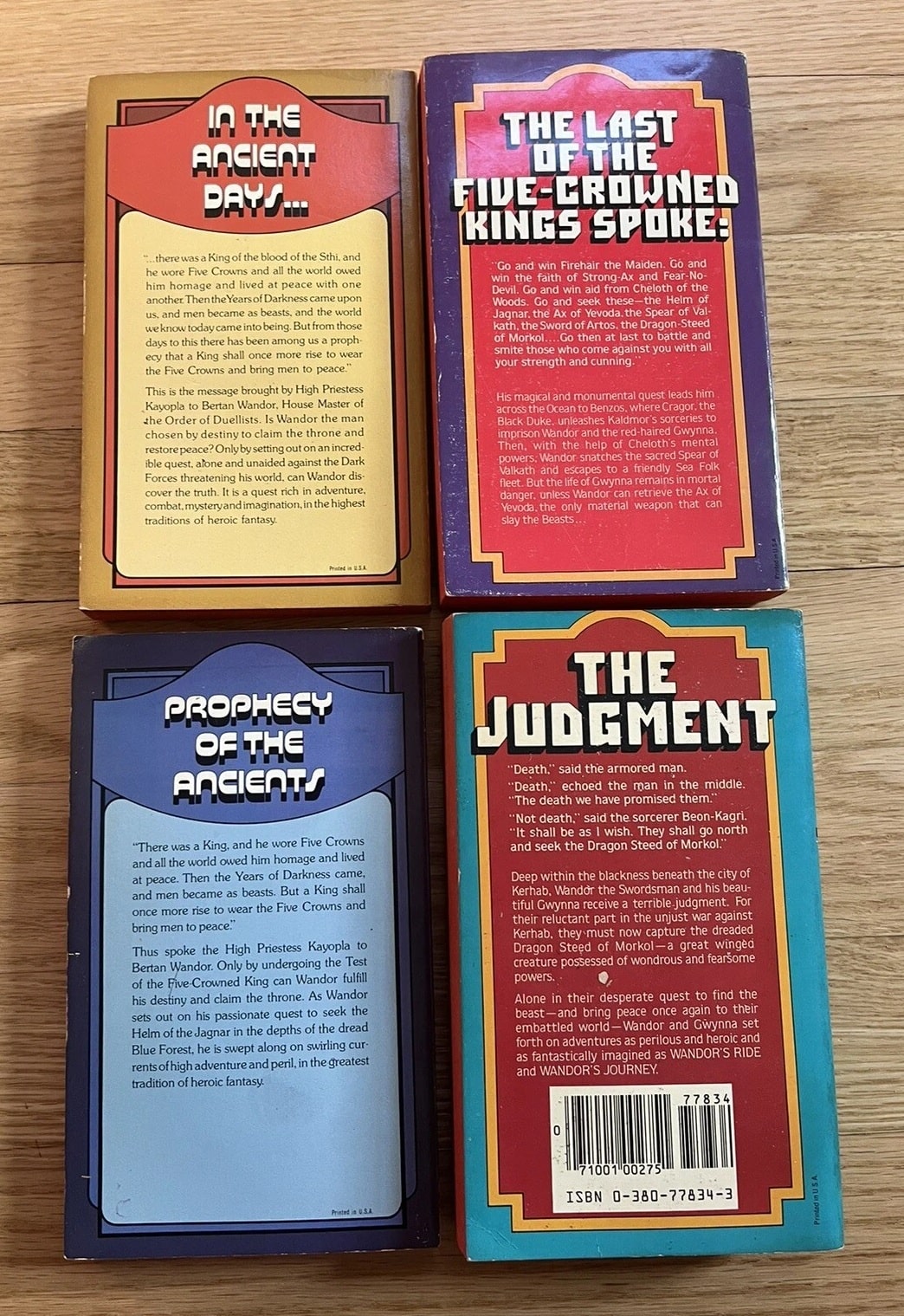
And it wasn’t like he was a young kid; he was 30 when the first Wandor book was published. I never read another of his books until I tried one of his Conan pastiches, which also wasn’t very good. I wrote him off. Later, however, I found out he’d written some of the Blade books that I enjoyed under a pseudonym, so he definitely improved over the years.
Green died in 2021 so I never got a chance to ask him if he regretted those condescending words. They wounded me both as a reader and a writer. I suspect that writers who think a particular genre is “easy” to write haven’t read very much or very deeply in that genre. And a writer should “always” respect the fans. Of which, I am one.
I’ve added cover pics of three other Blade books I have, 34, 35, 37, which I haven’t read. #37 lists Kevin Johnson as artist and the other 2 look like the same guy to me.
Charles Gramlich administers The Swords & Planet League group on Facebook, where this post first appeared. See all of his recent posts for Black Gate here.
Not saying anything profound, but: the fact that Green’s comments were taken so blithely for publication reaffirms that sword-and-planet/heroic fantasy has traditionally been pricked by the same blade of public regard as romance and chick-lit/cozy mysteries, and which is currently being applied to litRPG. When authors write something because it’s “easy,” for the purpose of meeting set tropes and satisfying certain proclivities, and/or to profit from a craze, story quality suffers and tarnishes the whole genre. If the tropes clearly outweigh the creativity in a given genre, all common respect for the genre and its readers is revoked.
Correct to do? No. But to some extent, it’s refreshing to be reminded that this happens across genders, genres, and time. It’s a path that applies to the early days of any writing trend. A work appears that appeals simultaneously on a primal level and for its creativity->The public takes an interest and calls for more->Writers respond by breaking the story into the elements that might be satisfying people and write to those->The writing becomes formulaic or only minimally variable->The writers and the public lose respect for the works because they no longer rise to the level of the original->A genre is simultaneously formed and decried.
I’m sorry that Green’s comments hurt so much. He probably had no idea of them having that effect, because he thought he was speaking a self-evident truth.
(…Now, if only we could convince “scholars” that this has been going on for a lot longer than they think, so they would stop doing ridiculous things like insisting that the Hymn to Ninkasi was a singular achievement that had a lot of variations because it was passed along like a game of Telephone, or insisting that the proliferation of “gospels” and folk-tales about the Christ child in the post-Gospel-pre-Bible period reflected a wide variety of beliefs among early Christians….)
As you say, I’m sure Green didn’t imagine or intend to hurt anyone’s feelings, but the comments likely indicated an overestimation of his own writing ability and originality at that time. It also suggests to me that his reading in the field had been somewhat cursory. I’ve heard other writers say similar things about genres they have written in, including Robert Silverberg. It’s a kind of apologetic thing that strikes me as odd. I don’t apologize for early stuff I’ve written, although I can certainly acknowledge having learned a lot since. That formulaic thing you’re talking about seems to happen in movies as well
Wow. Those John Alvin covers (#28-32) are terrific – good to see that Blade founds some pants. I’d have picked up any of those just on the strength of the cover. #30 reminds me of the Gygax “Saga of Old City” cover. Thanks for the terrific articles. As someone who haunted the sci-fi/fantasy sections of used bookstores back in the 80’s, you would have thought that I had seen some of these (and the others you’ve written about) but most are new to me. Thanks again
That’s one thing I miss about so many modern published books, the loss of such great and interesting covers
What I find most interesting about the Richard Blade series is that it birthed an enormous number of sequels in Russian and French.
There were evidently sixteen additional volumes in Russian, written by the Russian translator of the first six “Jeffrey Lord” volumes, Mikhail Akhmanov, in collaboration with Nick Perumov and other writers. (Akhmanov also wrote Russian Conan pastiches.)
The number of French additions to the series, though, were beyond reason. There were 206 volumes in all (apparently including translations of the initial 37). Richard D. Nolane (Olivier Raynaud) wrote 43 sequels, followed by Arnaud Dalrune, Patrick Eris, and Nemo Sandman, and occasional volumes by outher authors. I gather the French series only concluded in 2012.
Green’s Wandor series never concluded, stopping in the middle of the story with volume 4. I remember reading the first two, and finding them competent but run-on, and pretty much lost interest after that. As I recall, Lin Carter assessed the first in one of his “Year’s Best Fantasy” volumes as “sword and sorcery with a bite to it,” but in my view the bite started shedding teeth as the series chewed their way forward.
Wandor had a straggeringly large number of taskts he had to complete before he could save his country from a tyrant and become ruler. He got through several in the first volume, and then I think repidly went down to one per book thereafter. The page counts of the books got longer as the number of tasks accomplished in each got fewer. It would have been a long, long series had it been finished, and the villain (and possibly the hero) might well have died of old age before all the boxes were ticked. But the premise wasn’t bad; sort of a cross between the Greek legends of Jason’s quest and Hercules’ labors.
I only remember the first Wandor book and that not all that well. I pretty much wrote him off at that point and it wasn’t later until after I’d enjoyed some of the Blade books that I came back around to reading him more. Another series that went on longer in Europe was the Dray Prescott series, which went much longer in Germany than in England and the US. The author was British
Yep! Kenneth Bulmer = “Alan Burt Akers” = “Dray Prescot” (because why stick with your original pseudonym when your first person narrator is supposedly the real author, anyway?). In this case, since the additional volumes were still by Bulmer and the original language was English, the remainder of the series did eventually appear in the original language, from small publishing houses, first as ebooks, and then in omnibus print editions.
The Dray Prescot saga ultimately topped out at 52 volumes plus an unpublished fragment of a 53rd. Despite this impressive length, it was never actually wrapped up. Because Bulmer, alas, had a stroke and then died, two factors which proved an insuperable impediment to his continuing to write.
Ahh, you know Bulmer. His work as Akers was a big influence on my Talera series sword and planet works. You’re right, the remaining works were published over here eventually. I’ve got every single one. Bulmer is one of the authors I collect. I’ve talked about him often on the Swords & Planet league on facebook and will be doing more posts down the line.
Have you read any of Bulmer’s other stuff? I recently picked up “Roller Coaster World” (1972). Is it any good?
Bulmer wrote 100s of books. I’ve probably read about 2/3rds. He wrote under many, many pseudonyms. I haven’t read Roller Coaster World but here are some others I’ve read by him: Kandar
The Ships of Durostorum
The Diamond Contessa
Swords of the Barbarians
ODAN HALF GOD (BULMER) HOOK SERIES
Dream Chariots 1. Whirlpool of Stars
Whetted Bronze 2.
Crown of the Sword God 3. Star City
4. The Virility Gene
CAPTAIN SHARK SERIES FOX series
1. By Pirate’s Blood 1: The Press Gang
2: Prize Money
All of these are pretty good, although I’m not a big fan of his Hook series. the Odan, Half God series is wonderful.
This didn’t come out neatly from my cutting and pasting from my word files. the Half god series is Dream Chariots, whetted Bronze and Crown of the sword god. The fox series is The Press gang and Prize money. The hook series is Whirlpool of stars, Star City, and the Virility gene.
I’ve read a bunch of the Blade books and recently (well a year ish back) got a big bundle of them via ebay – like expanding my Ace Double I need to catch up on it. I read ’em a bit .. younger than ideal so my eyes popped out at the sex part of course. I’d already read some Gor and Spaceways by then.
IMO good adventure stuff and yeah Blade is a gentleman not a rapist. Glad you noticed that too.
Hmm – curious – could we do an article about the upcoming (SFX – vomiting) “Barbarella” movie? I’d like one, or I’d type one with dozens of other Hurlant/Metal graphic novels suggesting alternatives vs another pointless, wasteful re-make?
I’ve only heard the vaguest info about the Barbarella movie. Sounds like it’s would be something interesting to look at though
well it’s kind of like the Simpsons where a barker advertises the Haunted House ride at the carnival – then it’s boring with missing lights, dumb props, a mainenance man working on something live…. And the barker goes “I’m Sorry, Kids…” when they come out.
Today’s culture of re-re-re-re-remakes is bad beyond “Modern Audience” pandering. The stories SUCK. They are hollowed out HUSKS of what we remember as good. God help anyone trying to put out anything new. And people hate them. They don’t dare speak out to be put down and harassed or stalked by the trolls and paid shills but they don’t buy it anymore. This means even legit sequels and good new stuff that sneaks through suffers.
So I’m just of the “Dead, Jim…” on all these re-re-re-…makes. Wait until weeks AFTER they come out. The shills have proven themselves shills, the fake reviews stop coming, the few pundits you trust who subject themselves to it go (99%) “Bleah!” and you’ve saved time, money and hair. I’ll assume a Barbarella re-make is just SUCK and not in any cute sexy way either. Again it’d be more cool for LOTS of other Heavy Metal/Metal Hurlant things to be made into movies. Zora and the Hibernauts, Lann, Ghita of Alizaar, Skydoll, Druuna, Lorna, Metabarons… Even a Cheech Wizard movie since Wizards is old now and everyone knows the art style issue.
I hear you. the best stuff Lana and I have found to watch are typically independent films or some new director’s 1st couple of films. they may have some weaknesses but they have some heart.
There are actually over 200 Blade books. Most published only in German. However, translations of the whole series are available online
do you have any link for that? The 37 I write about were the original series in English. I know the Germans have continued other series beyond where they reached in English, like the Dray Prescot series, but I’ve seen nothing about them doing that for the Blade series.