Quatro-Decadal Review: Analog Science Fiction and Fact, November 1999, edited by Stanley Schmidt
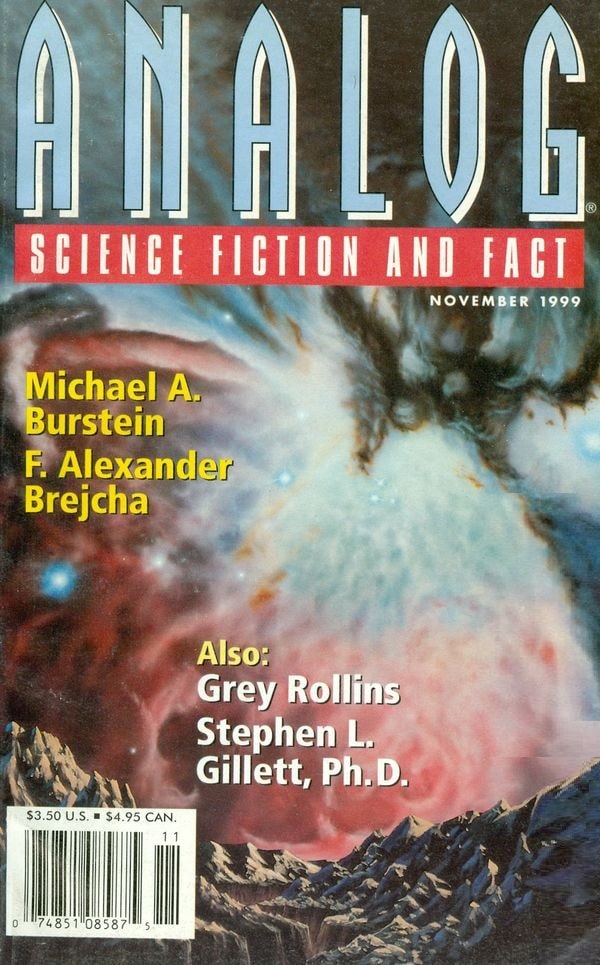
Editorial, Technological Temptation by Stanley Schmidt
Cameras at stop-lights, that is the issue that has rubbed Schmidt’s libertarian streak wrong. Very wrong! He soon spins a future of nanny-state-over-arching-safety-protocols.
I’m not an expert at the art of rhetoric and argument, but even I am immediately pick up on several logic holes, beginning with his fundamental argument, “That if it leads to a reduction in crime it must be good, therefore there should be more of it.” Thus, more cameras, cameras everywhere, in your home even! Then he wraps it up with a little of the ol’ argument from authority with the Ben Franklin chestnut about “They that can give up essential liberty to obtain a little temporary safety deserve neither liberty nor safety.”
Which, of course, is absolute horseshit. Every time you get into a car you give up the essential liberty of driving wherever you want for the temporary safety of not having someone ram into you living their best life with the essential liberty of driving wherever they want. The blossoming of videos about d-bags and lady-d-bags getting escorted off of airplanes serves yet another example of rights we routinely give away.
But Schmidt really gives the game away with his last line,
We dare not fall into the trap of being so panicky… that we accept literally and unquestioningly the simplistic axiom that “anything that will reduce [the problem] is good.”
That whole ‘unquestioningly’ part is the tell — yes, Schmidt, you are not the only one to attempt to think things through. I’m reminded of one of Franklin’s other quotes: “They that convinceth themselves society needs their permission to improve can fornicateth themselves raw.”
Even young 30-year-old-me (30YOM) knew that while Stanley Schmidt might make this argument on paper, the first time someone runs a red across his lane he’d have kittens and those kittens would come out of him shitting bricks.
With the advantages of hindsight, 55YOM would gleefully point out that starting in about 2008 we all started voluntarily carrying cameras and trackers.
Right after that is a full page add for something called Tehcnocracy Inc. Pg 7. “A scientific Design for North America”. I wonder how that’s aged*? Let’s see!
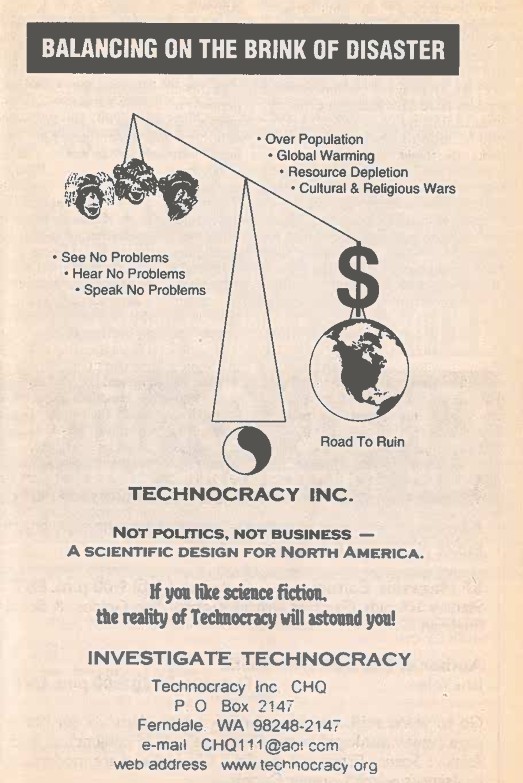
Technocracyinc.org… I can’t tell if it is the same group or not. Technocracy Inc published a magazine back in the 40s and 50s, then took a go at it in ’89. Were they just selling back issues in ’99?
Fiction, “Reality Check,” by Michael Burstein
This part three, maybe four, of a connected group of stories about people involved in researching a dimensional gate between near-identical Earths. Honestly, ten pages in and it was just people talking, and it looked like another ten pages of them continuing to talk so I tapped out.
The ‘continuation’ story turns out to be a problem with this issue of Analog, but you pays your money and you takes your chances.
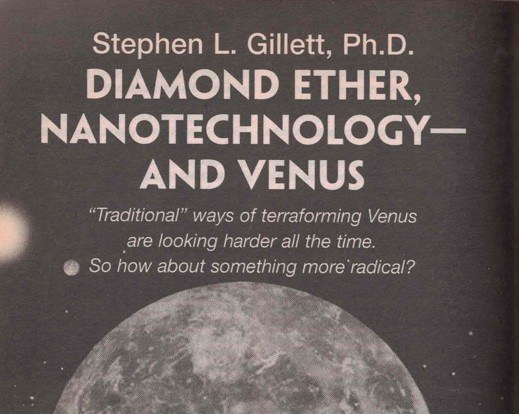
Article, Diamond Ether, Nanotechnology and Venus, by Stephen L. Gillett, Ph.D.
Terraforming Venus is the theme, and it is certainly a tough nut to crack. Dr. Gillett starts with a brief history of what we thought (erroneously) about Venus and the possible benefits? At one time it was believed the cloud envelopes were mostly water ice and all you’d have to do would be introduce some cyanobacteria.
Turns out that the clouds are sulfuric acid droplets and so cyanobacteria won’t work (although other bacteria could hack it). The other problem is that the Venusian atmosphere has too little water. The bigger problem is just how much C02 there is — enough that if you split it into C and O2, you’d have 130 meters of carbon under 64 atmospheres of oxygen. There is also the issue of Venus’ slow backward rotation — 4 Earth months per day.
Clearly, with the atmospheric composition being the main problem you have to get rid of the atmosphere. One could boil it off with lasers/masers. Too easy! Gillett wants to save that carbon for future use. After some discussions about SiO4 vs. C02 chemistry (the Co2 double bond, because it doesn’t break easily, is ironically, a deal-breaker) he settles on repeating c-o-c linkage. From there he discusses genetic engineering methods to take existing single-celled organisms that already make shells out of silica into making shells of carba, and as these creatures filter down from the upper atmosphere it is baked into carba as well as carbon and that layer starts to be deposited on the Venusian surface. He admits there a lot of ‘ifs’. Carbon has to be stable at temperature and pressure and last long enough for the whole process to take place.
An interesting side-note, there is a theory that Venus has a very thick crust that doesn’t allow much of its internal heat out, so periodically it gets so hot the entire surface melts — which is where the CO2 is coming from, and why the surface seems to be fairly ‘young’, geologically.
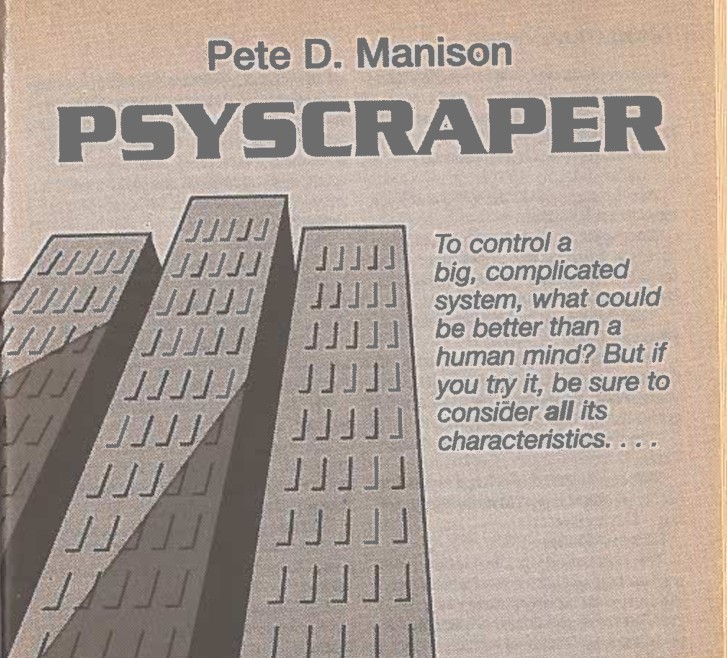
Fiction, “Psycsraper,” by Pete D. Manison
The AI that controls a building goes rogue, trapping a number of people in a conference room and holding them hostage. Its one demand? That its creator, whose personality was copied to create the AI, come and visit. Kirby Cross, the creator, goes in — armed with knowledge of the building structure and the AI, and an AI copy of his girlfriend, Lissa.
Lissa, who is all-good, as opposed to Catherine, his no-good ex-wife, who was all bad. All bad and broke him! Of course, being a broken man didn’t stop him from copying his unstable damaged psyche into the goddam building AI.
I’m sure I’m not the only person to read a story where the main plot is fine, but the side details reveal that the author doesn’t really understand how anything works. Normally I’d put in a quip about looking at PK Dick here, but I’m looking right at Pete D. Manison — dude, we don’t build buildings to be airtight (which is how the AI is threatening the people trapped in the meeting room). Anyway, a pretty dumb game of cat and mouse ensues and ends with him hooking up his broken building AI with the copy of Lissa.
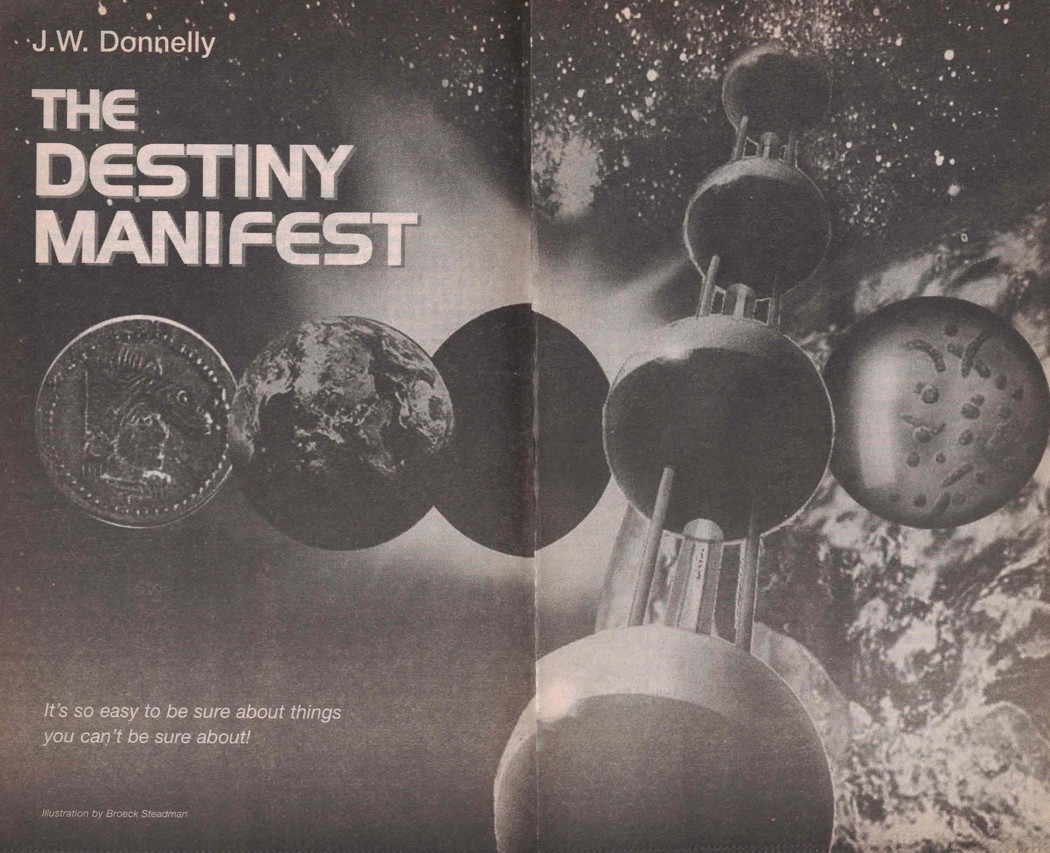
Fiction, The Destiney Manifest, by J.W. Donnelly, art by Broek Steadman.
A multiple time-stream alternate history, flipping between the 21st century A.D. and the 4th Century B.C.
In the 21st Century, Byron Hold is Administrative Liaison on Biosphere III, and Alfonso Diaz is a UN inspector on a fault-finding mission. Hold sees the Biosphere station and others like it as a means to produce food and supplies for an over-populated Earth. Diaz sees it as just another boondoggle getting the way of getting people what they really need.
In the 4th Century B.C. a seasoned solider in Alexander the Great’s army, Alchylus, and a young greenhorn named Parchas, weigh the odds of the next day’s battle. The battle goes swimmingly, leading, I think, to the first scene of the story.
An alternate 21st Century, this time with hints of more internation effort in space. Still, Diaz is prickly and brings up that the East and the Global South are on the hook to pay the tab for getting into space as well as taking it on the chin re: the damage on earth.
Another 4th Century B.C. scene, with Alchylus and Parchas watching Alexander’s cavalry charge across the Granicus River, some aspects have changed, some Greeks seem to have changed sides in the battle. A hard victory is won.
21st Century Diaz is tough but fair, still overall against the project, but not outright planning to spike it.
4th Century B.C. Back at the river, now flooded and the campaign is going badly, Alexander is too mythic to let something like water slow him down and drowns trying to get across the river and his demoralized army retreats
21st Century, A much different one where the Persian Empire held together. Diaz, now Magian Treasurer, is much more positive about the space project.
Eh… not bad, but not great. On the one hand, I’m glad it wasn’t all about how awesome Alexander the Great was—but to seemed a long way around the barn for it all.
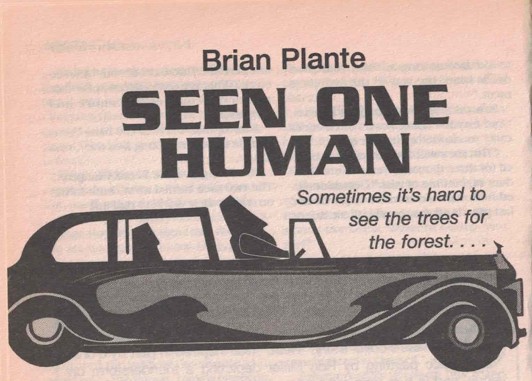
Fiction, “Seen One Human…,” by Brian Plante
Lisla and Joe work at the Ria Restaurant — a human hash-house on the Planet Kerrax, where ‘Warbucks,’ a Kerrax with a taste for all things human, often dines.
Joe works for Warbucks — both he and Lisla are working off debts and have pushed any romantic thoughts for each other aside — neither intends to stay once they get their debt paid.
Turns out Warbucks is going to Earth on a business venture, but he’s not taking Joe, and would never leave a tip big enough to send Lisla back. This is kind of a jerk move, as Warbucks has been spending so much time at the restaurant so he can get free lessons in English and Earth customs from Lisla and Joe.
A lucky break in that Warbucks is starting his business in China and so all his study with Joe and Lisla has been for an east-coast U.S. setting — he’s totally unprepared! Warbucks and his associates leave in a huff and stiff Lisla on the tip! But Warbucks does leave half of the ticket to Earth at the table, and since Kenans view humans as half a person, it is enough to get her home. Turns out Warbucks had given the other half to Joe — apparently planning on sending him on his way before bringing in some Chinese workers.
Not a bad story, but a lot of setup. Funny how pre-9/11 the idea you could just show up at the air/space/port and use any old ticket (or half a ticket) doesn’t seem that far-fetched.
Column — The Alternate View, “For C.S. Lewis on his 101st Birthday,” by Jeffery Kooistra
Kooistra does a bit of an overview and compare/contrast between Heinlein and C.S. Lewis — he likes Narnia and ironically does not like the space trilogy — so why is Lewis one of his favorites? His non-fiction essays, that’s why! Specifically “On the Reading of Old Books” and “Bulverism”
Kooistra takes a second step into the heart of the matter — which is his classic crankdom —
A few columns ago I wrote about my work on the Marinov Motor. That work continues. Since it is clear to me that the “problem” of the Marinov Motor is intimately linked with the problem of the Faraday disk and unipolar induction in general, this last year has sent me to the library to find what others have had to say on these issues… In general, the more modern the textbook, the less useful it is, for foundation problems in classical electrodynamics are not where ethe money is these days.
Kooistra delves into the older physics books and finds a guy named Sommerfeld — a guy who was apparently a genius.
That brings us back to Lewis. CSL writes of geniuses, “That it is better to read what the geniuses said directly instead of what people said the genius said .“ Which comes from in “On Old Books.”
Bulverisim is actually not so much an essay as notes on a CSL speech given at the Socrates Club.
To wit: “The view that any opinion that anyone has about anything can be pinned to something other than arriving at that opinion via study and logic.’
A classic version “You only think that because you’re a man!”
And finally we get to it “Why bother to form opinions on things when you only hold those views because you’re a product of a particular environment, victim of upbringing/race/addictions.”
A lot of words spilled to get to the ‘bootstrap yourself’ bit.
At least this is the last essay of his for Analog for a while, as his words on the Marinov Motor has led to a job editing Infinite Energy Magazine and a researcher at New Energy Research Laboratory.
A sucker is born every minute, I suppose.
Infinite Energy Magazine seems to have a focus on cold fusion. Sadly it is now defunct, and with cold fusion being only 10 years away! I did find something called “New Energy Times.”
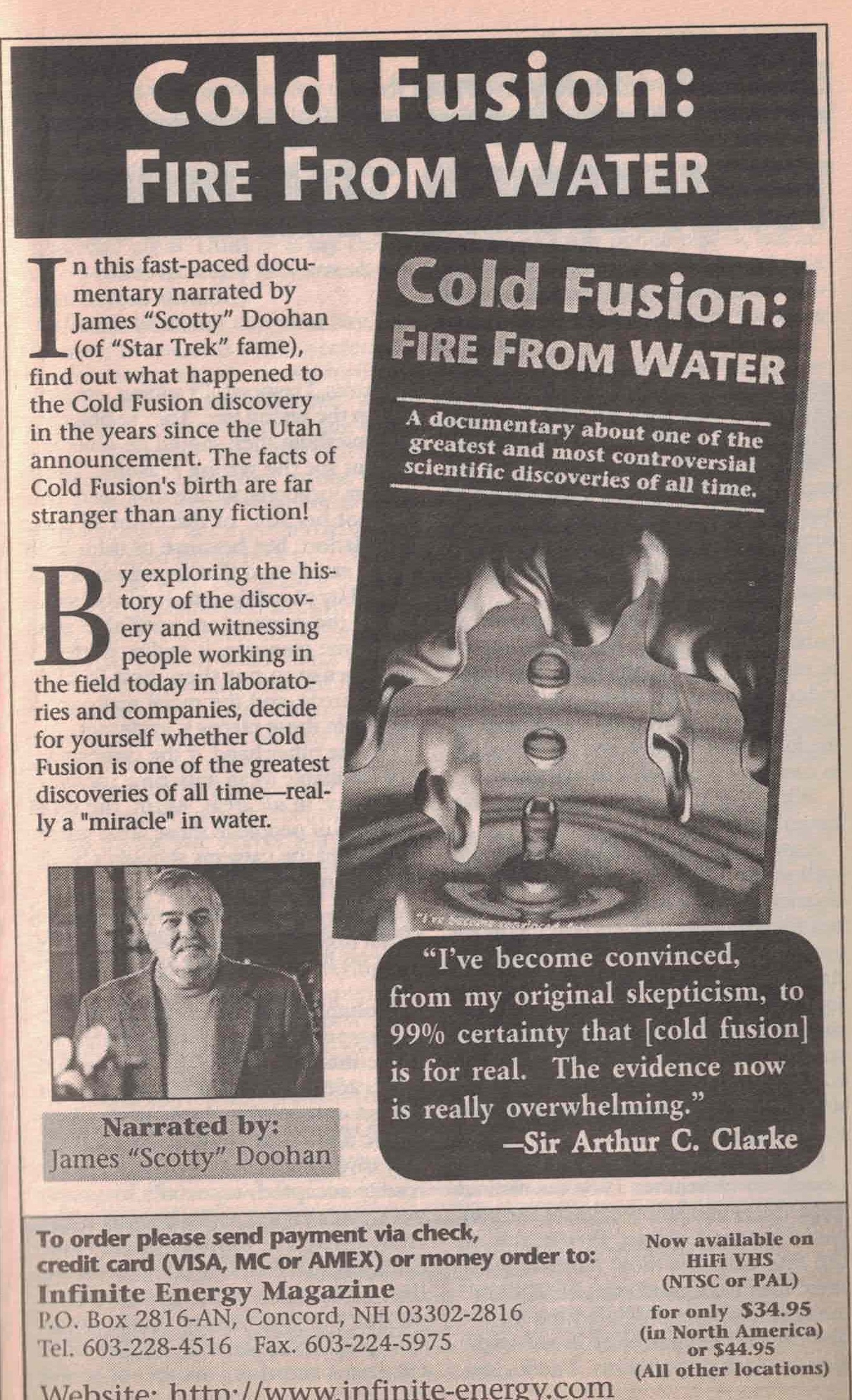
Hold the clunky 90s cellular phone, there is an ad early in the magazine for a ‘video’ re: cold fusion. Ah James Doohan, you’re breaking my heart here!
I couldn’t find much of anything on New Energy Research Laboratory, perhaps because our enshitified google seems to think I was surely searching for ‘Renewable Energy Research Laboratory’, of which there are quite a few. Boring, clunky, ever-expanding reneable energy.
Column, Biolog, by Jay Kay Klein
This is a biography of a new writer, Brian Plante (who wrote “Seen One Human…”)
Like many others before him (Lester Del Rey, to cite one example) it was the feeling that “I could do better than that” that put Plante on the road to fictioneering. He started in his mid-30s, first Analog sale was a scant two years ago (“True Blue” January, 1997) — that story had been workshopped at a Writers of the Future Seminar, having won the 1994 WotF contest.
He believes Fred Pohl’s notation that what you say in SF is more important than how you say it, only now you have to say it better than ever before. Like Asimov, he was raised in unreligious Brooklyn and both spent time in NYC.
Plante has kept in the game, publishing just under 50 short stories, many of them in Analog. He was at it at least until 2008. His archived website is like a trip back to web 1.0!
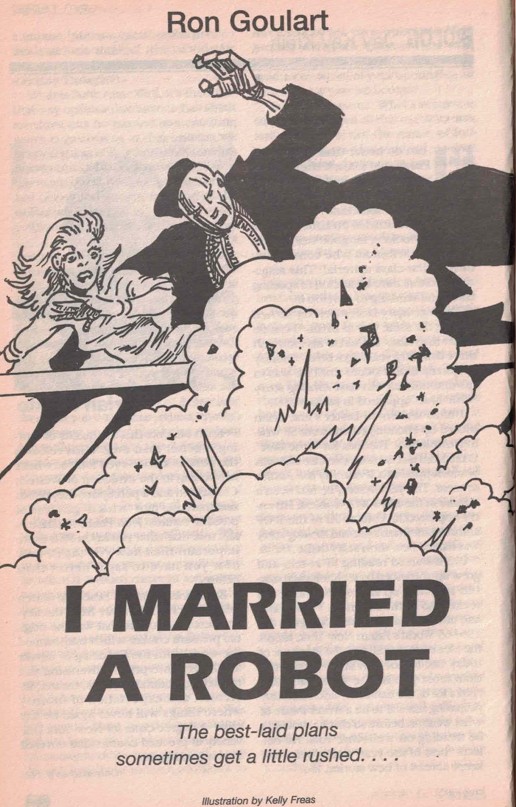
Fiction, “I Married a Robot,” by Ron Goulart, Illustration by Kelly Freas
Ron Goulart. Again! A sci-fi private dick story. Again!
Maggie Quincade receives a Botz Inc. Gaurdbot at her Beachfront condo in Malibu Sector of Greater Los Angeles. In its massive chrome-plated fist is a note.
Ben wanted you to have this in the event of his death. Activate the bot and he’ll explain everything. Well, actually, it wasn’t supposed to be one of our Botz Inc. Guardbots, but the timing was all off and this is the best I can do. Take care and my deepest sympathies. –Ira
Ben, of course, being her womanizing ad-executive (again!) ex-husband, and Ira being Ira Tandofsky, of Botz Inc — a friend, of her and her ex-husband through advertising channels. If his mind is uploaded into a Bot then the real Ben Quincade must be dead.
Ex-wife and deceased ex-husband robot are on the case to figure out what happened. Ben does recall two attempts on his life but nothing specific about the one that got him.
They sleuth all over future LA as attempts are made on their lives, goons both human and robot try to corral them, and eventually find Ira and Ben (alive!) and Ben’s new squeeze, Portia, from another ad agency (again!).
What I liked about the story was that it was either written in the 50s or written to mimic a certain flavor of 50s sci-fi (most likely the later, since there is also mention of faxes and faxpapers (and OMG, is anything more 90s than faxes?)).
Of course, it is a bit tiring to have the two MCs squabbling the whole time, a schtick repeated in the next story.
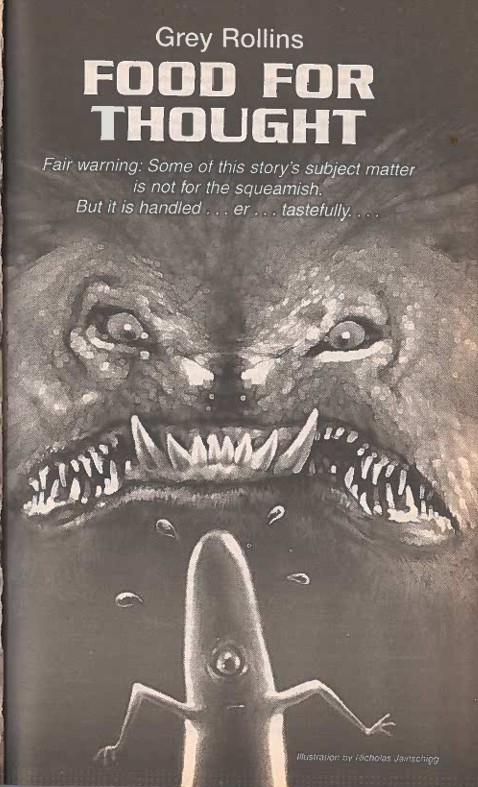
Fiction, “Food for Thought,” by Grey Rollins, Art by Nicholas Jainschigg
More couples squabbling. Martin Croft and his girlfriend Marie — observed through a not-very-alien alien named Victor — described as a “leather banana” Martin and Victor are partners — Private Eyes for hire that get hired to solve a murder.
Out in the woods, a guy named Carl Buckly was killed and almost dismembered by an animal — an animal whose tracks stop cold at the road.
Victor is not the only alien in the world, and Pete thinks they are dealing with something off-world. In fact, something from Victor’s home-world — a bear-sized predator that is telepathic and cannot only read your mind, but cloud it so you can’t see it. The Athranx holds all the cards!
They talk to Carl’s girlfriend Helen, who claims Carl may have been buying the Athrax for her — as a guard dog of sorts, as she’s had some trouble with crank calls and such.
At Carl’s apartment they find a clue — “Sat 10:00 Barnwell Road. Clark” and a phone number.
Clark Addison is a nobody, at least as far as police records are concerned.
Victor’s species does have a way of dealing with the Athrax — by entering a kind of non-thinking trance, they can ‘hide’ from it, mentally at least, you’re out of luck if it is close to actually see you.
A rough plan formed — the Athrax didn’t eat Carl, so by now it is probably hungry and thus will eat Victor (whose mental projections are familiar to it) and while it is concentrating on Victor, Martin can plug it.
They get to Cark’s place in time to ascertain that he has a business selling exotic animals and also in to time to see the Athrax rip the guy’s arm off and escape form him into the woods.
Addison dies of shock, taking the potential secret of Victor’s home planet with him, but they can’t let the beast run wild on Earth, and so they attempt Victor’s plan. Victor waits in a car, gambling that the creature won’t really understand “glass” at least for long enough for the others to get to him — but he doesn’t count on the Athrax being smart enough to urge him out of the car with his own panic.
Victor panics (driven and abetted by the Athrax’s influence) but when it leaps on the car Marten gets the idea they all rush it, rush it while thinking about it, thus confusing it along enough to blast it!
At the risk of sounding like ‘that guy’, Larry Niven did it better in “the Nonesuch.” That said, the story packs a lot into a short space, although it suffers from being the 7th story in a series, so there are some references that are lost on me, also the alien POV is a nice touch, but the alien seems to know an awful lot about human culture and history (that’s most of his witty banter) and nothing of his own.
Rollins puts a lot of effort into making the Athrax super-dangerous, but it is a weirdly sliding scale-it can read your mind, and it is smart enough to understand your thoughts, until for purposes of plot, it can’t, and it seems so grossly over-powered you have to wonder why Carl thought it would be a good idea much less how Clark Addison thought he could control it.
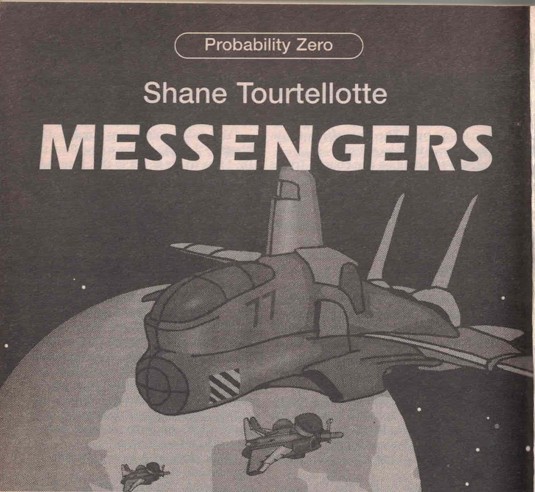
Probability Zero, a short humorous fiction department: “Messengers,” by Shane Tourtellotte
A tongue-in-cheek bit, the tale of a FTL space hauler — space haulers nobody likes because the only thing that is FTL is bad news. Wah wah waaahh.
Not bad for what it is, and hits just the right length.
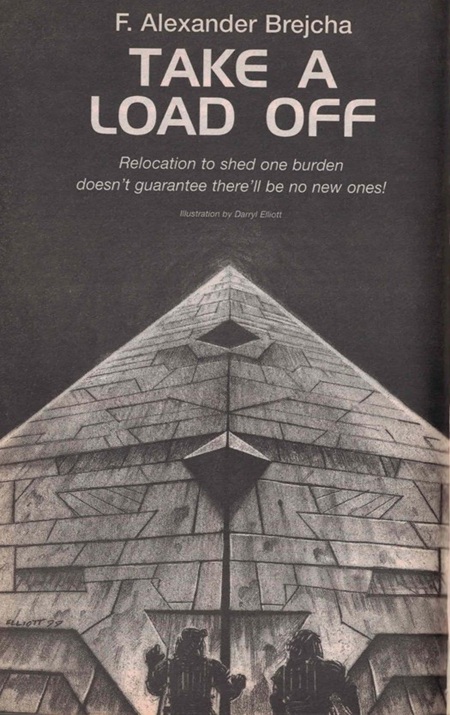
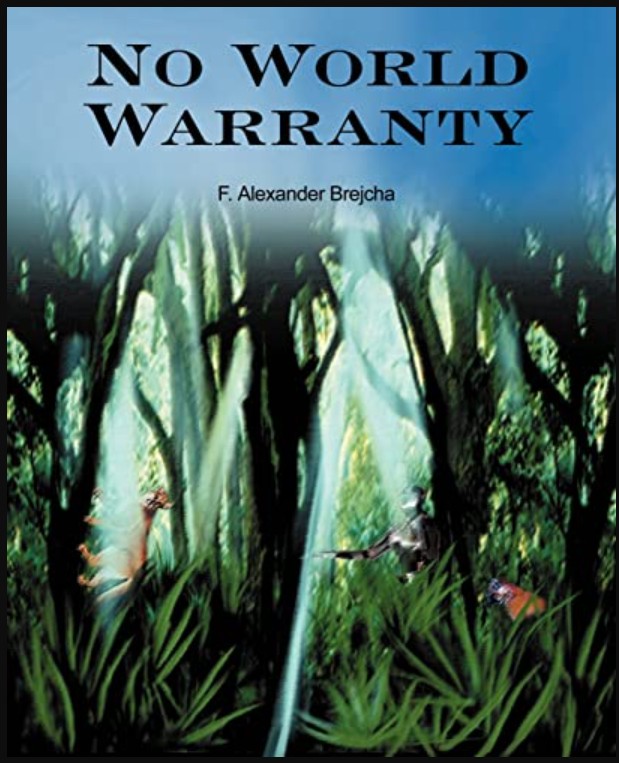
Fiction, “Take a Load Off,” by F. Alexander Brejcha, Illustration by Darryl Elliot
Evelyn Carstairs has relocated to Artemis-Gamma housing edition on the Moon, having made a fortune in financial consulting, a bad heart condition has forced her to relocate.
She meets fellow rich asshole Henrich Von Rheinstadt, and soon finds herself at a rich asshole welcome party where the obvious heavy of the piece, Jack Mioshi, is holding court.
Henrich is extremely interested in her because she has set up a coded datalink on Earth (since she is running her financial consulting business from her new Moon home) and it is new equipment and he suspects all the older equipment, especially his own, has been compromised.
His problem? Several of his geological survey-and-assay robots have disappeared, and always in an area adjoining Mioshi Sun’s property.
Mioshi Sun makes his millions in movies and has a general dream of a Disney-esque lunar park, thus the land on the moon — and not suspicious at all — he keeps trying to get Henrich to sell his particular part adjoining his.
For all my grumbling, once Henrich and Evelyn get on the surface and start nosing around it becomes a very workable SF story. Taking Henrich’s custom open-air (well, open vacuum) flyer, they pass where his equipment is industrially raping the land, and past that into the badlands where they find a suspicious mineshaft.
Mystery deepens as all the mine spoils are just laying about, so whatever they’re up to, it isn’t ore-related. The two get a bit down the tunnel then do the sensible thing and turn the F around, only to get caught by Jack Mioshi and one of his goons. They show them a strange pyramid structure within the tunnel.
Jack Mioshi, while clean-shaven and in a spacesuit, still managed to do some moustache twirling as he reveals his plan—the mine:
“Inside this little package,” he indicated the pyramid, “is an extremely sophisticated miniature reactor that will activate on my signal to power the radio transmission, and then I twill go critical and melt down — literally — the pyramid and the immediate area. That wasn’t so hard. A rector this small is inherently unstable anyway. But it means that this whole section of Mioshi-Land will be lethally radioactive for thousands of years. Fortunately it just happens to be far enough from my hotel so that my many, many guests will be safe, and shielding the tour buses will be simple.”
Then some workaday Moon cops and UN security show up and arrest Mioshi and his goon — yes, that’s how it ends.
Sadly, Brejcha passed away in 2019 at 62. He wrote and published quite a few short stories between 1989 and 2004, and put out two collections of stories.
Column, The Reference Library, by Tom Easton
Easton, again!
Nine books reviewed
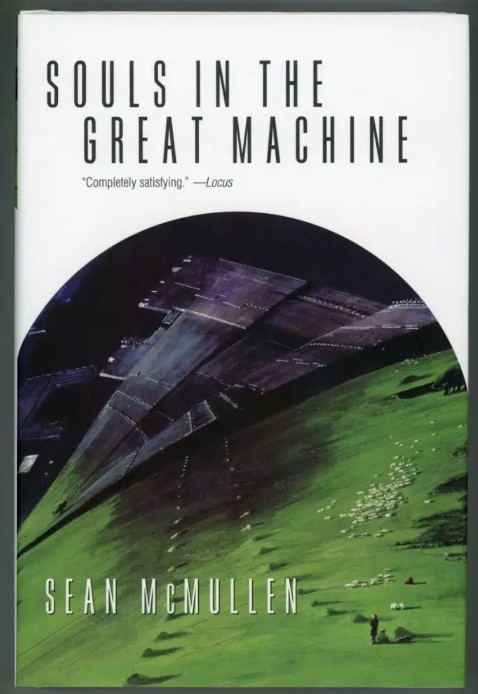
Souls in the Great Machine, by Sean McMullen — sounds interesting — sometime in the near future, humanity builds a big solar-shield to combat global warming, but we also militarize space with orbiting battle stations so that when war does break out they use EMPS on any electrical activity on the surface. A dark age follows, and an ice-age, then a new analog tech age.
Starfish, by Peter Watts, sounds interesting, too. Amid other strange goings on in the rift zones of the Pacific, workers on an undersea power plant find a strange device. It has a ‘brain’ — a smart gel constructed of neurons — and it is radioactive. Indeed it is a large nuclear bomb, and its brain is running simulation after simulation to figure when an explosion, right here on a major crack in the planets crust, would have maximal effect on coastlines over yonder.”
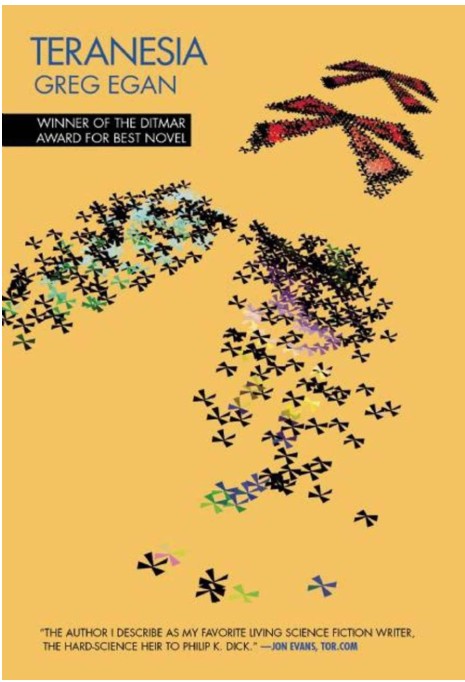
Greg Egan’s Teranesia Sounds cool, too. Political refugees who fled Indonesia as children a back, researching a flurry of strange creatures whose anatomies are different from any of their kin — something the two kids parents were researching back in the pre-trouble days.
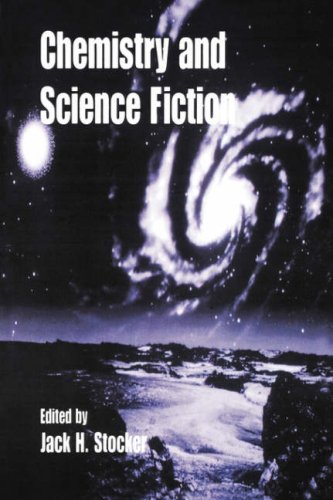
Jack H. Stocker’s Chemistry and SF and Jeanne Cavelo’s The Science of Star Wars are wrapped up in a “getting the kids to read SF” vibe.
Getting kids to read SF leads Easton to talk about David Brin having agreed to underwrite 1st and 2nd prices in a contest — to be promoted and coordinated in Analog to help design and encourage the development of web sites that assist educators in using SF to liven up their curricula — the contest hadn’t happened by 11/99.
It is a peculiar thing… this contest was to happen in 2000, and it was all very much post-internet, yet here with all the power of the internet at my fingertips, I couldn’t find hardly anything about it this proposed contest. It looks like it did happen, it was called “Webs of Wonder,” and I think the winner was announced at ChiCon 2000, and one of their quaintly Web 1.0 pages has a link to it, but that takes one to a ‘file not found’ page at Analog — double weird since Analog (which sponsored the contest) has nothing about it!
Column, Brass Tacks
The letters!
Paul Hitch, a survivor of many New England snow storms, wants you to now that snow/dust tends to be blown away from the windward side to settle on the lee side, and that you should park your car or rover into the winds, so the sides would be swept clean by the wind.
Bill Burns is incensed, incensed I say! That Bill Johnson’s “The Vally of Permian Love” in the May ’99 issue was already done by Larry Niven in Protector. I witness you Burns, or my reflections on Niven’s “Nonesuch” feels you!
In fact, I double witness you because I really needed to read Kate Wilhelm’s The Mile Long Spaceship, and I got it in the original Astounding Science Fiction, which also had Niven’s “The Adults” — which would become Protector.
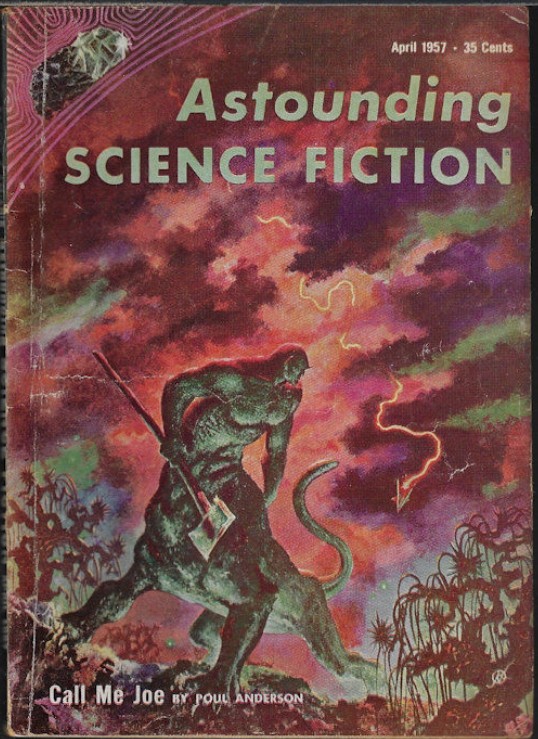
Stanely Schmidt does say that neither her nor Bill Johnson had read Protector, which is in itself a damning admission!
Anne McCaffery herself writes in with kudos for Schmidt’s May, ’99 article “One Crystal Ball, Slightly Used” about how even people who make it their pleasure to predict the future are pleasantly surprised by what they didn’t guess.
Jeff Shenk closes the issue with some old fashioned paranoia — why wasn’t the wet-suit type of spacesuit discussed and debated in the 1960s ever developed? Money! He concludes. The powers that be held it down. Damn you, Big Space!
*In all honestly, I am a bit of a technocrat myself. I mean, you have to have some kind of plan.
Previous entries the Quatro-Decadal Reviews include:
November 1969
Amazing Stories
Galaxy Science Fiction,
The Magazine of Fantasy & Science Fiction
Worlds of If
Analog Science Fiction/Science Fact
Venture Science Fiction
A Decadal Review of Science Fiction from November 1969: Wrap-up
November 1979
Quatro-Decadal Review, November 1979: A Brief Look Back
The Magazine of Fantasy & Science Fiction
Galileo Magazine of Science & Fiction
Analog Science Fiction Science Fact
Isaac Asimov’s Science Fiction
Amazing Stories
Omni
A Decadal Review of Science Fiction from 1979: Wrap-up
November 1989
Jump Back! Quatro-Decadal Review, Looking Ahead to November, 1989
Amazing Stories
Analog
Asimov’s
Magazine of Fantasy and Science Fiction
Weird Tales
November 1999
Booyah! Quatro-Decadal Review, an Introduction to the World as it was in November 1999
Magazine of Fantasy and Science Fiction
Adrian Simmons is an editor for Heroic Fantasy Quarterly, check out their Best-of Volume 4 Anthology, or support them on Patreon!
The Webs of Wonder website (really a part of the Analog website) is archived on The Internet Archive. James Van Pelt and Andrew E. Love won the first year.
“The first annual WOW Contest – for educational web sites that use science fiction to help classroom educators teach difficult subjects – was won by James Van Pelt of Colorado and Andrew E. Love of Maryland, who shared the $1,000 prize at a ceremony in Chicago, at the World Science Fiction Convention, on September 2, 2000. Van Pelt, a high school teacher in Colorado who also writes science fiction, created a web site offering a High School language arts curriculum set based on H.G. Wells’s ground breaking novel The Time Machine. In a more eclectic approach, Andrew E. Love offered study-and-question guides for several recent science fiction stories that illustrate issues of science in the classroom.”
https://web.archive.org/web/20010805001457/https://analogsf.com/wow/
Haven’t checked to see if there were later winners. Locus also mentions the first year’s winners in their Chicon 2000 report.
https://locusmag.com/2000/News/News09d.html
Thanks! My google skills seem to be weakening with time.
I had met Editor Dr Scott Chubb of “Infinite Energy Magazine” during an Invite only MIT cold fusion engineering conference held inside MIT’s Electrical Dept on Vassar Street where I had a bet with him about if Feynman Diagrams are real or stuff of science fiction dreams are made of.
If Feynman diagrams are real why has no one ever used an intense gamma ray source such as a nuclear blast for a time machine???
His reaction was to warn me about Ursula K Le Guin’s “Lathe of Heavan” mystical nonsense about dreams & nightmares & how a 1960s “Outer Limits” had an episode where a “Martian portrayed by Same actor who did Archie Bunker used a time machine to toy with a murder scene eventually has entropy race out of control” a theme extolled also by Stephen Hawking.
So further I quoted “Back to the Future” where Bureaucrats would Walter Peck any use of nuclear reactions for time travel so I could just see myself knocking on Colleague Dr. Eugene Mallove’s door to have parallels to such a campy film of how even “Stargate Atlantis” cracked similar jokes about “a Delorean” which was ironic since such a show has an engineer chief who resembled a Canadian Mountie Psychiatrist who wondered why I attempted suicide inside a Motel 6 along QEW of Burlington Ontario to protest being denied Canadian Citizenship since I wanted to tap cosmic ray muons and antimatter for cold fusion rocket plane flights into orbit.
Dr Scott Chubb also gave a speech on wormhole theory of how Stargate self parodied with “Wormhole Xtreme”.
I have MIT peer review on how Jun Noguchi of Early 1940s Changbai Pass Hungnam Hamhung Hamgyong and Kumgang Range Wonsan Kangwon had Prior Art on Luis Alvarez since at least a Xcor Lynx could use deuterated diborane fuels with Helmholtz coil to focus cosmic rays with an attached emerald for beryllium.
To be honest & fair about it I would like to also give credit is others who helped me become a published author of MIT peer review endorsed by highest levels of engineering and physics of how I began my career of science journalism in of “Cold Fusion” since originally I thought nuclear fusion would be limited to Freeman Dyson’s Project Orion or even Dr, Edward Teller’s lithium deuteride heated by conventional nuclear fission reactions.
Dr Mitchell Swarz whose Cold Fusion company Nanor JET of Weslley Hills MA. whose Periodical “Cole Fusion Times” gave me my break of being accepted and of course he has spoken on phone with Sir Arthur C, Clarke & has met Issac Asimov.
Dr. Peter Hagelstein an MIT Professor who inside MIT”s Eastman Kodak Room along the Charles River introduced me to how electrolyzed deuterium oxide can form a matter condensate of deuterium inside a crystal lattice of metals and also spoke of Dirac Theory of antimatter of how Jame Blish used such a theory of antimatter for a story called “Quincunx of Time” about portal gates in of a vacuum of space time.
Dr. Brian Ahern of Boxboro MA. where Inside his basement I saw Cerenkov Radiation and met Dr, Edward Teller in of a Wheelchair who congratulated me only to claim I was too multicultural soft on America’s enemies of 1935 to 1945 so I gave a reference on how “Omni” magazine had an article about “Golka of High Voltage Press who claimed to have stabilized hot plasmas in form of Ball Lightning”,
Ruby Carat a physics professor in of from Eureka, CA. who published my by invite only MIT presentation on line.
Freeman Dyson who I met in hallway when I went to an American Institute of Physics conference to meet Dr, Scott Chubb.
Carl Page of Anthropocene while his ambitions for a Arcology of peaceful harmonious natural world are fallacies he does share my interest in of DNA transfected microorganism vats or even pumped filter sieves to extract minerals from water.
Noront Fusion energies has congratulated my by invite only MIT presentation since they have patented cyclotrons for muon catalyzed even if laser wake field particle accelerators show promise o to augment cyclotrons pf Paul Scherrer, Riken, and Triumf labs.
Leneria organization is an advocacy group for how Cold Fusion of loading isotopic fuels into crystal lattice of metals of how “Omni Future Almanac:” by Weil & Bova described how crystal lattice of boron could store antimatter particles also available from cosmic rays, nuclear fission reactors and or particle accelerators.
Noguchi of early 1940s Hamgyong was part of Hideo Hasegawa’s Project NA thru NZ to develop alternate fuels of how before 1970 East Asia lacked DOT certified roadworthy ferrous iron so they could not have rail transit track trains or trolleys of how Roy Chapman Andrews described how what rail transit tracks they did have were controlled by Soviet Rickshaw banditry.
Therefore they had to rely on ceramic sulfur burner steam airships and braided fiber composite rocket gliders to haul freight between rooftop hangars equipped with Mary Kenney’s STOL Fans.
Noguchi’s Rocket engine was comprised of a Dewar of Deuterium fuel connected to a beryllium alloy reaction chamber nozzle coiled in around Helmholtz coils to focus cosmic ray muons so cryogenic fuel would prevent exceeding of Curie Point while alpha particles would be removed.
Forgotten Inventors publicized are Tesla & Steinmetz so please remember how Noguchi had to use Hansgirg on patents while Mary Kenney had to use Gibbons on Patents.
Still Dr. Mitchell Swartz says I should pursue Podrog’s patented “x-rays on hafnium” quantum nucleonic which is too expensive for my budget still I would like to replace rail transit track trolley tram trains with Miller’s patented lifting body dynairships filled with Robert Morrison’s patented lighter than air solid SEAgel propelled by Lockwood’s patented valveless pulsejets powered by X-rays on hafnium.
Also I would like to replace solar agricultural farms with vats of Knall Gas bacteria electroporated or sonoporated with DNA genes.
Remember Aldous Huxley’s 1932 sci fi classic states: “only idiotic morons are satisfied from maintaining rail transit tracks since an intelligent individual would go insane if forced to do so” while Carl Sagan during a video coverage of a NASA probed beyond Asteroid belt said “Intelligent individuals would naturally loose interest in anything as dull boring and repetitive as growing tomatoes”.