Tor Double #35: Robert A. Heinlein’s Universe and Dean Ing’s Silent Thunder
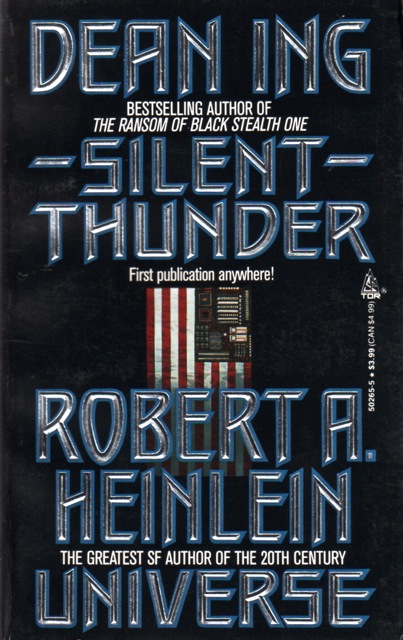
Tor Double #35 is the penultimate volume in the Tor Double series and also the final multi-author offering, originally published in July 1991. A throwback to the early volumes in the series, this volume, although only having a single cover, has embossed title text for the first time since volume #19.
Universe was originally published in Astounding Science Fiction in May 1941. Although not the first generation ship story, Universe is a relatively early example of the subgenre and Heinlein’s first foray into it, although he would return to it in the future, eventually published Universe and its sequel “Common Sense” as the novel Orphans of the Sky.
Hugh Hoyland lives on a generation ship, being raised by his uncle Edard. When he accompanies his uncle to a Witness to resolve a contract dispute with a neighbor, the Witness informs Hugh that he has been selected to become a scientist, one of the people who is tasked with keeping the generation ship functioning. The Witness also gives Hugh a history lesson in which the reader learns that the inhabitants of the generation ship know it was created by Jordan and is meant to be taking them on a journey to Far Centaurus, although the actual meaning is forgotten. To the passengers of the ship, it is the entire universe.
Even a Hugh is taught the scientific “gospel,” he is still a young man. The story opened with Hugh and his friend, Alan Mahoney, hunting “muties” through the less inhabited portions of the generation ship. The muties get their name either because they are descended from mutineers, because they have suffered mutations, or a combination of both. On one of their mutie hunting trips, Hugh is taken captive by a mutie named Bobo and presented him to the leader of the muties, Joe-Jim Gregory. Joe-Jim is a mutant with two autonomous heads, which don’t always agree with each other.
Hugh falls into the role of their slave with little argument, but Joe sees something special about Hugh and continues his education. The result of this is that the scientific knowledge he has been trained in is augmented by information that the “civilized” passengers lack. Eventually, Joe feels Hugh has enough background to fully understand the nature of the generation ship and shows him the original control room and the galaxy outside the ship.
Before his expedition against muties, Hugh became aware that there was a vague schism between the older, more hidebound scientists, and the younger ones, who were more willing to espouse theories which bordered on the blasphemous. Once he has been convinced of the “truth” by Joe-Jim, he attempts to convince the mutie to allow him to take the new gospel back to the scientists he had been studying with in order to attempt to successfully achieve the goal Jordan had set out for him.
While Universe stands on its own, it does end in a way that offers pointers to the next story in the series, which isn’t surprising since “Common Sense” would be published only five months later and Heinlein had clearly plotted out both parts of the story, although Orphans of the Sky wouldn’t be published in novel format until 1963, more than twenty years after the two novellas had their first publication.
Universe was written around the same time Isaac Asimov was writing the early Foundation stories, so it is interesting to note that both authors cast scientists and priests and science as a religion, although while the scientists of the Foundation seemed to be doing so in a calculated manner, the scientists in Universe, such as Nelson, were clearly believers who interpreted their historical texts as allegories when they didn’t understand the scientific principles behind them.
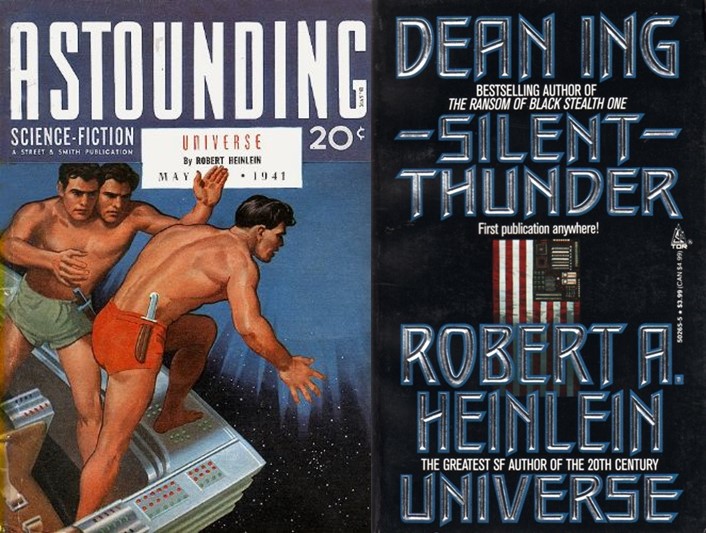
Tor Double #35 cover by Joe DeVito
Dean Ing’s Silent Thunder was an original story for the Tor Double line and has not been reprinted. It may be the darkest and most political story published in the Tor Doubles series.
Opening in March of 1967, Ing introduces Sergeant Walter Kalvin, assigned to assist in a midnight rendezvous in Vienna because he was a native speaker of German, unlike the major who was heading the operation. Although the drop goes south, with the major and Kalvin’s contact, a scientist who had been lying low since World War II, dying, he finds himself in possession of a device used by the Nazis to amplify the persuasiveness of Hitler’s speeches.
The novel jumps to May of 1997. Kalvin is now serving as Chief of Staff to President Harrison Rand. He has been amassing power for himself and some members of the President’s cabinet are becoming concerned, leading to the decision to send information to news anchor Alan Ramsay, in the hopes that Ramsay could undermine Kalvin’s power.
Ramsay works his contacts to try to figure out how much of the information he has received is accurate, and in the process he attracts Kalvin’s wrath. Kalvin employs a variety of hoodlums to carry out his orders in order to maintain plausible deniability and keep the government from knowing what he is doing. These people do not have the veneer of civility that Kalvin must maintain, and so Ramsay and those close to him find themselves dealing with people for whom violence is a release, up to and including pedophilia, although, fortunately, Ing does not provide any details beyond letting the reader know that abuse is taking place.
Once Ramsay begins asking questions, the stakes are almost immediately raised for him, although it only becomes clear how ruthless his opponents are over time, allowing Ing to build the tension as the story progresses. The reader is more aware of the situation, however, than Ramsay is, so what could have been a who-done-it or a how-is-it-down becomes simply a case of how-will-it-play-out. Unfortunately, Ramsay is one of the least interesting characters in the novel, so the while the reader cares about what happens to the people in Ramsay’s life, they are less concerned with Ramsay himself, despite being the focal point.
Although Ing focuses mostly on Ramsay’s attempts to learn more about the conspiracy that has fallen into his lap while keeping himself, his daughter, and his ex-wife safe, Ing also provides insight into Kalvin’s maneuvers throughout. Through President Rand, Kalvin is attempting to hamstring the media and make them more amenable to only reporting the news Kalvin wants reported. He mentions other policy plans that will follow, all of which present the United States on a slide towards fascism.
It also becomes clear to the reader, and only slowly to Ramsay and his compatriots, that Kalvin is using the device from Nazi Germany, known as a Donnersprache, to control President Rand, and, when necessary, allow Rand to use the device, although Kalvin can control it so Rand is only successful when he is supporting Kalvin’s instructions and not when he goes off script. Rand’s complicity is not entirely clear throughout most of the story.
Ing’s United States under the control of a charismatic President who can make people follow him regardless of their own desires strikes a strong chord nearly 35 years after the story was originally published. Rather than fire up large crowds, Kalvin prefers to remain behind the scenes, using individuals with sketchy backgrounds to do his dirty work, but Ing’s depiction of a power behind the scenes who bases his technique on the rise of Hitler is chilling. The fact that Ing found the need to introduce a technological device in order to enhance the potential dictator’s charisma seems a little naïve in the modern political climate.
Joe DeVito provided the cover.
 Steven H Silver is a twenty-one-time Hugo Award nominee and was the publisher of the Hugo-nominated fanzine Argentus as well as the editor and publisher of ISFiC Press for eight years. He has also edited books for DAW, NESFA Press, and ZNB. His most recent anthology is Alternate Peace and his novel After Hastings was published in 2020. Steven has chaired the first Midwest Construction, Windycon three times, and the SFWA Nebula Conference numerous times. He was programming chair for Chicon 2000 and Vice Chair of Chicon 7.
“Universe” is a pretty good story. There is a great audio version of it from back in the day from “X-Minus One”.
https://www.youtube.com/watch?v=13VS_klDrio
Ing’s story sounds quite good, too.
Nice comments throughout the series, Steven! Regarding your closing remark on ‘Silent Thunder,’ a number of communications experts have noted how the change in dominant media technology in the U.S. over the past 60-odd years – from print, to TV, to the internet – has changed public discourse, from voters following political leaders without question, to being more likely to accept unsubstantiated statements as fact, and less able to exercise critical thinking skills – which certainly echoes the ‘technological device’ Ing posited.