Military Cyborgs, Alien Plants, and Desert Heists: January-February 2026 Print Science Fiction Magazines
 |
 |
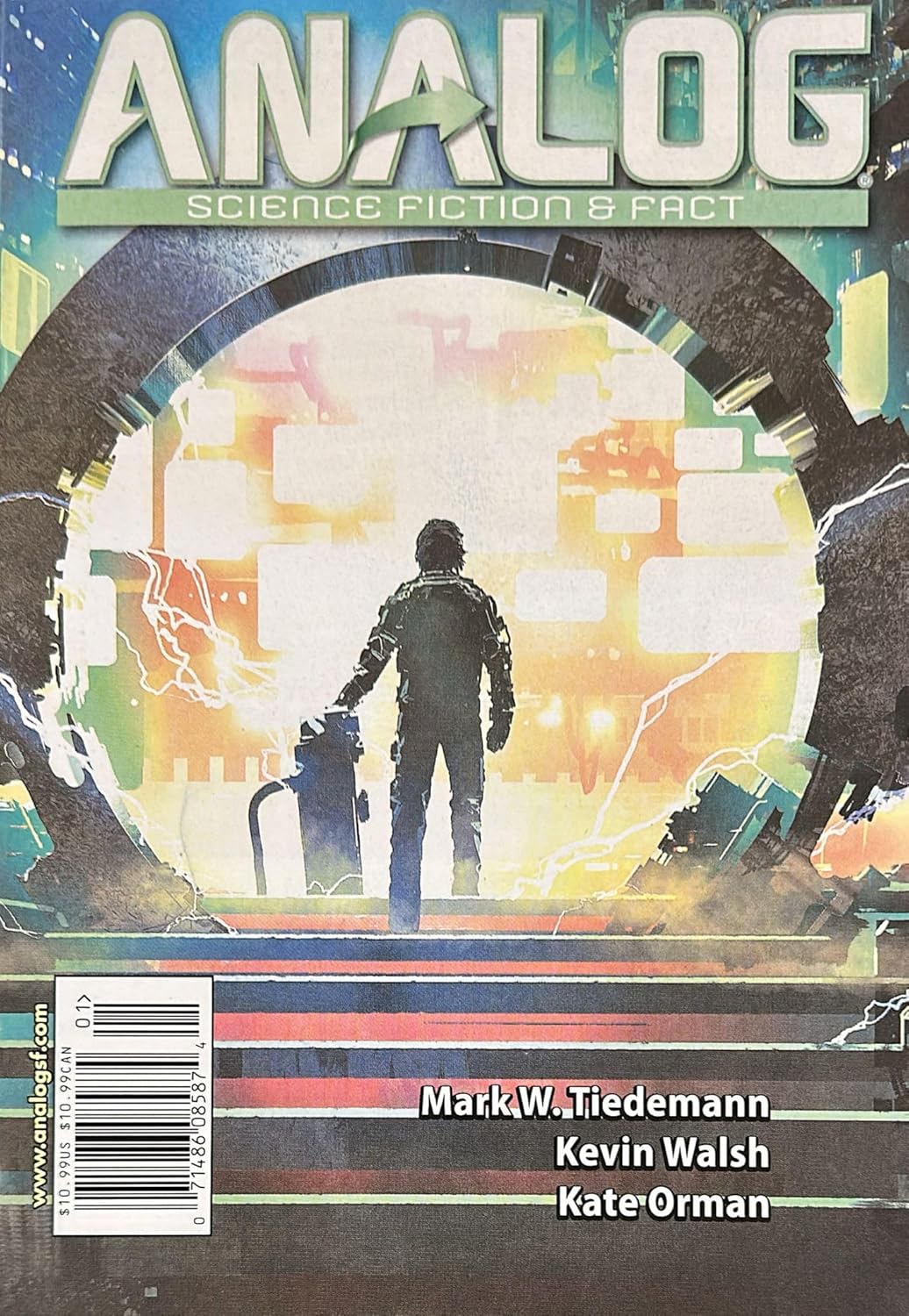
The January-February issues of Analog Science Fiction & Fact and
Asimov’s Science Fiction. Cover art by Tithi Luadthong and Dominic Harman
We’ve settled into a new reality with Analog and Asimov’s SF. Both magazines are consistently running more than two months late, but both are at least on a predictable schedule, arriving regularly in two-month intervals. Readers more observant than I have pointed out that the publisher, Must Read Magazines, has removed the cover date and Next Issue date from the covers entirely, which was probably a good idea.
They do provide semi-regular updates online, and on March 31st Emily Alta Hockaday, Managing Editor at Dell Magazines, posted this in the Analog Science Fiction and Fact Magazine Fan Club on Facebook in response to a question on postal delivery.
We’re in the process of switching printers — both because of print quality and the delays we’ve experienced with them. Once we have the contract with the new printer figured out, I’ll have warehouse dates to share for both March/April and May/June.
Hopefully that change will help them gradually get back on schedule. In other news, Sheila Williams continues to recover from the brain aneurysm she suffered two months ago. She remains hospitalized, but her family posts occasional updates, including the delightful photo of Sheila below.

Until Sheila returns, Emily Hockaday continues to act as interim editor of Asimov’s.
As usual, the latest issues have plenty to offer science fiction fans, including new stories by Alexander Jablokov, William Preston, Adam-Troy Castro, Susan Palwick, Sean Monaghan (twice!), Jack Skillingstead, Will Ludwigsen, Lavie Tidhar, James Sallis, Mark W. Tierdermann, Geoffrey Hart, Matt McHugh, Jo Miles, Rich Larson, and many more.
Victoria Silverwolf at Tangent Online enjoyed the latest Analog.
“Sin Eaters” by Mark W. Tiedemann is the lead novelette. A police officer rescues alien children from a man who kidnapped and tortured them. The adult aliens refuse to press charges. The officer tries to figure out the motives of the man and the aliens, while dealing with his own emotional trauma. This is a powerful story that deals with issues of guilt, atonement, and psychological healing in a thoughtful and mature fashion. It also provides an example of true, profound friendship, rarely seen in fiction.
In the novelette “The Origami Man” by Doug Franklin, a fishing boat discovers what seems to be a drowned man in the middle of the ocean. The being turns out to be alive, and something other than human. It goes on to interact with the man who found it in a special way. At first, the mood is that of a horror story, with the entity compared to a zombie or a shape-shifting alien. The conclusion changes the tone drastically, in a way that some may find a bit too sentimental. The story is most notable for a vivid portrait of its Alaskan setting.
“You Who Sought the Stars’ Distant Light” by Stewart C. Baker is narrated by what was once the mind of a human being, now the consciousness of a starship. It defends itself against an intruder, only to discover its former relationship with the person invading it. The revelation of the narrator’s previous life, now forgotten, offers emotional appeal.
“Unsung” by Derrick Boden features a man who has been genetically engineered and prosthetically enhanced to become a military cyborg, destined to be a hero in a war taking place across the solar system. He participates in many battles, becoming less human each time, until he learns the truth about his origin and purpose. This is a dark, cynical story, with multiple deceptions involved in the plot.
The title character in “And She is Content” by Frank Ward is an artificial intelligence running a starship while the crew and passengers are in hibernation. Once a century during the long voyage the people wake up and enjoy the pleasures of a city created for them. The AI panics when the journey is complete, now that she has no purpose and will lose the company of the ship’s commander. This is a romantic science fiction story, reminiscent of Anne McCaffrey’s 1961 story “The Ship Who Sang” and its sequels. The once-a-century city is compared to the one featured in the 1947 musical Brigadoon. The AI and the Commander are referred to as the famous medieval lovers Heloise and Abelard. These allusions create a wistful, nostalgic mood that will appeal to softhearted readers.
“Linka’s Out” by Rich Larson takes place on a mining planet. The protagonist travels to the planet’s prison to meet the title character when she is released. The reunion leads to a shocking conclusion. This is a gloomy and hopeless tale, set on a harsh world dominated by an autocratic corporation. A hint to the story’s mood appears very early in the text, when the reader learns that the bodies of dead workers are recycled into raw material. The discovery that the main character makes at the prison is particularly gruesome.
All the characters in “Iron Star Swing” by Kate Orman are beings made up of subatomic particles, although they appear to each other as people or even as inanimate objects. They live on the surface of the sun, which is now a black dwarf in the immensely far future. They feed on neutrinos that reach the sun from stars that become novae. The plot involves a wounded warrior in a war that has lasted trillions of years and a young being who sometimes takes the form of a boy and sometimes of a firetruck. As can be seen, this story is most notable for its bizarre setting and characters.
Read Victoria’s complete review here.
The new Asimov’s is reviewed by Mina at Tangent Online. Here’s an excerpt.
“The Greenway” by Susan Palwick is an odd story, but it grows on you. The narrator is alone with her two children when the caravan comes bringing the “greenway” with it. We learn that all people eventually begin to sprout plants (a new meaning for “gone to seed”), which slowly kills them. But the sprouting bodies bring a new fertility that is spread every spring by the caravan. The bitter-sweet ending stays with you.
“Ecobomb” by Alexander Jablokov is an invasion story that doesn’t take itself too seriously. The aliens are truly alien, sending “ecobombs” to change the ecosystems on the planet they are invading. But the humans on the Earth adapt to the changes and start working with the new flora and fauna to create hybrids. They create biocomputers and, through cooperation, they not only survive but are ready when the alien invaders arrive. The story grows on you like an unpleasant fungus.
“The Man with the Ruined Hand” by Sean Monaghan starts with a heist in the middle of a desert of a distant planet. Cliff is sent to catch the thief but finds himself in the middle of a double cross. It feels like the author wanted to create a Philip Marlowe vibe, but Raymond Chandler did it better.
In “Replacement Theory” by Jack Skillingstead, Tyler suddenly starts seeing everyone around him as monsters, including his girlfriend Emma. Does he have a brain defect or is he surrounded by aliens? Then he meets someone else with the same problem. But who can he trust?
“The Imaginative Youngster’s Handbook to UFOs” by Will Ludwigsen is one of those short stories I really like — a wonderful surprise. What starts off reading like a book for intelligent and imaginative youngsters slowly gains an emotional depth that is truly heart-rending. We begin to care very much about one particular child, who experiences abuse and bullying in their daily life, yet who manages to keep wonder alive inside themselves despite their loneliness. There is gentle humour and questioning of things adults hold to be self-evident but, mostly, there is compassion and a desire not to be a person who hurts others just because you have been hurt yourself. What’s particularly well done is the mix of a child’s logic with adult understanding. I would read this more than twice!
“As Long As We’re Still Here, We Might As Well Dance” by Adam-Troy Castro continues our descent into grimness. We watch the last moments of two people who did not flee when the Nihilators arrived to destroy and “repurpose” their city, including anyone left alive in it. We see love and defiance, and an unwillingness to die. The real tragedy is that both protagonists stayed because each in their own way believed they deserved to be damned.
“The Lady in Camo” by John Richard Trtek is a detective story with references to Blade Runner, Chandler, and Sherlock Holmes. Jack Twice is hired to find a missing person. It’s a world filled with clones, soft deaths and partial resurrections. I wanted to like this story but just couldn’t fully engage with it. The last few lines are good, making you wish the rest of the story had lived up to them.
Read Mina’s complete review here.
Here’s all the details on the latest SF print mags.
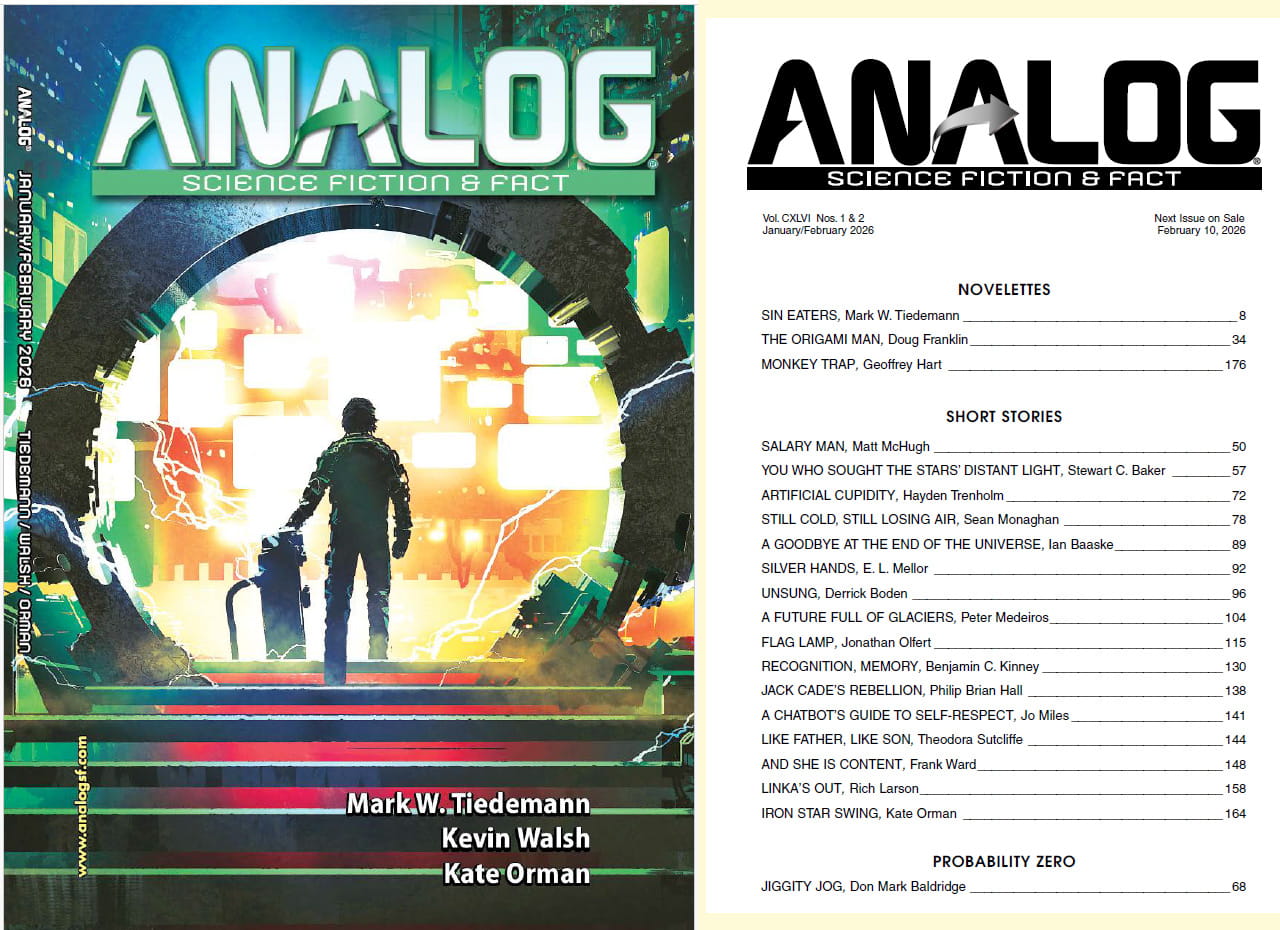
Analog Science Fiction & Science Fact
Editor Trevor Quachri gives us a tantalizing summary of the current issue online, as usual.
This issue’s opening salvo of 2026 stories continues right on into a furious fusillade of fiction next issue, including:
“Sin Eaters,” by Mark W. Tiedemann: how do you investigate — let alone prosecute — a crime when the societal standards violated are so alien that we can hardly recognize them?; A slick interstellar heist (…or is it?) in “The Starworthy Slip,” by AC Koch; a particle-scaled solar fable in “Iron Star Swing” by Kate Orman; a sweet burgeoning romance that mingles with a perspective on a deep geological timescale to reveal something else entirely, in Peter Medeiros’ “A Future Full of Glaciers”; a salvage crew that thinks they’ve found signs of intelligent life only to realize that the life may have anticipated them more keenly then they’d like, in Geoffrey Hart’s “Monkey Trap”; a look at the realities of building permanent settlements on the Moon, in “Homes Away From Home,” our Fact Article for the issue, by Michael W. Carroll; and more, from Doug Franklin, Howard V. Hendrix, Theodora Suttcliffe, Sean Monaghan, Matt McHugh, and others, plus, of course, all our regular columns, including an additional Guest Alternate View from Richard A. Lovett on AI and conspiracy theories (sadly, ever more relevant by the day); as well as our annual Index and Analytical Laboratory ballot.
Here’s the full TOC.
Novelettes
“Sin Eaters” by Mark W. Tierdermann
“The Origami Man” by Doug Franklin
“Monkey Trap” by Geoffrey Hart
Short Stories
“Salary Man” by Matt McHugh
“You Who Sought the Star’s Distant Light” by Stewart C. Baker
“Artificial Cupidity” by Hayden Trenholm
“Still Cold, Still Losing Air” by Sean Monaghan
“A Goodbye at the End of the Universe” by Ian Baaske
“Silver Hands” by E.L. Mellor
“Unsung” by Derrick Boden
“A Future Full of Glaciers” by Peter Medeiros
“Flag Lamp” by Jonathan Olfert
“Recognition Memory” by Benjamin C. Kinney
“Jack Cade’s Rebellion” by Philip Brian Hall
“A Chatbot’s Guide to Self-Respect” by Jo Miles
“Like Father, Like Son” by Theodora Sutcliffe
“And She is Content” by Frank Ward
“Linka’s Out” by Rich Larson
“Iron Star Swing” by Kate Orman
Probability Zero
“Jiggity Jog” by Dan Mark Baldridge
Science Fact
Nor Any Drop to Drink by Kevin Walsh
Special Features
The War, Astounding, and Campbell by Edward M. Wysocki, Jr.
Me-N-You-Genics by Howard V. Hendrix
Poetry
Escape Pod by S.L. Johnson
The Bones They Left by Stanley Poole
Reader’s Departments
Editorial: The State of the Union by Trevor Quachri
In Times to Come
The Alternate View by John G. Cramer
In Memoriam: J.T. Sharrah by Emily Hockaday
In Memoriam: Bruce Boston by Emily Hockaday
Guest Alternate View by Richard A. Lovett
Unknowns, edited by Alec Nevala-Lee: Time Lapse by Todd McClary
The Reference Library by Sean CW Korsgaard
Brass Tacks
2025 Index
Analytical Laboratory Ballot
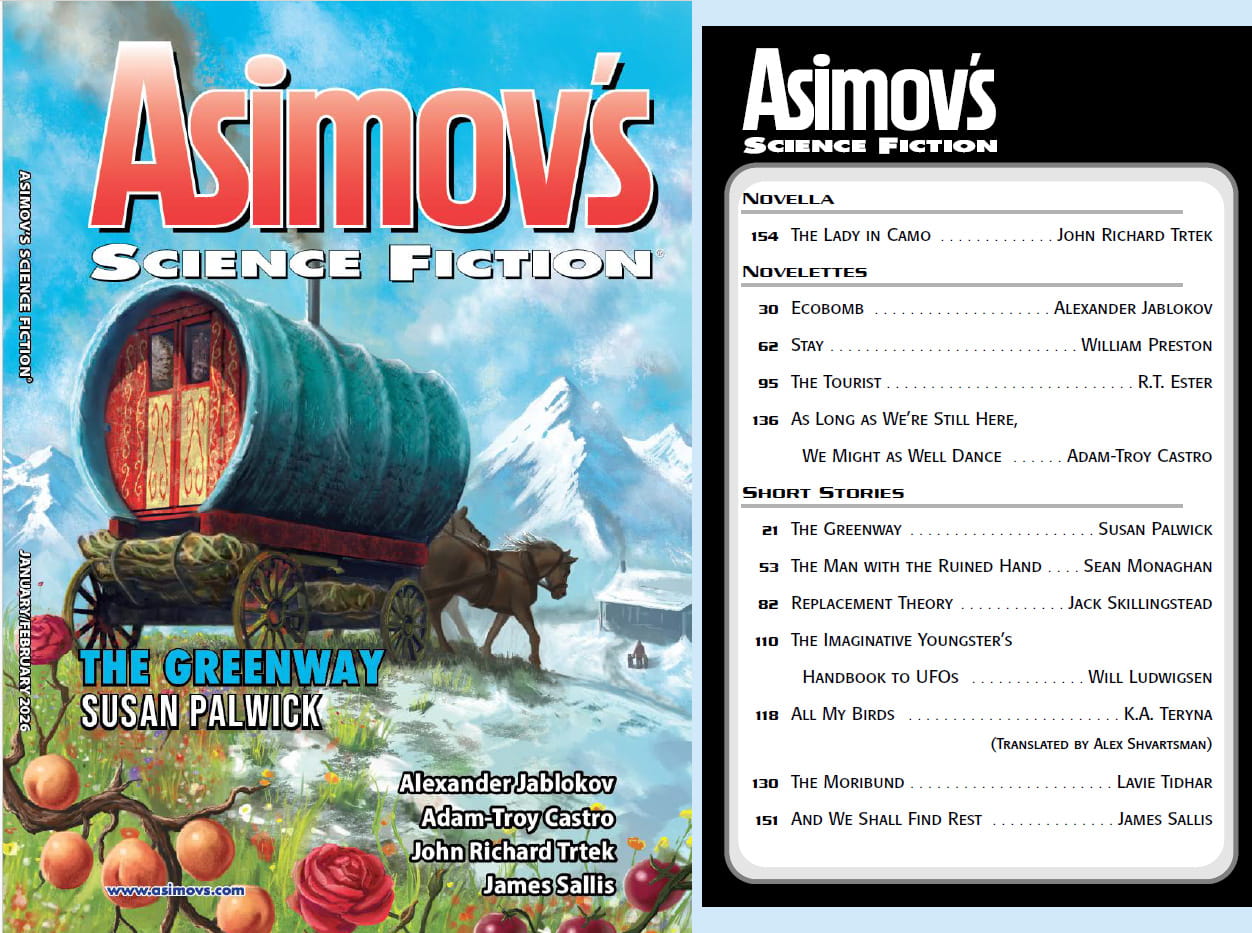
Asimov’s Science Fiction
Sheila Williams provides a brief summary of the latest issue of Asimov’s at the website.
We have a lively bunch of stories in our January/February 2026 issue! John Richard Trtek’s novella teems with intrigue, deceit, danger, and the mystery of “The Lady in Camo,” while Alexander Jablokov’s novelette, “Ecobomb,” is a tense yet often amusing tale about the unanticipated consequences of an alien invasion!
William Preston tells a moving story about a dying man, his sister, his robot double, and his best friend in “Stay”; James Sallis’s characters calmly face alien visitors and the death of half of humanity in “And We Will Find Rest”; in his first sale to Asimov’s, R.T. Ester tells a complicated tale about “The Tourist”; also new to Asimov’s, well-known author Adam-Troy Castro’s characters enjoy a final day of freedom in “As long as We’re Still Here, We Might as Well Dance”; some young men experience serious breakdowns in Jack Skillingstead’s “Replacement Theory”; a woman faces an unusual condition in K.A. Teryna’s lovely story about “All My Birds” (this tale was translated from Russian by Alex Shvartsman); another woman faces mysterious strangers and an illness along “The Greenway” in Susan Palwick’s new story; Sean Monaghan reveals why you shouldn’t trust “The Man with the Ruined Hand”; a woman copes with an extreme fetish in “The Moribund” by Lavie Tidhar; and Will Ludwigsen charms us with “The Imaginative Youngster’s Handbook to UFOs.”
Robert Silverberg’s Reflections considers: “The Multiplicity of Mermaids”; James Patrick Kelly’s On the Net looks at AI audio and says, “Welcome to Just Okay”; Kelly Jennings’s On Books reviews works by Mary Soon Lee, Ray Nayler, Chuck Tingle, Charlie Jane Anders, and others; Kelly Lagor’s Thought Experiment shines a light on “Bradbury and Truffaut’s Empathy in Fahrenheit 451”; plus we’ll have an array of poetry, our yearly Index, and our 40th Annual Readers’ Award ballot!
You’ll find our January/February 2026 issue on sale at newsstands on December 8, 2025. Or subscribe to Asimov’s—in paper format or our own downloadable varieties — by visiting us online at www.asimovs.com. We’re also available individually or by subscription via Amazon.com’s Kindle Unlimited, BarnesandNoble.com’s Nook, and Magzter.com/magazines!
Here’s the complete Table of Contents.
Novella
“The Lady in Camo” by John Richard Trtek
Novelettes
“Ecobomb” by Alexander Jablokov
“Stay” by William Preston
“The Tourist” by R.T. Ester
“As Long as We’re Still Here, We Might as Well Dance” by Adam-Troy Castro
Short Stories
“The Greenway” by Susan Palwick
“The Man with the Ruined Hand” by Sean Monaghan
“Replacement Theory” by Jack Skillingstead
“The Imaginative Youngster’s Handbook to UFOs” by Will Ludwigsen
“All My Birds” by K.A. Teryna (Translated by Alex Shvartsman)
“The Moribund” by Lavie Tidhar
“And We Shall Find Rest” by James Sallis
Poetry
Monster by Megan Branning
The Freetown Bar and Bookstore by M.C. Childs
Thirty-Six Views of the Milky Way by Connor Yeck
Closing Time by Brian U. Garrison
Humans Make Anything Their Pets by Dawn Vogel
Departments
Editorial: WorldCon Extraganza by Sheila Williams
Reflections: The Multiplicity of Mermaids by Robert Silverberg
On the Net: Welcome to Just Okay by James Patrick Kelly
Thought Experiment: Bradbury and Truffaut’s Empathy in Fahrenheit 451 by Kelly Lagor
2025 Index
Asimov’s Readers’ Awards Ballot
On Books by Kelly Jennings
Next Issue
Analog, Asimov’s Science Fiction and The Magazine of Fantasy & Science Fiction are available wherever magazines are sold, and at various online outlets. Buy single issues and subscriptions at the links below.
Asimov’s Science Fiction (208 pages, $9.99 per issue, one year sub $57.75 in the US) — edited by Sheila Williams
Analog Science Fiction and Fact (208 pages, $10.99 per issue, one year sub $57.75 in the US) — edited by Trevor Quachri
The Magazine of Fantasy & Science Fiction (208 pages, $12.99 per issue, one year sub $46.95 in the US) — edited by Sheree Renée Thomas
The January-February issues of Asimov’s and Analog are officially on sale until mid-February, but since that was almost two months ago and the magazines are still on sale, I suspect they’ll be on shelves a little longer than that. No word on when to expect the next F&SF, but let’s say 2027 to be on the safe side.
See our coverage of the November-December 2025 issues here, and all our recent magazine coverage here.