Guns or Butter? Race for the Galaxy by Tom Lehmann
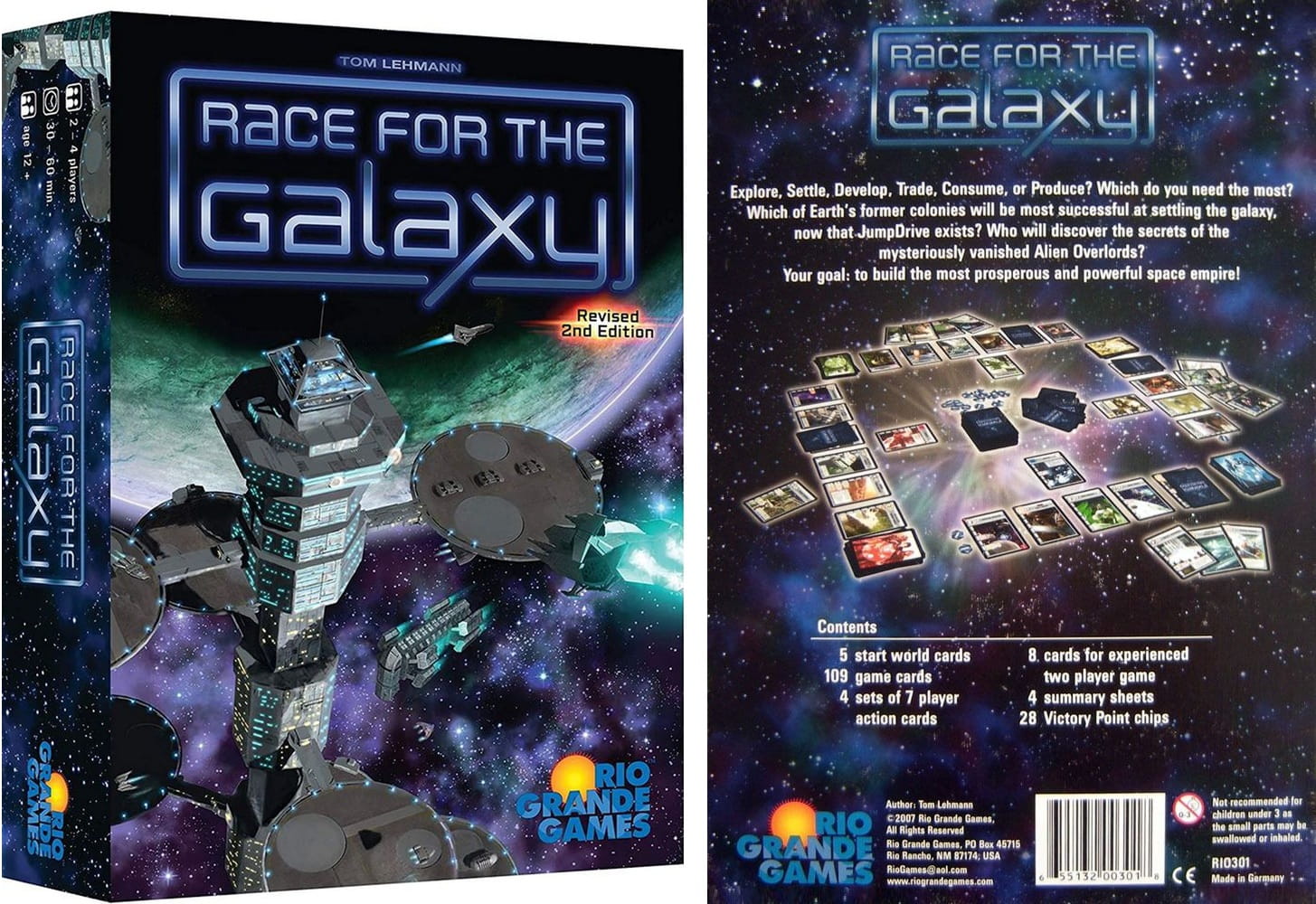
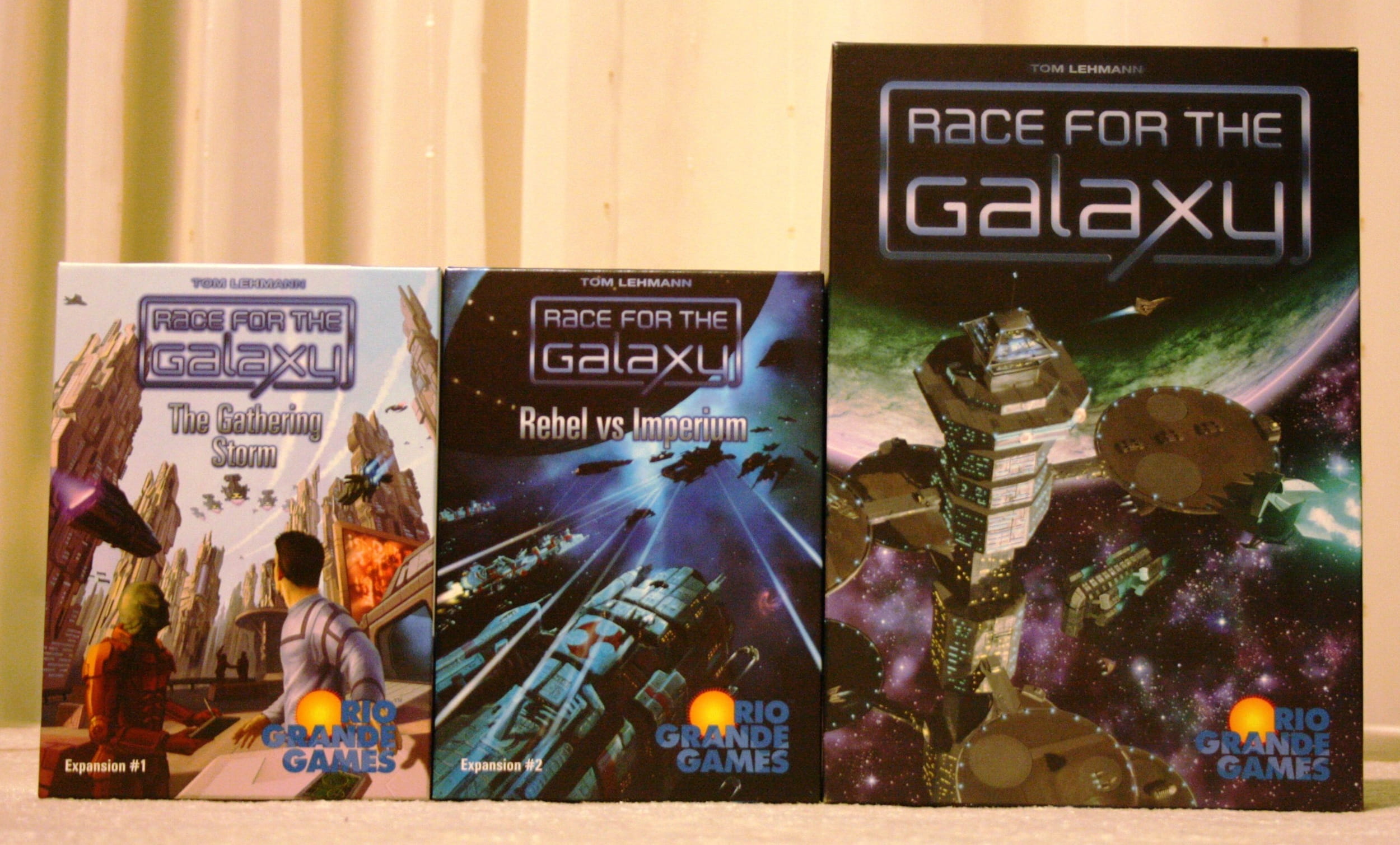
Race For the Galaxy, Revised 2nd Edition, by Tom Lehmann (Rio Grande Games, 2007)
As I mentioned in my review of Terraforming Mars, Race for the Galaxy is one of my long-time favorite games. Its play models the expansion of up to four interstellar civilizations, each from one of five possible starting points: Old Earth, Epsilon Eridani, Alpha Centauri, New Sparta, and Earth’s Lost Colony. Development is represented abstractly, with nothing that represents physical variables, population, or any other real quantity; the idea is to come up with the right combinations of capabilities.
This is a card game, not a board game. There’s no predefined space for play to happen in. Rather, each player creates their own space by the play of their cards into a “tableau.”

When any player’s tableau gets up to twelve cards, the game ends and players’ scores are determined. Scores are represented by the only other game components: victory point counters. Players can acquire victory points in the course of play, but the decisive scores are determined at the end, based on what’s in each player’s tableau.
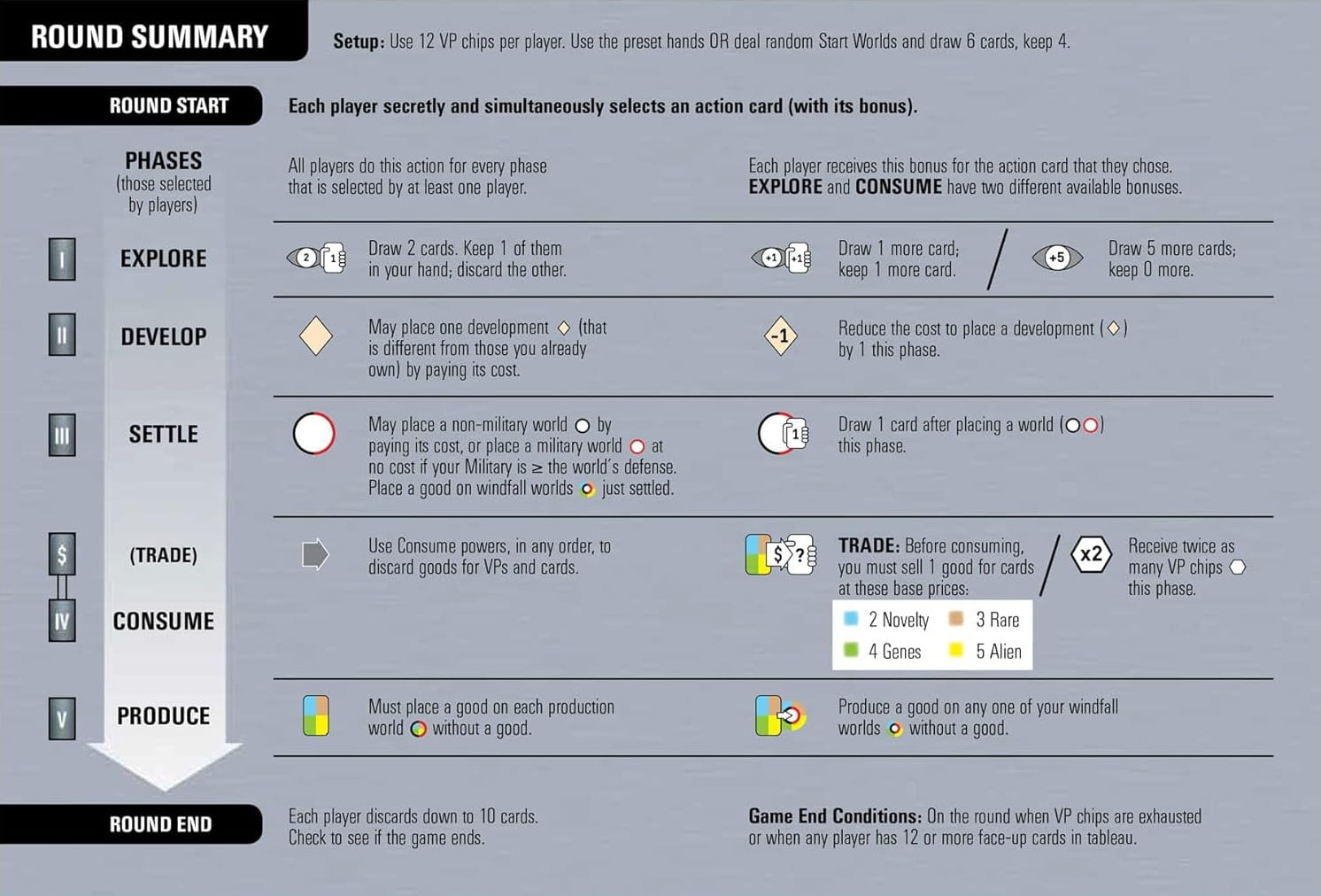
The rules are a bit complex, but I was able to summarize them in a few minutes. And the game comes with helpful large cards that have “round summary” on one side and “card summary” on the other, one for each player.
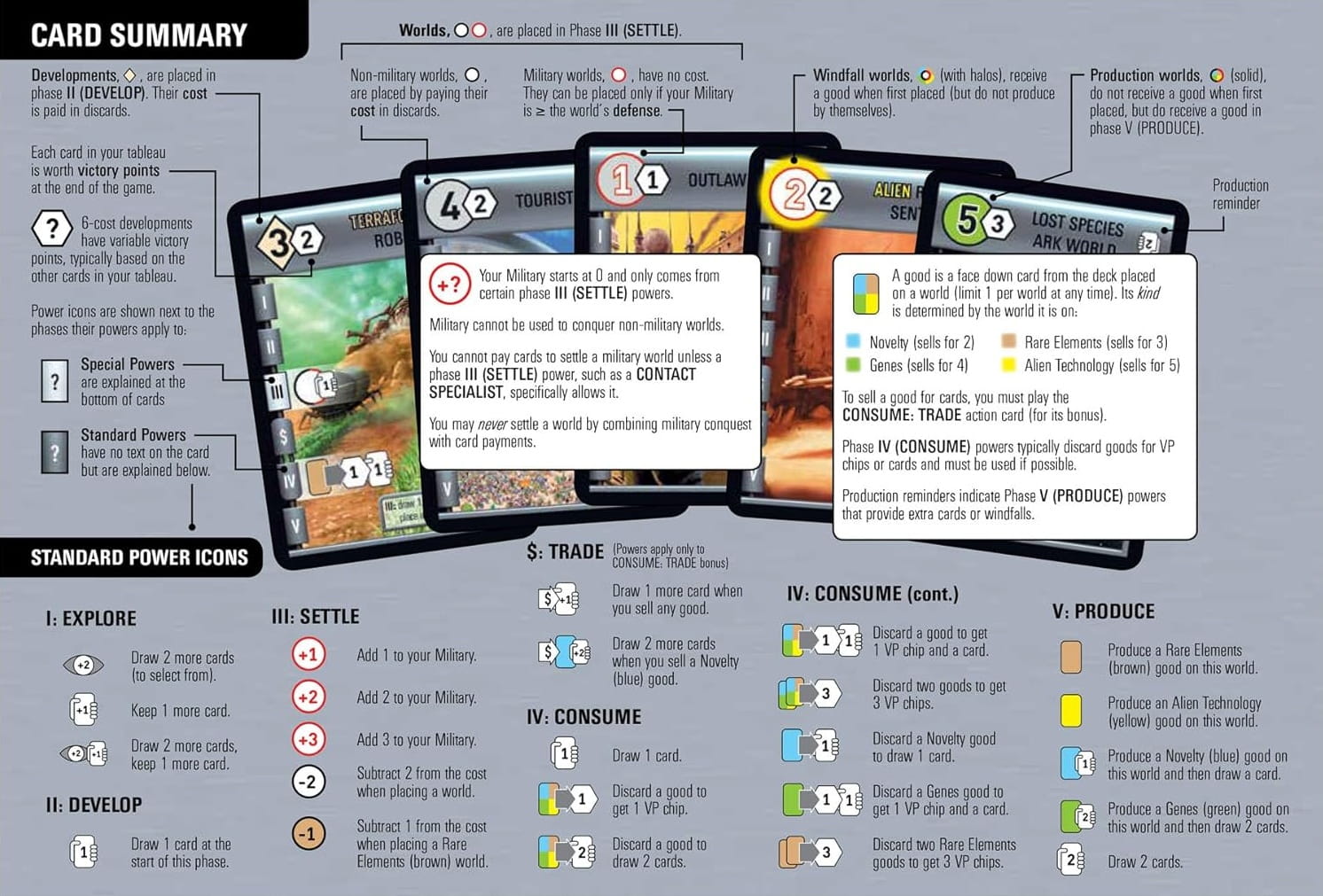
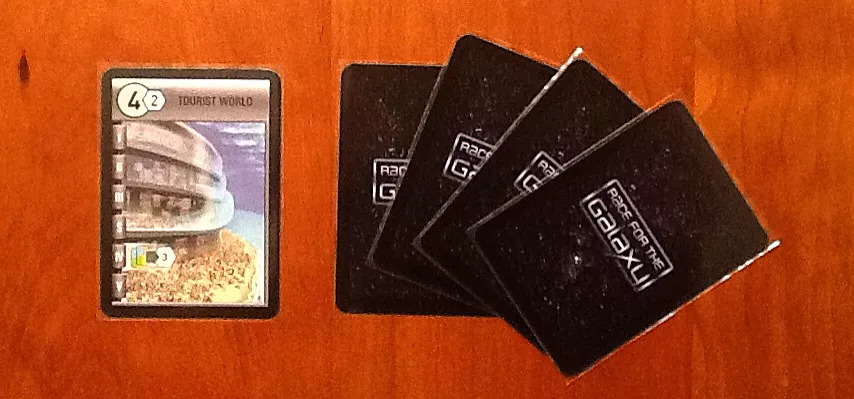
Race for the Galaxy has an ingenious design where cards serve multiple functions. Played face up onto a tableau, they can represent either worlds added to one’s galactic civilization, or technological or social advances achieved by it (“developments”). Discarded face down, they represent a price that must be paid to put a world or a development into play.
Played face down onto a world card, they represent its economic output (one of novelty goods, rare elements, genes, or alien technology), which can later be discarded to gain victory points and/or more cards in the player’s hand.
Since each turn ends with reducing hands to no more than ten cards, players have to economize carefully in putting worlds or developments into play: Cards with lower payoffs may be better discarded to pay for activating cards with higher payoffs.
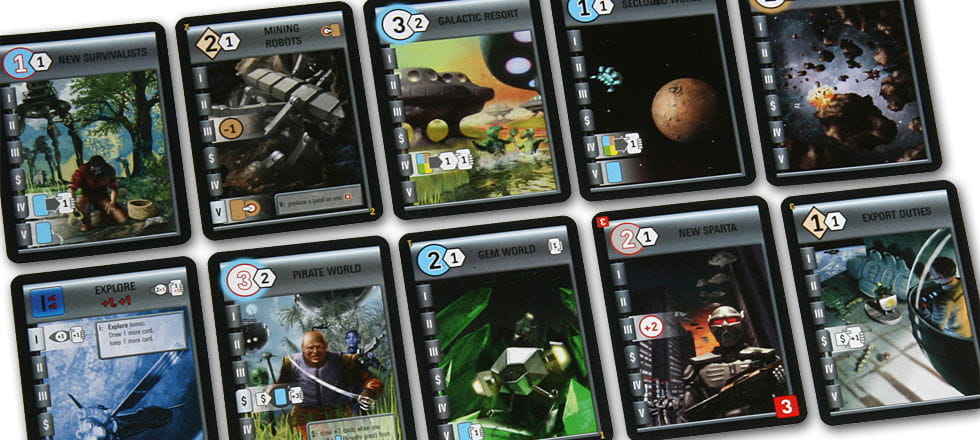
A lot of the play of a hand is thinking about what combinations of cards will give the most useful results, based on the goods worlds can produce and the powers that worlds or developments may provide. For example, a tableau with worlds that produce rare elements invites playing cards that allow trading in rare elements, or that make it cheaper to add a rare element world to a tableau, or that score victory points at the end for having rare element worlds in the tableau — and so a player can develop a kind of theme where those specific cards have high value.
There’s a higher-level strategic choice behind all of this: There are two ways to add worlds to a tableau. The economic route involves spending cards from a hand: “buying” the world, or symbolically, colonizing it. The military route doesn’t require such an expenditure. Instead, the military power ratings for all the worlds in the tableau are added up and compared with the stated military power to conquer a world.
So players choose to act either as builders or as conquerors (the proverbial “guns or butter”). I have to confess both to a philosophical bias toward the economic route, and to finding the combinatorics it’s based on more interesting; when I introduced a friend to the game recently, I intentionally chose to play a military world and follow a military strategy, as an informal handicap — which seems to have worked, as he beat me handily in that first game!
The thing that’s largely missing in Race for the Galaxy is player interaction. There’s not much players can do either to help each other or to hurt each other! (My wife doesn’t much enjoy it as a game because of that design feature; she prefers more social games — for example, the elaborate trading in Settlers of Catan.) Play is, literally, a race: Who can build or conquer faster?
Watching other players has mostly indirect effects. First, there are five actions that can be taken in a turn: Explore (adding new cards to a hand), Develop (playing developments onto a tableau), Settle (playing worlds onto a tableau), Consume (exchanging goods for victory points and/or additional cards), and Produce (having one or more worlds add new goods). But they don’t all happen in a turn! Each player selects one action that will benefit them.
So it’s sometimes possible to say, “Fred’s low on cards, he needs to explore, so I don’t have to select Explore.” Second, if another player is getting close to having a dozen cards in their tableau, that’s a signal to go for quick payoffs in play, and disregard long-term tactics that probably won’t be completed. I’m not sure yet how much of a difference that makes, as I hadn’t paid close attention to it in my previous experience with the game.
The absence of direct rivalry aside, Race for the Galaxy seems to have enough complexities so that it’s not for everybody; it feels as if it’s roughly at the level of, say, Terraforming Mars (though play is much faster — my friend and I got through two rounds in less time than one round of Terraforming Mars took us).
This may be partly a reflection of the inherent challenges of economic/technological development games. But it’s a genre that I like a lot, and Race for the Galaxy strikes me as an excellent example of it.
William H. Stoddard is a professional copy editor specializing in scholarly and scientific publications. As a secondary career, he has written more than two dozen books for Steve Jackson Games, starting in 2000 with GURPS Steampunk. He lives in Lawrence, Kansas with his wife, their cat (a ginger tabby), and a hundred shelf feet of books, including large amounts of science fiction, fantasy, and graphic novels.