A Game of Classic Science Fiction: Terraforming Mars by Jacob Fryxelius
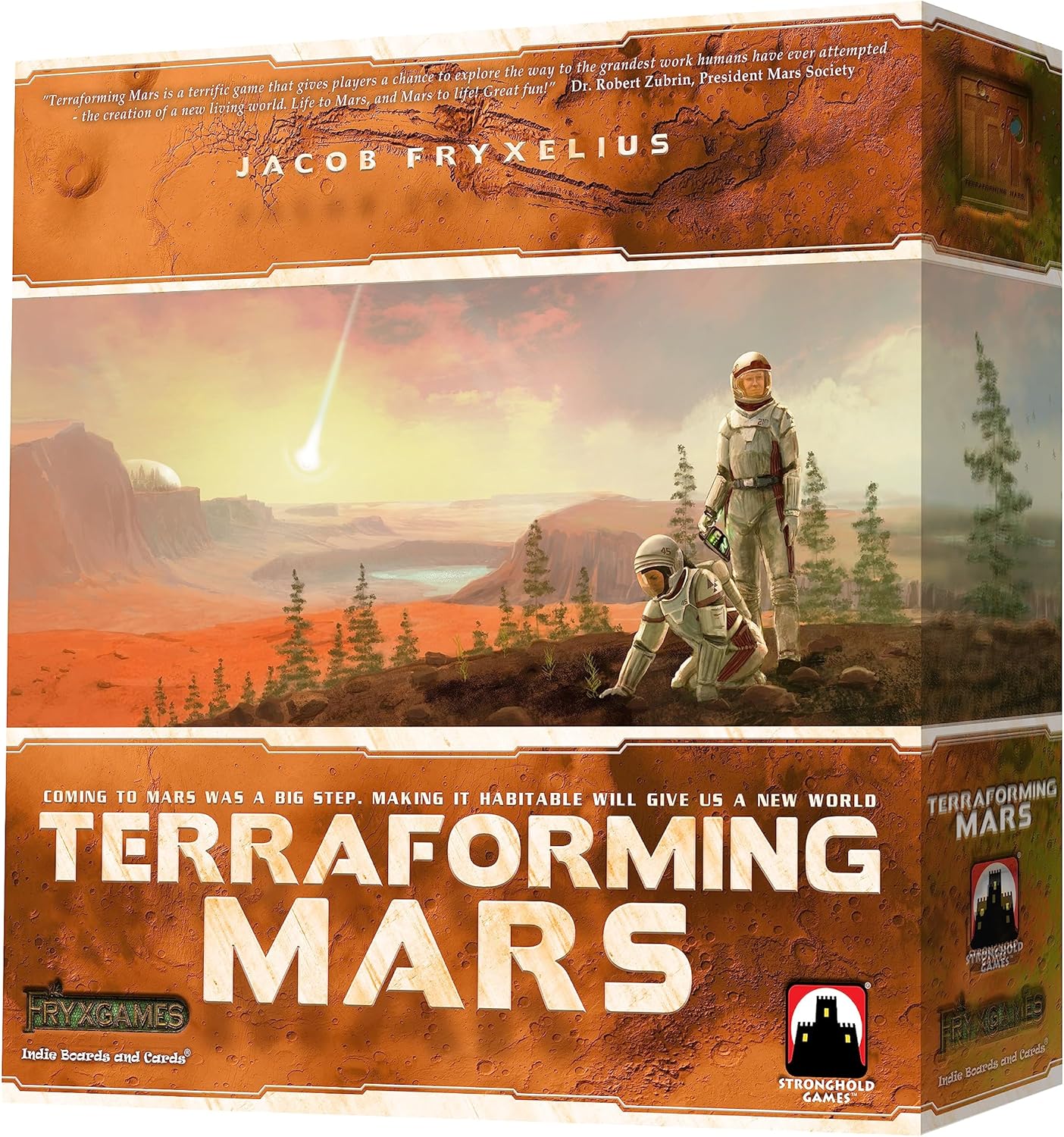
About a year ago, I added Terraforming Mars to my collection of board games, fascinated by the premise. At the very end of the year, a local friend proposed to get together and try playing it. On 2 January, three of us sat down to a first game, using the beginner option of everyone playing a standard corporation and keeping all ten of their initial cards without having to pay for them. Four and a half hours later, we started counting up scores.
Terraforming Mars is a game about economic investment and its returns, like Race for the Galaxy, one of my long-time favorites. The premise is fairly hard science fiction: Several corporations have been granted charters by Earth’s world government to begin — as the title says — terraforming the planet Mars: raising its temperature and oxygen and giving it bodies of water. When these reach specific designated values, the game ends and score is taken. There are no violations of fundamental laws of physics such as faster-than-light travel; the departure, so far as there is one is not qualitative but quantitative, in the rapid progress of terraforming, though in some compensation, play is divided into “generations,” which implies a time scale on the order of centuries.
[Click the images to terraform them.]
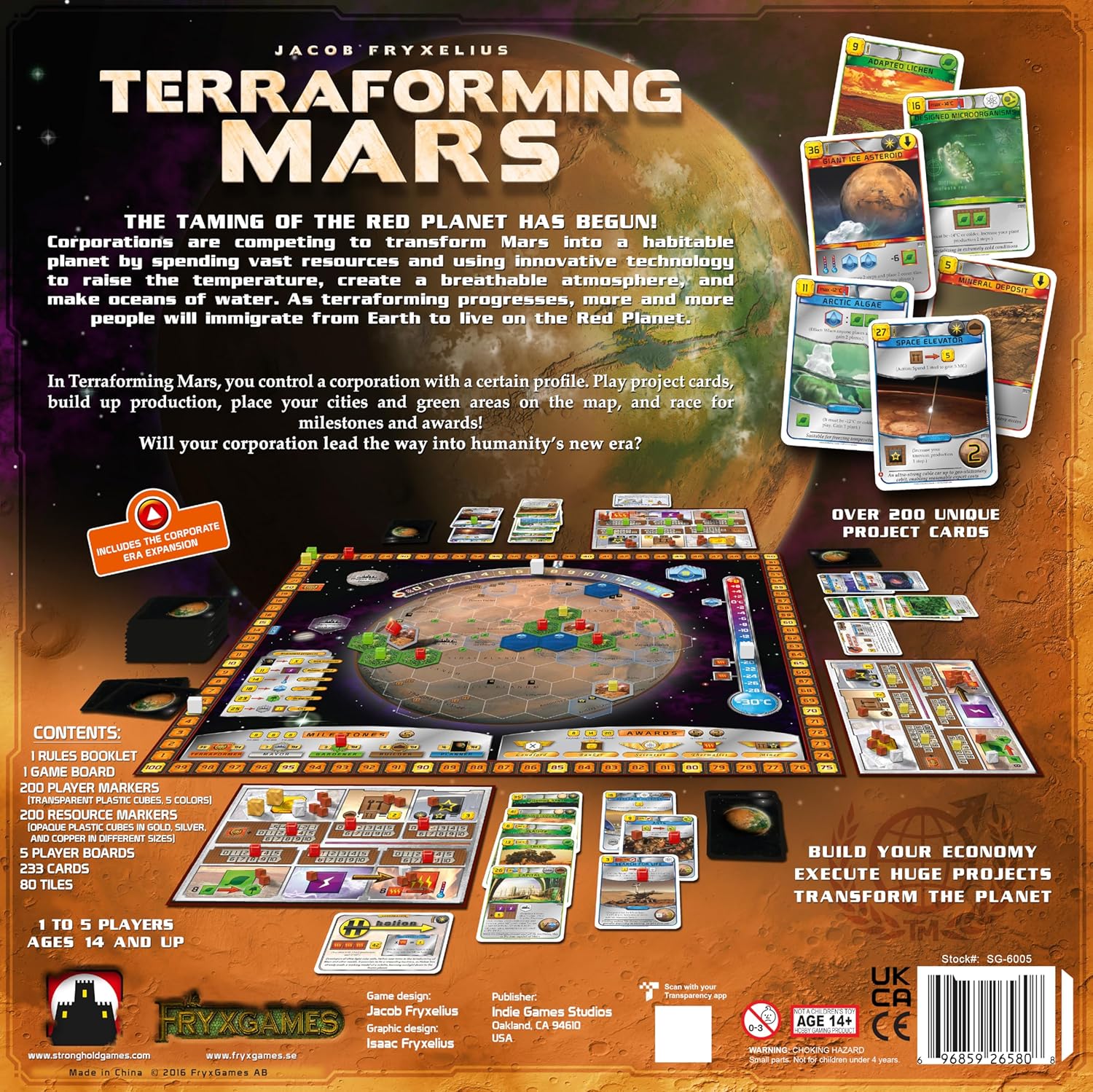
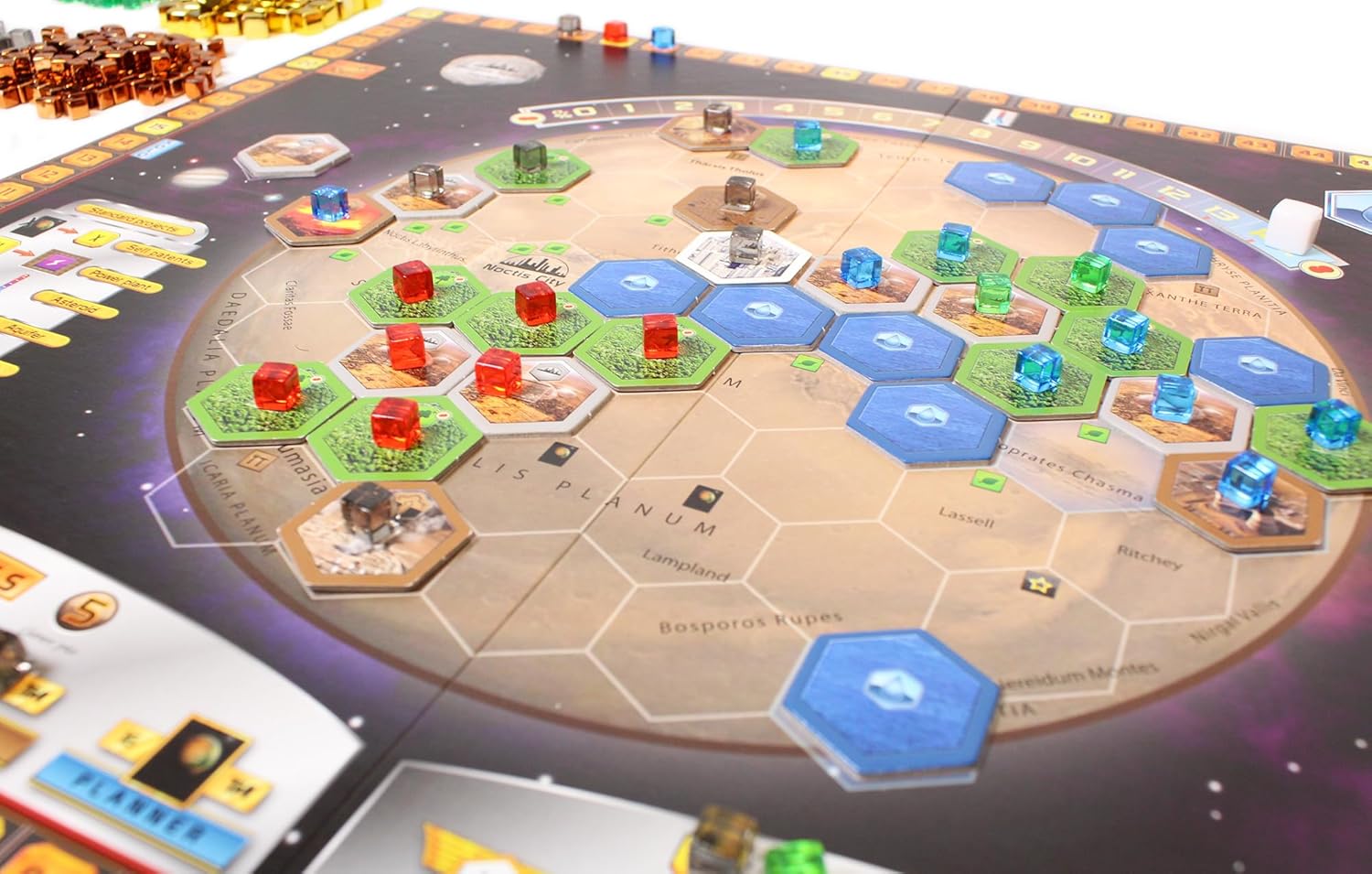
The rule book for the game is 16 pages, but that includes introductory material, illustrations, and several game variants, including a solitaire version. The actual rules are in easily readable type and can be read through in a few minutes. Most of the complexities are strategic and are expressed in the text and graphics of game cards. Along with these cards, each player has a personal game board that keeps track of resources, and players share a larger board that’s a map of one hemisphere of Mars, where tiles can be placed to represent cities, oceans, vegetation, and other special achievements.
The map is also used to keep track of various scores and accomplishments. Reading the map is a little complicated, like watching the screen for character status in a computer game; on this first session we took a while to figure out some of its sections. But I think it can become familiar quickly.
In a way comparable to Race for the Galaxy, each generation in Terraforming Mars is divided into phases. A generation begins with each corporation receiving four cards from a deck, which represent newly acquired capabilities if the player wants to pay for them (“‘Take what you like,’ said God; ‘take it, and pay for it.'”) After that, players perform various actions, many but not all enabled by the cards, and some of which add tiles to the large board. Spatial arrangement of tiles is important and is partly restricted by the game rules.
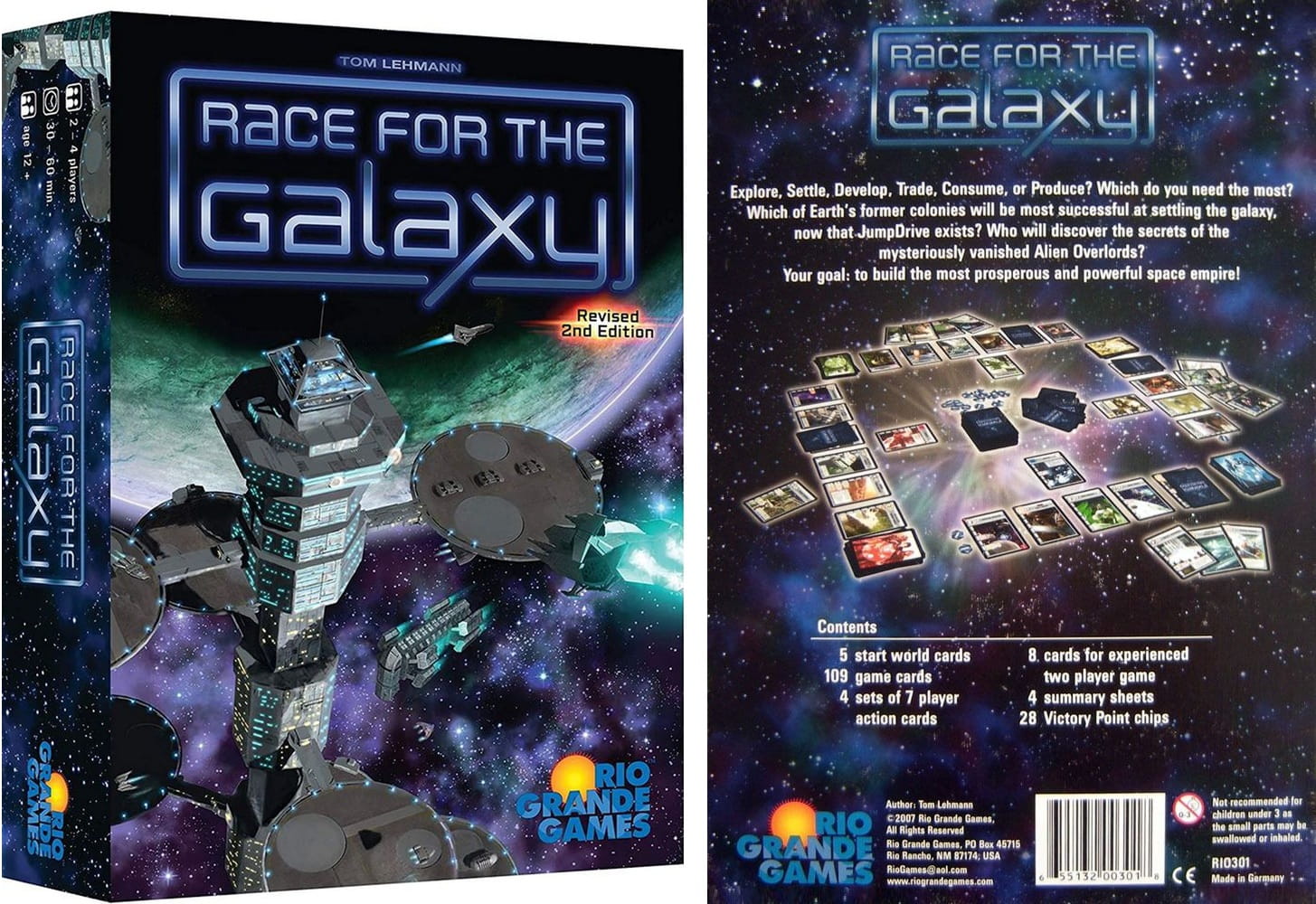
Race For the Galaxy by Tom Lehmann (Rio Grande Games, 2007)
Some cards are used up by one action; some are kept and displayed in front of the player, and some of these can be used for a new action in each generation. All of this costs credits, and sometimes other resources! At the end of the generation, players engage in “production,” which provides more credits (based partly on their terraforming scores) and sometimes other resources that can be used to advance terraforming, directly or indirectly.
One thing that’s largely omitted from the game is violent conflict; most of the time, the various corporations are competing in an enterprise that theoretically benefits all of them (moving them toward a fully terraformed planet). There are a few moves that advance one player while imposing costs on another. An economist would call these “externalities”; a historian might call them “acts of war.” But as with, for example, Settlers of Catan (another European game), players have the option either of cutthroat competition or of deciding that that makes playing the game less fun, and avoiding it.
One of the three of us found the game rules a bit too complicated and hard to follow, so this may not be a game for everybody. It’s certainly not a casual game! But the other two of us enjoyed it a lot. In The Psychology of Everyday Things (published 1988), Donald O. Norman set out principles for ease of use, and pointed out that well designed games are deliberately a little difficult to “use” successfully (that is, to win); otherwise they become boring when the player solves them. I don’t see Terraforming Mars as likely to become boring.
Many games have an implied story. Sometimes this is very abstract, as with chess (a game about feudal warfare) or bridge (a game about capitalistic competition and cooperation); sometimes a kind of story emerges from the play of the game. (And sometimes, as with Dungeons and Dragons, telling bits of story is an actual move in the game.) Terraforming Mars has a fairly strong story aspect: It tells about how humanity moves out into the solar system and makes other planets humanly livable, in the style of classic science fiction writers (a clever joke in the rule book is to give examples of play with three players named Kim, Stanley, and Robinson!), of recent video series such as For All Mankind, or of the proposals of billionaires.
If you like that premise, or are willing to accept it, you’ll find Terraforming Mars a well thought out representation of a lot of its scientific details. I expect that as we play more games, and move on to using more than the standard starting corporations, we’ll find interesting bits of added flavor in the profiles of other corporations. And I may try playing the solo version when I have a few hours free; it seems likely to be entertaining.
William H. Stoddard is a professional copy editor specializing in scholarly and scientific publications. As a secondary career, he has written more than two dozen books for Steve Jackson Games, starting in 2000 with GURPS Steampunk. He lives in Lawrence, Kansas with his wife, their cat (a ginger tabby), and a hundred shelf feet of books, including large amounts of science fiction, fantasy, and graphic novels. His last piece for Black Gate was a review of Whose Body? by Dorothy Sayers
A friend who is both a cosmologist and a gamer has Terraforming Mars and all of its expansions. It is probably his favorite game, and I do like how the engine-building game fits neatly into its theme. Nothing better than getting a water-bearing comet to crash right on top of your neighbor’s solar farm. Mars!