New Treasures: The Year’s Best Science Fiction: Thirty-First Annual Collection
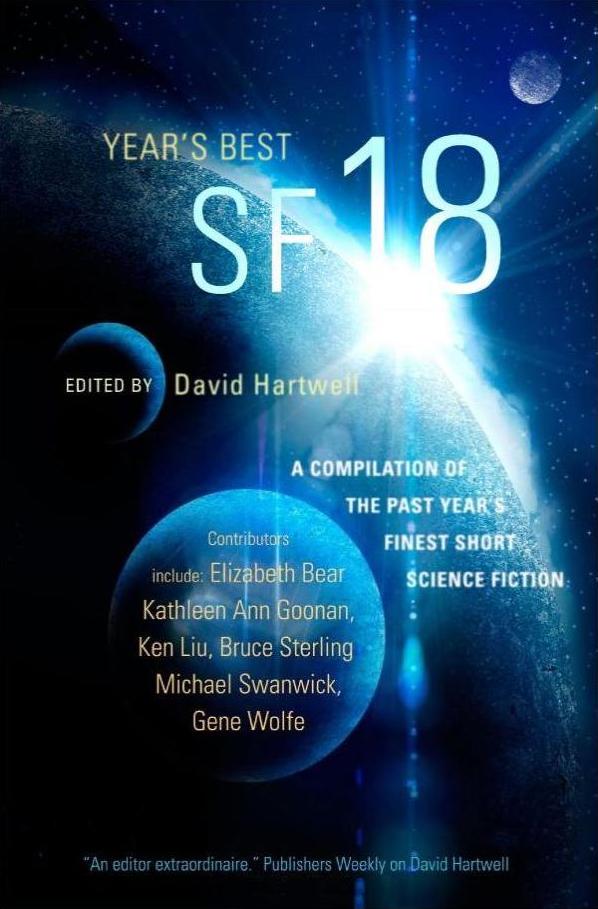
 It’s that time of year again. I’ve been reporting here on the annual crop of Year’s Best SF and Fantasy anthologies as they’ve arrived over the summer — including Rich Horton’s sixth (published in June), the eighth volume from Jonathan Strahan (May), and David Hartwell’s eighteenth volume (December 2013).
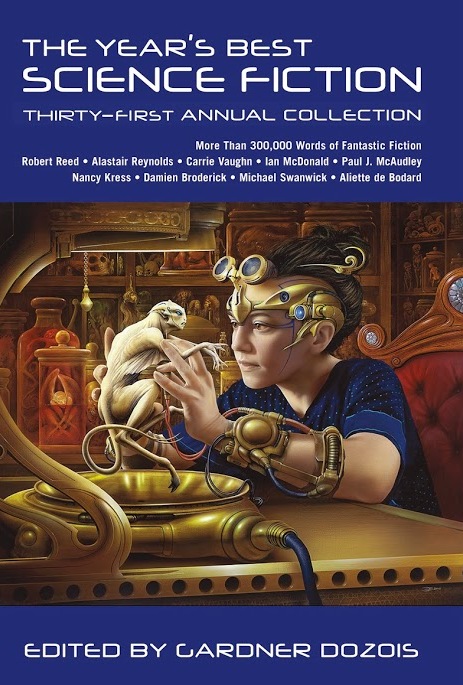
And now at last the great granddaddy of them all arrives: Gardner Dozois’s The Year’s Best Science Fiction: Thirty-First Annual Collection. Arguably the most essential of the lot, it is certainly the most comprehensive and the most irreplaceable. Gardner, the Hugo Award-winning editor of Asimov’s SF for two decades, has been compiling and editing this volume every year without fail since 1984, and his richly detailed annual summation is required reading for anyone who expects to really understand science fiction.
In the new millennium, what secrets lay beyond the far reaches of the universe? What mysteries belie the truths we once held to be self evident? The world of science fiction has long been a porthole into the realities of tomorrow, blurring the line between life and art. Now, in The Year’s Best Science Fiction: Thirty-First Annual Collection the very best SF authors explore ideas of a new world in the year’s best short stories.
This venerable collection brings together award winning authors and masters of the field such as Robert Reed, Alastair Reynolds, Damien Broderick, Elizabeth Bear, Paul McAuley and John Barnes. And with an extensive recommended reading guide and a summation of the year in science fiction, this annual compilation has become the definitive must-read anthology for all science fiction fans and readers interested in breaking into the genre.
The Year’s Best Science Fiction: Thirty-First Annual Collection was published by St. Martin’s Press on July 15. It is 750 pages, priced at $40 in hardcover, $22.99 in trade paperback, and $10.99 for the digital edition. The cover is by Jim Burns.
 There are a couple of things I’ve noticed in my Fantastia experience so far which I haven’t yet mentioned. The first is the general friendliness of people: the ease I’ve had in getting into conversations while in line for a film, or in the theatre waiting for a movie to start. I’ve met other writers, a programming director for a Mexican horror film festival (
 I’m going to do something a little different in this instalment of my diary of the Fantasia film festival: I’m going to write about two movies in the reverse order from which I saw them. I watched both on Saturday, July 26, and it so happened that the second one struck me as a perfectly fine movie of the sort of movie that it was, while the first seemed a little bit more.