Future Treasures: Queen of Fire by Anthony Ryan
Future Treasures: Queen of Fire by Anthony Ryan

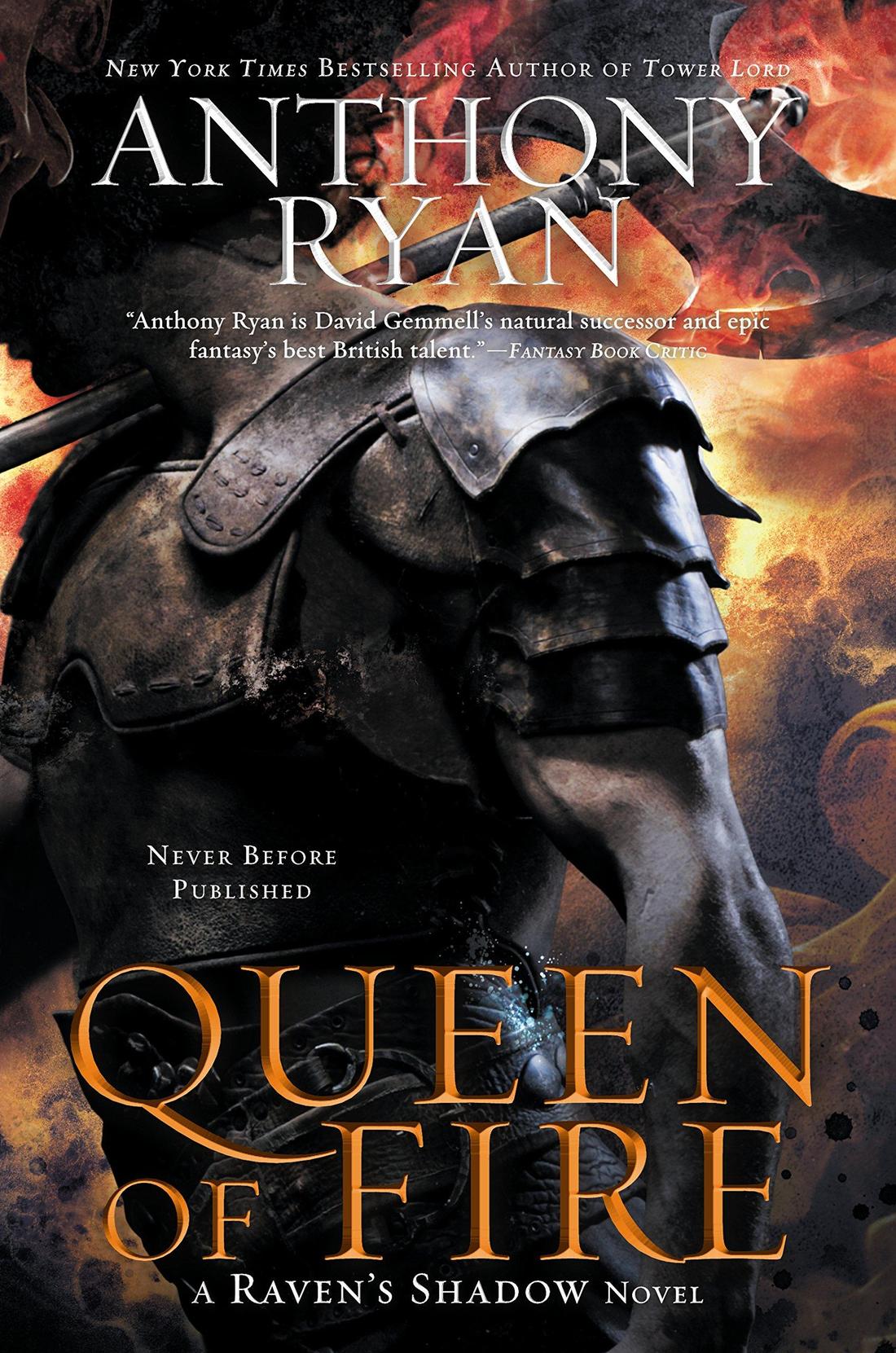
Queen of Fire Anthony Ryan-smallI first took notice of Anthony Ryan with the publication of Tower Lord (2014), the second volume in the New York Times bestselling Raven’s Shadow trilogy (why do I always discover series with the second volume?) The series began with Blood Song (2013); by the second book, Ryan was being called “David Gemmell’s natural successor.” In the final volume, Vaelin Al Sorna must help his Queen reclaim her Realm — despite the fact that his enemy has found a dangerous new collaborator, one with powers darker than Vaelin has ever encountered…

“The Ally is there, but only ever as a shadow, unexplained catastrophe or murder committed at the behest of a dark vengeful spirit. Sorting truth from myth is often a fruitless task.”

After fighting back from the brink of death, Queen Lyrna is determined to repel the invading Volarian army and regain the independence of the Unified Realm. Except, to accomplish her goals, she must do more than rally her loyal supporters. She must align herself with forces she once found repugnant — those who possess the strange and varied gifts of the Dark — and take the war to her enemy’s doorstep.

Victory rests on the shoulders of Vaelin Al Sorna, now named Battle Lord of the Realm. However, his path is riddled with difficulties. For the Volarian enemy has a new weapon on their side, one that Vaelin must destroy if the Realm is to prevail — a mysterious Ally with the ability to grant unnaturally long life to her servants. And defeating one who cannot be killed is a nearly impossible feat, especially when Vaelin’s blood-song, the mystical power which has made him the epic fighter he is, has gone ominously silent…

Queen of Fire will be published by Ace Books on July 7, 2015. It is 642 pages, priced at $28.95 in hardcover, and $14.99 for the digital edition.
Tin House 64 Now Available

Tin House 64 Now Available

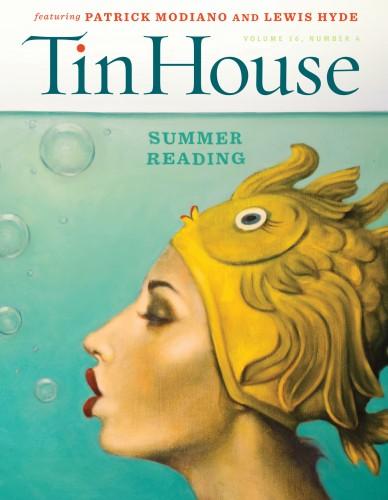
Tin House Magazine 64-smallWe cover exclusively fantasy magazines here at Black Gate… although our definition of “fantasy” can be pretty liberal. From time to time we’ve included science fiction magazines, horror zines, art and game publications, and others. If we think BG readers could conceivably be interested, we’ll give it a look.

Last week, more or less on a whim, I laid down $12.95 for the big Summer Reading issue of Tin House. Tin House is an American literary magazine, showcasing fiction and poetry from new and established writers. The magazine was founded in 1999, and has published fiction by Stephen King, Kelly Link, Jonathan Lethem, David Foster Wallace, Aimee Bender, Richard Ford, Donna Tartt, and many others. The Summer Reading issue is huge — 224 pages — and filled with fiction. In his Editor’s Note, Rob Spillman gives us a sneak peek at the contents.

For this issue, five New Voices caught our eye… We admired the confidence and precision of the prose in the short stories of Sarah Elaine Smith and Matthew Socia — Smith’s “Pink Lotion” following a problematic addiction recovery, Socia’s “American Tramplings” being the tale of a stampede epidemic. While discovering emerging writers is always a thrill, it is a different excitement reading the work of masters who are in full command of their powers. For readers unfamiliar with the latest Nobel Laureate, Patrick Modiano, his “Page-a-Day” (beautifully translated from the French by Edward Gauvin) is an ideal introduction, wherein the author explores his favorite subject — Paris — and obsesses on time, memory, and the legacy of World War II. In “Forgetting Mississippi,” Lewis Hyde revisits the brutal 1964 murder of two young black men. Hyde, who was a civil rights activist at the time, not only puts the crime in context but also does the seemingly impossible — searches for forgiveness.

Read More Read More

Faces of Iraq

Faces of Iraq

Proud dad in Nasiriyah

The Iraqis we see in the news almost always fall into three types–The Evil Fundamentalist, The Useless Official, and The Wailing Victim. The media have a hard time dealing with a broad range of characters, so they tend to fall back on these types again and again.

Of course the reality is more complex. While there’s no shortage of bloodshed and corruption, most of Iraq’s 33 million people go about their day-to-day affairs trying to live a normal life.

Back in 2012 I traveled to Iraq to write about it for the now-moribund travel blog Gadling. Click the link to read the series. Sadly, the photo galleries have been taken offline, but you can still read the articles for the moment.

Read More Read More

New Treasures: Mermaids and Other Mysteries of the Deep, edited by Paula Guran

New Treasures: Mermaids and Other Mysteries of the Deep, edited by Paula Guran

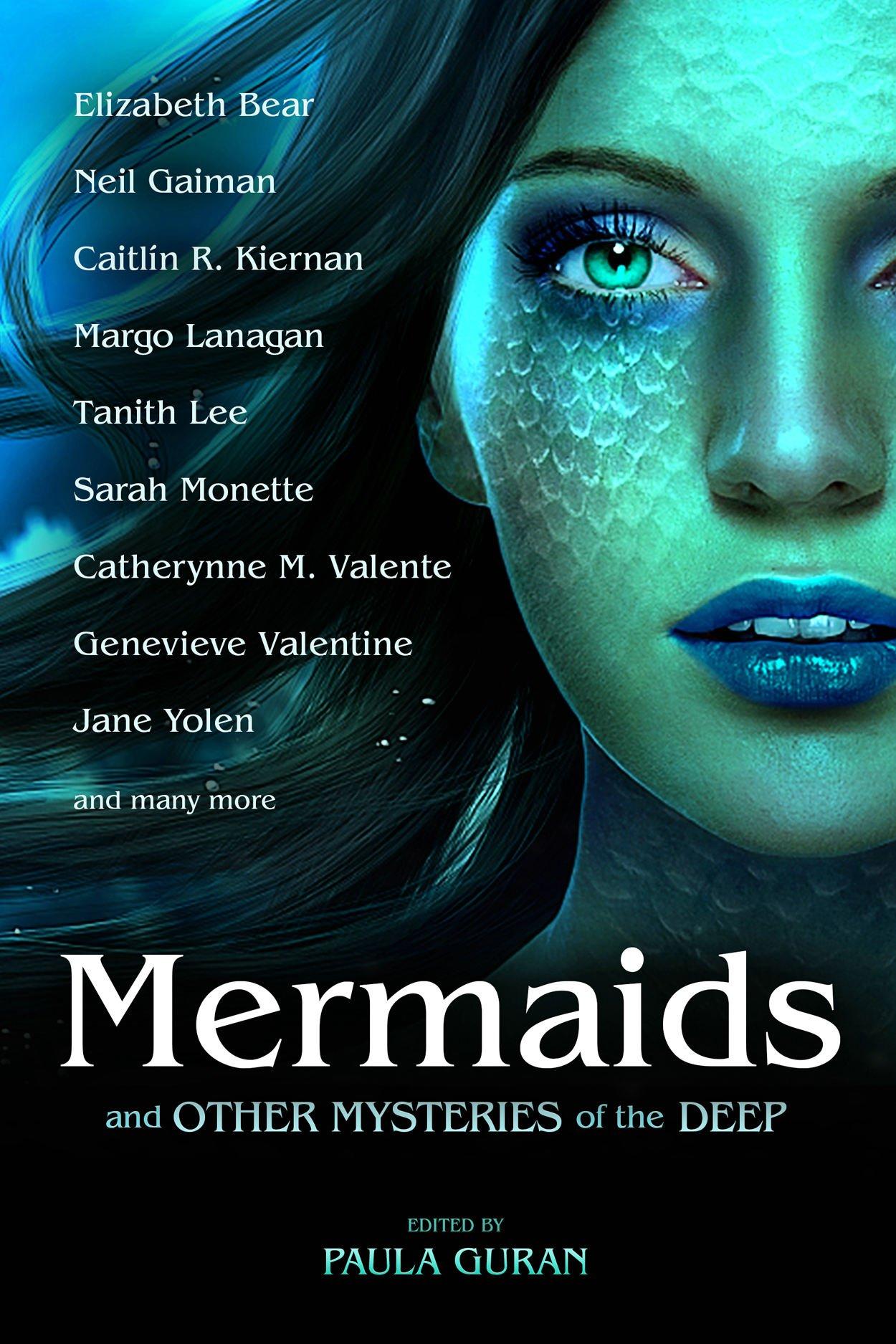
Mermaids and Other Mysteries of the Deep-smallPaula Guran edits The Year’s Best Dark Fantasy & Horror every year, and her most recent anthology was Blood Sisters, packed full of vampire stories by women. So it’s good to see her deliver something outside the horror genre… or, perhaps, it’s good to see her keen eye for dark fantasy brought to bear on a subgenre that’s usually associated with The Little Mermaid. 

In Mermaids and Other Mysteries of the Deep, Paula has assembled a wide range of fiction by Tanith Lee, Peter S. Beagle, Samuel R. Delany, Neil Gaiman, Delia Sherman, Gene Wolfe, and others. Here’s a brief snippet from her introduction:

Powerful and incomprehensible, the oceans were thought to be the home of many monstrous creatures — sea serpents and dragons; the Norse Kraken, Greek Charybdis, Japanese Isonade, Biblical Leviathan. Rivers have monsters, too, like the Yacumama of the Amazon River or the malevolent zin, who live in the Niger River. As for lakes, even if you’ve never heard of the Welsh afanc, you know the Scottish Loch Ness monster.

The waters of the world were also believed to contain mythological creatures whose behaviors were as inconstant as our feelings about the mysteries of the deep. As Jane Yolen has said, “It is the allure of the beautiful, unattainable, mysterious Other. In every culture in every clime, there are stories of such creatures in the oceans, rivers, ponds, wells. Water is such a mutable, magical substance itself, the human imagination simply cannot believe it’s not peopled as the earth is. We want there to be such underwater civilizations and — not finding them — we invent them and then turn around and believe in our own invention.”

Read More Read More

Venture, July 1957: A Retro-Review

Venture, July 1957: A Retro-Review

Venture Science Fiction July 1957-smallI’ve written about Venture before, a short-lived companion to F&SF, first in the late ’50s, then again in the late ’60s to early ’70s. It tried to be a bit more adventure-oriented, and also (at least in its first incarnation) seemed to try to have a sexier image.

The feature list is pretty thin – most significant is the first book review column by Theodore Sturgeon, whom the editor proudly introduces as “the discoverer and distinguished proponent of that basic maxim known as “Sturgeon’s Law.” He reviews only one book, Martin Greenberg’s collection of non-fiction of SF interest, Coming Attractions. The inside back cover has a feature called “Venturing,” short bio-ish pieces about a few of the issue’s authors (Sturgeon, James Gunn, and “Paul Janvier”). The cover is by Ed Emshwiller (in my opinion, not one of his better efforts), and the interior art is by John Giunta and by Cindy Smith.

The stories are:

“Not So Great an Enemy,” by James E. Gunn (17,500 words)
“And Then She Found Him,” by Paul Janvier (6,900 words)
“Aces Loaded,” by Theodore R. Cogswell (6,500 words)
“The Keeper,” by H. Beam Piper (8,700 words)
“The Education of Tigress McCardle,” by C. M. Kornbluth (3,700 words)
“Seat of Judgment,” by Lester Del Rey (7,700 words)
“The Harvest,” by Tom Godwin (800 words)

Read More Read More

Vintage Treasures: The Black Corridor by Michael Moorcock

Vintage Treasures: The Black Corridor by Michael Moorcock

The Black Corridor Michael Moorcock-smallLast week I purchased a small collection of vintage paperbacks (something I do a lot). I bought it chiefly because it was inexpensive, all the books were in terrific shape… and it had a Michael Moorcock paperback I’d never seen before.

The Moorcock was The Black Corridor, an Ace Science Fiction Special, written in collaboration with Moorcock’s then-wife, Hilary Bailey (author of Frankenstein’s Bride and Fifty-First State.) The Ace Science Fiction Specials are highly prized by readers and collectors alike. They were edited by Terry Carr, and included first editions of Ursula K. Le Guin’s The Left Hand of Darkness, Alexei Panshin’s Rite of Passage, John Brunner’s The Jagged Orbit and The Traveler in Black, and William Gibson’s Neuromancer, among many others.

The Black Corridor is something of an odd bird. It wasn’t as successful or acclaimed as many of the other Ace Specials, and in fact it has never been reprinted in paperback in the US. But it does have its admirers. It was cited by Karl Edward Wagner as one of the thirteen best science-fiction horror novels, and Harlan Ellison said “Saying I enjoyed this book would be damning with faint praise… I was surprised by this book, at least eleven times.” Although it was never reprinted in paperback in the US, it was included as part of the omnibus collection Sailing to Utopia, The Tale of the Eternal Champion #5, published by Millennium (UK) and White Wolf (US), alongside The Ice Schooner, The Distant Suns, and the novelette “Flux.”

The Black Corridor is based on an incomplete fragment of a thriller written by Bailey, which Moorcock called “a straight future disaster story – collapse of society stuff.” Moorcock substantially re-drafted it, setting the bulk of the book in interstellar space, to tell a tale of an Earth collapsing into anarchy and war, and the starship and crew that flee into space. The book is fairly experimental, even for Moorcock. It contains sequences of typographical art where, as Moorcock put it, “words create a pattern of other letters forming other words,” and the narrative is enhanced with entries for the spaceship’s log, dream sequences, and computer printouts straight out of the 1960s.

The Black Corridor was published by Ace Books in 1969. It is 187 pages, priced at 75 cents. The cover is by Leo Dillon and Diane Dillon. There is no digital edition.

Sarah Avery Nominated for 2015 Mythopoeic Award for Tales from Rugosa Coven

Sarah Avery Nominated for 2015 Mythopoeic Award for Tales from Rugosa Coven

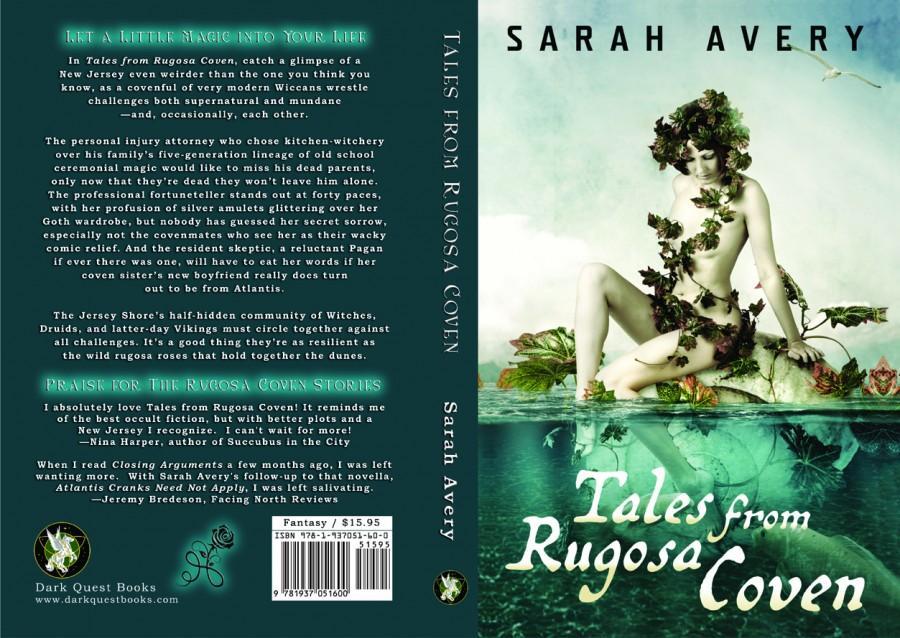
tales-from-rugosa-coven-Avery-smallBlack Gate blogger Sarah Avery has been nominated for the 2015 Mythopoeic Award for her novel Tales from Rugosa Coven, published in 2013 by Dark Quest.

The Mythopoeic Fantasy Award for Adult Literature is given to the fantasy novel, series, or collection for adults published during the previous year that best exemplifies “the spirit of the Inklings,” the Oxford literary discussion group that included J. R. R. Tolkien and C. S. Lewis. The winners will be announced during Mythcon 46, held July 31 – August 3, 2015, in Colorado Springs, Colorado. Congratulations to Sarah, and all the nominees!

Sarah’s short story “The War of the Wheat Berry Year,” a slender and deceptively simple fantasy featuring The Traitor of Imlen, was published in Black Gate 15. The complete list of nominees for the 2015 Mythopoeic Awards follows.

Mythopoeic Fantasy Award for Adult Literature

  • Sarah Avery, Tales from Rugosa Coven (Dark Quest)
  • Stephanie Feldman, The Angel of Losses (Ecco)
  • Theodora Goss, Songs for Ophelia (Papaveria Press)
  • Joanne M. Harris, The Gospel of Loki (Gollancz)
  • Joe Hill and Gabriel Rodriguez, Locke & Key series (IDW Publishing)

Read More Read More

May Issue of Swords and Sorcery Magazine Now Available

May Issue of Swords and Sorcery Magazine Now Available

Swords and Sorcery Magazine May 2015-smallIssue 40 of Curtis Ellett’s Swords and Sorcery Magazine, cover-dated May 2015, was published this week. Each issue of Swords and Sorcery contains two short stories, and is available free online. This issue includes new fiction from Christopher Mowder and Anna Sykora, and a discussion of Fritz Leiber’s Fafhrd and the Grey Mouser by Fritz Leiber (strangely called “Fritz Lieber” in the intro) by Rick Hudson.

The Goblin’s Son,” by Christopher Mowder, is the story of a goblin father who must deal with his son going off to war and serving beside old enemies to help create a peace. This is Mowder’s first published short story.

How Pawla Stole the River Livvy,” by Anna Sykora, is an ecological fable and a delightful fantasy. A wild creature helps a village of humans drive off invaders who threaten their homes. Sykora is a prolific writer who has published over a hundred stories and many poems. This is her first appearance in Swords & Sorcery.

Back in Lankhmar Again,” by Rick Hudson, is a discussion of the Fafhrd and the Grey Mouser stories by Fritz Lieber (sic). Hudson is a noted writer of literary fiction, a Senior Lecturer in English Literature at Manchester Metropolitan University. His essay “Return to Hyboria” and story “Wraith-Raker” have recently appeared in Swords & Sorcery.

Read the current issue here.

Swords and Sorcery Magazine is edited by Curtis Ellett, and is available free online. Fletcher Vredenburgh reviewed issue #40 in his May Short Story Roundup. See our June Fantasy Magazine Rack here, and all of our recent Magazine coverage here.

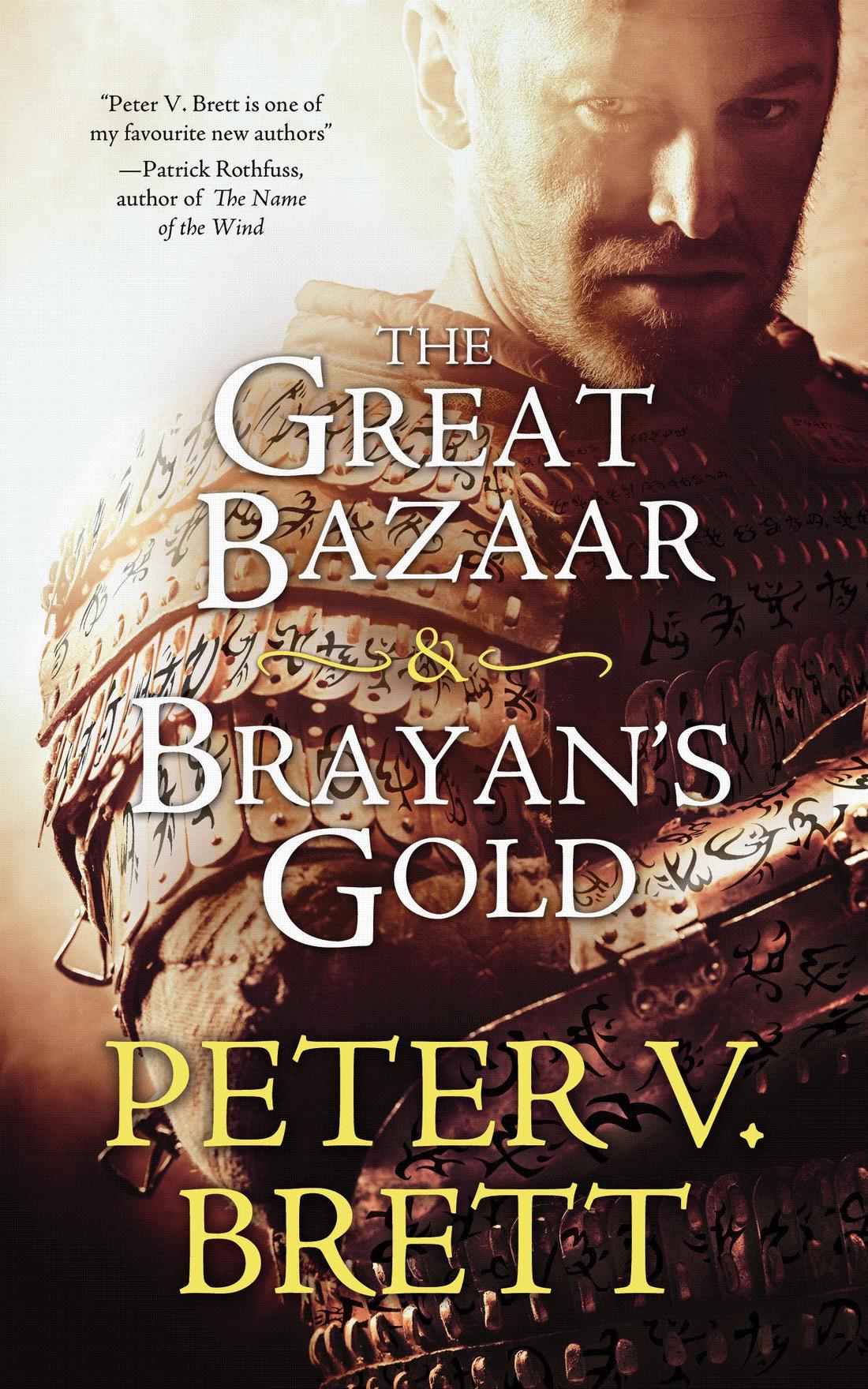
Future Treasures: The Great Bazaar & Brayan’s Gold by Peter V. Brett

Future Treasures: The Great Bazaar & Brayan’s Gold by Peter V. Brett

The Great Bazaar and Brayan's Gold-smallPeter V. Brett’s second novel in the Demon Cycle, The Desert Spear, became an international bestseller, and the next two books in the series made him one of the top-selling authors on the market. So it’s no surprise that The Great Bazaar and Brayan’s Gold, two limited edition novellas from P.S. Publishing, set in the world of the Demon Cycle, and detailing Arlen’s early adventures, have been sold out for years.

Now Tachyon Publications is releasing an omnibus collection of both novellas in a handsome and affordable trade paperback edition. It something no fan of Peter V. Brett will want to miss.

From the dangerous world of the Demon Cycle comes the early adventures of Arlen, Peter V. Brett’s quintessential fantasy hero. These exciting origin tales follow Arlen as he learns to navigate a world where the elemental forces of evil conjure themselves from the earth each night.

Humanity has barely survived a demonic onslaught by using magical wards that protect their cities and homes. Only a handful of mercenaries and explorers risk traveling after the sun sets. Arlen, seeking adventure and fortune, is barely protected by the warded armor upon which he has inscribed intricate defensive runes. From a journey ferrying a wagonload of dynamite to a mountain stronghold, to a dangerous mission to recover desert treasures, Arlen faces friends and enemies with a strong arm and a cunning wit.

We’ve previously covered Peter’s novels The Daylight War and The Skull Throne.

The Great Bazaar & Brayan’s Gold will be published by Tachyon Publications on July 14, 2015. It is 186 pages, priced at $14.95 in trade paperback. There is no digital edition. Cover by Elizabeth Story.