The Public Life of Sherlock Holmes: Solar Pons & Cthulhu?
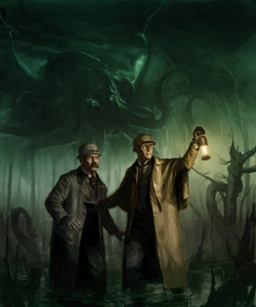 To the extent that August Derleth’s name is famliar to most Black Gaters, it’s in relation to his major role in the Cthulhu Mythos. I’ve read a fair amount of H.P. Lovecraft, but frankly, his stuff creeps me out and I’m not too into those stories: nor the ones by other authors – for the same reason. Of course, I am a devotee of Derleth’s Sherlock Holmes-like Solar Pons tales. Within the Pontine Canon, one can find an emerald thread…
Luther Norris was, is and will certainly remain the foremost Ponsian of them all. In his introduction to The Memoirs of Solar Pons, he points out that Pons has a wider range of interests than Holmes, using the titles of their published monographs as his foundation. Now, we can certainly take issue with Norris’ statement that “Holmes..has little concern for topics not related to his ‘little problems.’”
I do not believe that the polyphonic motets of Lassus had anything to do with one of Holmes’ cases. And it’s quite likely that his monograph on the Chaldean roots in the ancient Cornish language was not work-related. However, the majority of his writings were on topics useful to his career as a consulting detective, so we will agree with Norris in principle.
Norris points to two monographs as examples of Pons’ more varied interests: “An Inquiry into the Nan-Natal Ruins of Ponapae” (1905) and “An Examination of the Cthulhu Cult and Others” (1931). The context of Norris’ discussion implies that these are non work-related topics. It is this point regarding the latter that we are addressing.

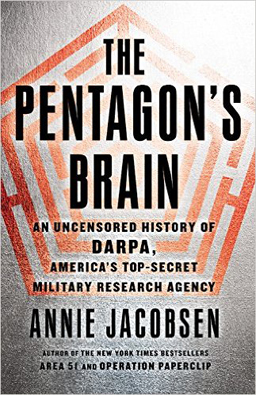 I sat down to read Annie Jacobsen’s 2015 book The Pentagon’s Brain — subtitled An Uncensored History of DARPA, America’s Top Secret Military Research Agency — thinking I’d get a new perspective on the development of the American military-industrial complex. And a new angle on the history of science in the 1950s and 1960s and beyond. Also that I’d learn a bit about the development of the internet, and who the people were who came up with it, and why they did, and what they were thinking. I got all of that. But I also found a new angle on science fiction, and the way SF shapes the world for better or for worse.