Browsed by
Category: Blog Entry

New Treasures: Patrice Sarath’s The Crow God’s Girl
New Treasures: Patrice Sarath’s The Crow God’s Girl

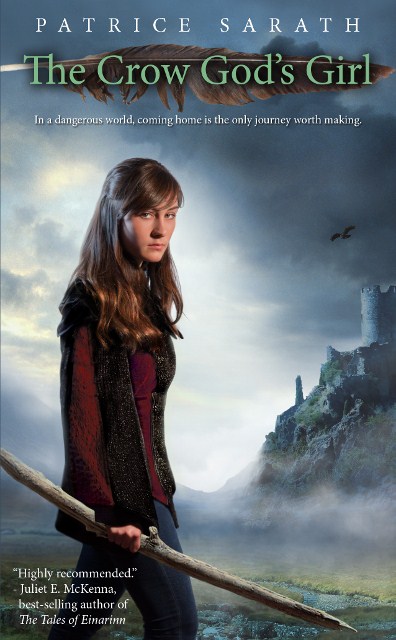
the-crow-gods-girl-patrice-sarathPatrice Sarath has had an enviable career. Her contribution in Black Gate 4, “A Prayer for Captain LaHire,” the tale of three knights and followers of Joan of Arc who discover the horror a fourth disciple has unleashed, was one of the most acclaimed stories from our early years and was reprinted in Year’s Best Fantasy 3 (2003). She edited the anthology Tales From The Secret City in 2007.

She turned to novels in 2008 with Gordath Wood, a book she describes as “hard to categorize:”

It’s fantasy but with only a touch of magic to it. It has romance, but is not a romance (a very different beast). It has a murder-kidnap mystery in it. Basically it has all of the elements of books I like to read. And although everybody has different tastes, I am betting that more than a few of you also like your books the same way I do — shaken and stirred. So if you like fantasy-mystery-romance novels, this one’s for you.

Gordath Wood was well reviewed and spawned a sequel, Red Gold Bridge, in 2009. In 2011 she published The Unexpected Miss Bennet, a Pride & Prejudice sequel which follows middle sister Mary Bennet, the most misunderstood of the Bennet sisters.

Now she’s turned to digital books with a second sequel to Gordath WoodThe Crow God’s Girl. When Lord Terrick’s youngest son is kidnapped, teenage Kate Mosland teams with a mysterious young girl named Ossen to execute a daring rescue… an action with unexpected consequences. As the kingdom stands on the brink of war and Terrick demands Kate submit to a new role, Kate finds that another daring and unexpected action may be the only way to find her true home.

The Crow God’s Girl is 326 pages and was published June 6, 2012. It is available via Amazon Kindle for $3.99.

The Spectre Library Brings Rare Pulp Fantasy Back to Life

The Spectre Library Brings Rare Pulp Fantasy Back to Life

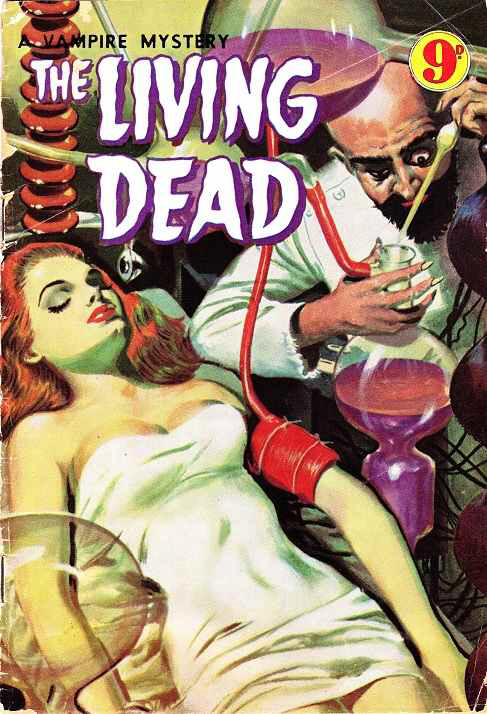
the-living-deadWhen I originally wrote the title above, it was “The Spectre Library Brings Rare Pulp Fantasy Back to Print.” I had to change it when I realized it wasn’t true. Damn digital books… I have to change the way I speak now.

Let me start over.

The Spectre Library, a small press outfit known primarily for reprinting the works of Victor Rousseau, has produced Kindle versions of all four of Michael Waugh’s rare short novelettes:

The Living Dead
Back From the Dead
Fangs of the Vampire
The Mystery of the Abominable Snowman

All four were originally produced by Cleveland Publishing Co., an Australian publisher, in pamphlet format between 1954 – 55. They are quite short, between 45 and 48 print pages.

The Kindle versions feature the original cover art, and are priced at $9.99 each (click on the image at right for bigger version).

On their website The Spectre Library says they “issue lost, rare works of fiction, with a focus upon publishing jacketed limited edition smythe-sewn hardcovers of Weird, Adventure, Detective, Crime, Oriental and Fantastic Content.” Sounds like an enlightened calling to me.

They also have an excellent gallery of cover art of Science Fiction, Fantasy, Weird & Occult publications — including paperbacks, digests, pamphlets, pulps, and magazines — from Britain, Australia and Canada between 1930-1966. It is curated by Morgan A. Wallace.

Sgt. Janus, Spirit-Breaker Carries on the Tradition

Sgt. Janus, Spirit-Breaker Carries on the Tradition

januscvr2163317_10150781784276920_117661766919_9778115_19571002_nThere is a longstanding tradition of occult detectives. Sheridan Le Fanu is generally considered the originator of the sub-genre with his chronicles of Dr. Martin Hesselius. Together with William Hodgson Hope’s Carnacki, Seabury Quinn’s Jules de Grandin, and Manly Wade Wellman’s John Thunstone, Dr. Hesselius’ cases are generally regarded as the finest examples of a continuing occult detective hero in the supernatural realm of mystery fiction.

Willie Meikle, Jim Butcher, and Simon R. Green are among the outstanding contemporary practitioners of the form. Now one may add Jim Beard and his creation of Sgt. Roman Janus to the list of occult detectives whose exploits are worthy of a larger audience. Beard is among the select group whose work is exclusively aimed at the niche market for New Pulp. Sgt. Janus, both as an original creation and as a literary work itself, raises the bar for Beard’s fellow authors to match the same exacting standard achieved here.

Janus, in Roman mythology, is the god of the gateway to the past and the future. So it is with Sgt. Janus, a character who provides the essential link between the astral plane and our own reality. The eight stories in this collection depict the character through the eyes of his clients. The device works brilliantly in giving the reader differing perspectives on the detective and his methods.

Read More Read More

Vintage Treasures: Science and Sorcery edited by Garret Ford

Vintage Treasures: Science and Sorcery edited by Garret Ford

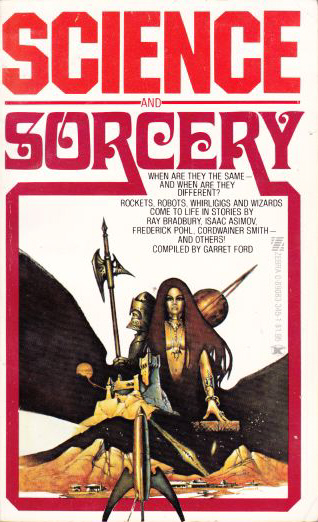
science-and-sorceryA few days ago I mentioned Martin H. Greenberg’s impressive collection of paperback SF and Fantasy, and the three boxes of that collection I carted back from the Windy City Pulp and Paperback Show. Two are now incorporated in my library. I set aside roughly a dozen of the more interesting titles to talk about here, and the first one is Science and Sorcery, an anthology of pulp SF stories from 1978.

It was published by Zebra, a pretty low-budget outfit. So low-budget, in fact, that it doesn’t even have a table of contents.

Who publishes an anthology without a table of contents? That’s pretty edgy. A publisher desperate to save paper, apparently. The whole thing feels slapped together, from the introduction on the back of the title page to the oddly formatted first story, Cordwainer Smith’s “Scanners Live in Vain” (page 3).

Fortunately, science fiction fans are a diligent and industrious lot, and I found a complete TOC online (at the book’s Wikipedia page, believe it or not). Here it is:

  • “Scanners Live in Vain”, by Cordwainer Smith
  • “The Little Man on the Subway,” by Isaac Asimov & James MacCreigh
  • “What Goes Up,” by Alfred Coppel
  • “Kleon of the Golden Sun,” by Ed Earl Repp
  • “How High on the Ladder?” by Leo Paige
  • “Footprints,” by Robert E. Gilbert
  • “The Naming of Names,” by Ray Bradbury
  • “The Eyes,” by Henry Hasse
  • “The Scarlet Lunes,” by Stanton A. Coblentz
  • “Demobilization,” by George R. Cowie
  • “Voices from the Cliff,” by John Martin Leahy
  • “The Lost Chord,” by Sam Moskowitz
  • “The Watchers,” by R. H. Deutsch
  • “The Peaceful Martian,” by J. T. Oliver
  • “Escape to Yesterday,” by Arthur J. Burks

A pretty eclectic mix, to be honest. Can’t remember the last time I saw an anthology with fiction by Sam Moskowitz. Or James MacCreigh, Ed Earl Repp, Leo Paige, Robert E. Gilbert, George R. Cowie, John Martin Leahy, R. H. Deutsch, or J. T. Oliver, for that matter. I don’t want to say this anthology primarily consists of nobodies, but it looks like this anthology primarily consists of nobodies.

Read More Read More

Q&A With Tolkien and the Great War Author John Garth on Michael Martinez’ Middle-earth website

Q&A With Tolkien and the Great War Author John Garth on Michael Martinez’ Middle-earth website

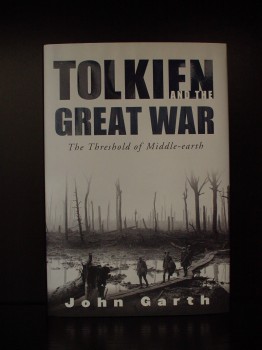
tolkien-and-the-great-warAs a subscriber to the Mythsoc listserv, I was very grateful to find a link from Michael Martinez — proprietor of the fine Middle-earth.xenite.org website — to a recent interview conducted with J.R.R. Tolkien scholar, John Garth, author of Tolkien and the Great War: The Threshold of Middle-earth (Houghton Mifflin Company, 2003). It’s a fascinating read and worth checking out; you can find it here.
Some reviewers have dubbed Tolkien and the Great War the best book on Tolkien that has yet been written. I wouldn’t go that far (for the record that book is Tom Shippey’s The Road to Middle-earth) but it is arguably the best book on Tolkien in the last decade. While Humphrey Carpenter’s biography is still the seminal work on the life and times of Tolkien, it brushes only lightly over his military service. Tolkien’s experiences with the Lancaster Fusiliers are stamped all over The Lord of the Rings, as Garth ably demonstrates in Tolkien and the Great War, and so any complete understanding of the influences of Tolkien’s works must account for his World War I experiences.

Read More Read More

Star Trek is New Again With Fresh Animated Intro

Star Trek is New Again With Fresh Animated Intro

Our buddy John DeNardo at SF Signal tells us about this extremely cool re-imagining of the original Star Trek intro, with William Shatner’s famous voice over… and some very compelling animation.

Keep your eye out for a red shirt who buys it half a second after beaming down, right around the 20 second mark.

The video was produced by The Quintek Group, a digital retouching studio in the Detroit area.

I got seriously nostalgic watching this. It makes me want to blow the dust off my DVD box set of Star Trek Season One and enjoy a few episodes.

Thanks, John. Owe you one.

Goth Chick News: Fed Says No Zombie Apocalypse; But Bullets Available Just In Case

Goth Chick News: Fed Says No Zombie Apocalypse; But Bullets Available Just In Case

image0061When we here at Goth Chick News predicted that “zombies were the new vampire,” we meant it as an entertainment trend, not a doomsday prophesy. But lately all of us here in the underground bunker are a just a tad bit grateful that our offices are in the bowels of Black Gate headquarters where we could conceivably hole up for several weeks, sustained by a stash of Pop Tarts and Patrone.

Because the reanimated dead are in mainstream news a little more often than we’re comfortable with lately.

Beginning with the horrific face-eating arrest in Miami, followed by several other seemingly subhuman acts, there’s been a flesh-munching wave of terror. We’re not the only ones wondering what’s behind it.

A bona fide zombie apocalypse, however, is not what we should be worried about, at least according to the federal government.

Wow… feeling better already.

Read More Read More

The Retro Pulp Art of Tim Anderson

The Retro Pulp Art of Tim Anderson

blade-runner-pulpWe love pulp fiction. And we love classic SF & fantasy movies.

So what’s not to love about Tim Anderson’s re-imaginings of classic SF films as pulp paperbacks?

Anderson is a concept designer for Electronic Arts in Salt Lake City. He’s also worked as a concept designer for Paramount Licensing, Inc., Radical Comics, and various independent filmmakers.

He’s started working on a personal side project that he hoped would motivate him “into thinking more graphically,” a series of highly detailed period paperback covers for some of the most famous SF films of the 20th Century.

Here’s what he says about his Blade Runner piece at right (click for a bigger version):

If you haven’t guessed by now, I’m a huge sci-fi fan, and a huge fan of Ridley Scott. Here’s a pulp cover I have had in the works off and on for a while now. I was inspired by the detective pulp covers of Robert McGinnis. If ever there was a sci-fi movie that lent itself well to a detective pulp cover, it’s Blade Runner.

Anyone who’s a fan of the great Robert McGinnis is okay by us.

Check out Tim Anderson’s versions of Alien, The Matrix and others here.

Art of the Genre: The Usual Suspects

Art of the Genre: The Usual Suspects

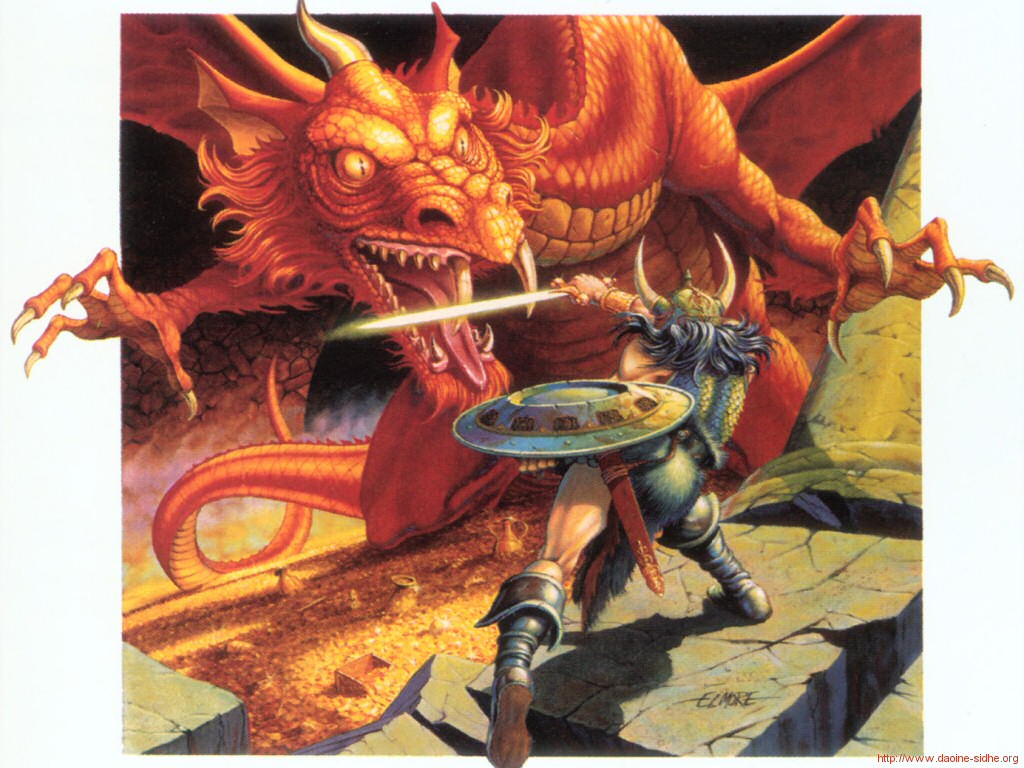
You want Larry Elmore, I've got Larry Elmore!

You all know I’m a total art geek, right? I mean, that should be plainly obvious simply by the titles of the blogs I write. To me, the nature of art is tied into my DNA, and although I don’t practice it myself, I certainly find untold joy in the viewing.

I’ve written before about my early years and the influence fantasy art had on me during those times. Without book covers, I’d simply have never begun reading, and therefore my choice of profession would have changed from writer to ornamental iron retailer. Certainly selling, installing, and designing ornamental iron isn’t a bad profession, and there is money in it if the markets are right, but I can’t help but feel a sadness when I consider the joyless toll such a career would have taken on me.

So, instead of being financially secure and responsible, I’ve somehow found myself in L.A. as a writer, editor, and jack-of-all-traders literary amalgamation. All this, because of art, and more particularly the art of old school TSR’s Advanced Dungeons & Dragons.

If the above is the keystone to my existence, then I fervently hold to it as all that is meaningful in my professional life. That said, I find the 1980s, in particular, an untold inspirational period, no matter how silly our clothing choice may have been during that decade.

Read More Read More

The Burnham Society

The Burnham Society

the-burnham-society-logoThe premise of this podcast series is that tourists came from as far as the Faerie Kingdom and Hell to visit the 1893 Chicago World’s Fair and, once it was over, decided to stay. These sub-cultures continued to co-exist with every other immigrant community in Chicago, integrating just enough to go unnoticed by most people. The Burnham Society was established to intervene in those situations where the sub-cultures don’t peacefully co-exist. The organization is perpetually trying to maintain its lofty goals while dealing with petty day-to-day politics (much like its namesake, architect Daniel Burnham).

The posts (which normally run between seven and eight minutes) are smart, funny and surprisingly touching. We learn why you should never clap for Tinkerbelle, how demons get their restaurant licenses, all the reasons you shouldn’t seek immortality and various other tidbits of secret history and magical advice. Rowan Bristol, the narrator and reluctant book-seller, presents himself as a surly and impatient guide through supernatural Chicago; but there is an undercurrent of optimism in every post. My favorite so far may be episode four (You Are Not the Chosen One), which begins as a snarky deconstruction of the Harry Potter series, but becomes something subtly beautiful and, in many ways more empowering than JK Rowling’s amazing series (brief aside: Does anyone else get the impression that Rowling originally intended Hermione Granger to be the main hero of the books?) The most recent post (Molly and the Dragon by Steven Fluet) is a wonderful short story about how anyone can find magic.

You can find all of the podcasts on the Burnham Society home page or iTunes. You can also learn more about the Burnham Society on its Facebook page. Hopefully, some of you will be inspired to follow Daniel Burnham’s advice and make no small plans.