Browsed by
Category: Blog Entry

Dungeon Crawl Classics – Growing Fresh from Old Roots
Dungeon Crawl Classics – Growing Fresh from Old Roots

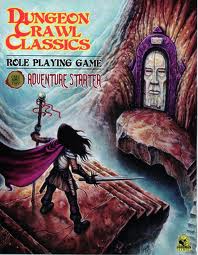
dcc1Dungeon Crawl Classics Role Playing Game
Joseph Goodman
Goodman Games (480 pp, $39.99, Hardback; $24.99, Download)
Reviewed by Howard Andrew Jones

I’m afraid that the Dungeon Crawl Classics role-playing game will hit the modern game audience the way a hard rocking band with great guitar hooks hits teenagers who think greatness is held by those auto-tuned voices and dancing lip-syncers. It might be that they’ll have the sense to understand something good, done right, even if it is artistically out of style, but I can’t help thinking they’ll be too hypnotized by flash and swagger to see the beauty.

Well, I use the term beauty loosely, because the plethora of art in DCC is old-school, in your face, evocative, bloody, and dynamic. It has some of the same aesthetics as counter-culture comics from the 60s, but it’s waaay cooler. Where else can you randomly flip through pages and come first to a wizard riding through a harbor on a giant marauding tentacled thing while being assaulted by an elf riding a hawk? Another quick flip takes you to an armored warrior pointing the way to a sinister cavern carved like the open maw of a monster, and a charismatic spell-caster launching a spray of firebolts.

But the book isn’t just the art – though the art sure aids in suggesting the atmosphere of the game itself. This isn’t your brother’s role-playing game. For that matter, it isn’t your dad’s AD&D, either. Primary creator Joseph Goodman is on record as saying that it’s the first game based on a thorough reading of Appendix N from the original Dungeon Master’s Guide. If you’re not in the know, Appendix N was a list of recommended reading featuring the likes of Robert E. Howard, Michael Moorcock, Fritz Leiber, and all kinds of other creators of literary fantasy goodies, most of which my local library didn’t have back when I was in junior high, or I would have been swept away into some realms of adventure a lot earlier.

Read More Read More

Black Gate’s Closet: Crisiswear

Black Gate’s Closet: Crisiswear

What the heck does one wear at the end of the world? Sure, yes, most people would answer, whatever you can find, but…why not be prepared, and why wait till disaster strikes? Don’t you want to look like a post-apocalyptic hardass? I mean, come on, who doesn’t want to get their Mad Max and Alice on? Nobody wants to be the tarp-toga guy who ties guns to his belt with bootlaces. It’s unwieldy.

Enter, Crisiswear.

Crisiswear is a Chicago-based clothing company. They specialize in future-forward fashion with industrial elements. All of their clothing is custom made, double stitched and built to last. This is survival gear that you can blow up evil, mutant villains in and then dance around their charred lairs.

Stock up on versatile, hedonistic, cyberpunk apparel at their website, or check out Crisiswear on Etsy.

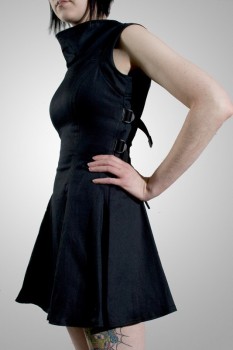
MedTech Dress by CrisisWear
MedTech Dress by Crisiswear
Kensen by Crisiswear
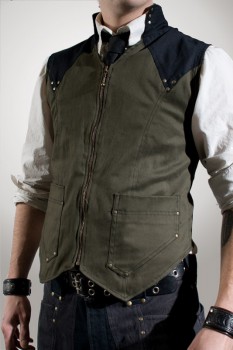
Vigilante vest by Crisiswear
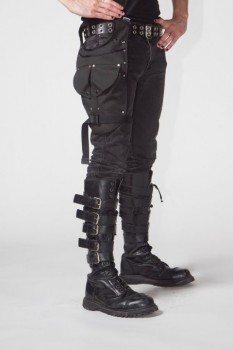
Solo Leg Holster by Crisiswear
Blogging Dell Comics’ Hercules and Hercules Unchained

Blogging Dell Comics’ Hercules and Hercules Unchained

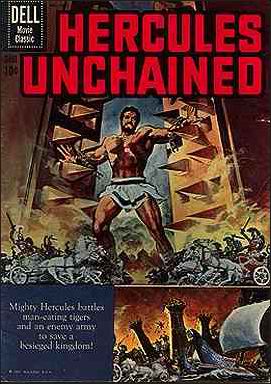
hercules-dellhercules-unchained-dell1When bodybuilder turned actor Arnold Schwarzenegger brought Robert E. Howard’s Conan the Barbarian to the big screen in a pair of stylish costume dramas in the early 1980s, it ushered in a Sword and Sorcery craze with scores of imitators on the big and small screen eager to recapture the first film’s runaway success. For many, it was as if history was repeating itself for in the 1950s, bodybuilder turned actor Steve Reeves had starred in a pair of Sand and Sandal epics, Hercules and Hercules Unchained that created a similar sensation. The Italian sword and sandal craze (or peplum, to use their proper title) dominated the European box office in the late 1950s until the advent of the so-called Spaghetti western in 1964. The film that started it all was Pietro Francisi’s The Labors of Hercules (1957) which was dubbed in English by Joseph Levine’s fledgling Embassy Pictures and released as Hercules by Warner Bros. in the US in 1958. Its success led to a Dell Comics adaptation by the legendary John Buscema in 1959.

The plot of this first film was a reworking of the Greek myth of Jason and the Golden Fleece with Heracles (going by his Roman name, Hercules) promoted from a supporting player to the lead role. Of course within a few years, Charles Schneer and Ray Harryhausen would cover much of the same territory with Jason and the Argonauts (1963) creating a lasting classic which would quickly supplant the movie that started it all. The latter film’s longevity is largely due to Harryhausen’s superb stop motion effects work which continues to influence film-makers after half a century.

Read More Read More

Goth Chick News: The Woman In Black is Coming for You… Again (and Again)

Goth Chick News: The Woman In Black is Coming for You… Again (and Again)

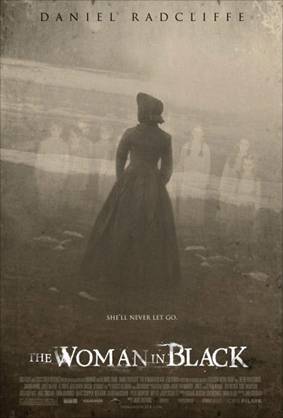
image0062Apparently The Woman in Black truly is a supernatural, immortal being.

When we first told you about it, the seriously creepy novel by Susan Hill was a long-running play in London’s West End, a made-for-TV movie in the UK, and barely a rumor from Hammer Films about a theatrical remake starring Daniel Radcliffe (Harry Potter); which turned out to be true after all.

Thankfully that bit about it potentially being shot in 3D never materialized…

At least not yet.

Hammer Films, which grossed $112 million globally on a $17 million investment has already made the no-brainer announcement that it’s moving forward with a sequel and perhaps more.

The Woman in Black: Angels of Death is currently in development with Jon Crocker once again writing the script based on a story by Susan Hill.

But don’t look for this one at your local bookseller, at least until after the movie is released sometime in 2014. Ms. Hill got busy on the follow up at the behest of Hammer Films.

The first film saw Radcliffe as lawyer Arthur Kipps who travels to Eel Marsh House on an assignment, only to discover the house belonging to his client is haunted by the ghost of a woman who is determined to find someone and something she lost.

The Woman in Black: Angels of Death will take place during World War II, forty years after the events in the original. Daniel Radcliffe will likely not be involved though there have been some recent rumblings that a cameo isn’t out of the question for continuity reasons.

Read More Read More

Reimagining Star Wars as West Wars

Reimagining Star Wars as West Wars

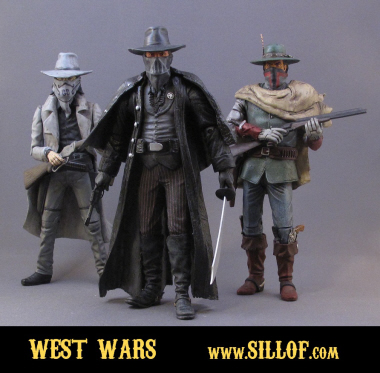
west-wars-vaderI usually ignore the endless stream of Star Wars fan creativity here on the blog — Lego remakes, the Silent Star Wars, and numerous others. Black Gate is all about shining a light on neglected fantasy… if you think Star Wars is neglected, it’s because you’re blind and deaf and you live on Easter Island.

But every once in a while a simple idea comes along that reduces me to a 12-year old Star Wars fanboy again. That’s what happened yesterday when I discovered Sillof.com, the brainchild of Indianapolis, IN, sculptor Sillof, who specializes in making custom action figures and also makes props for films.

Sillof has created a line of action figures called West Wars, featuring a brilliantly realized cast: Luke S. Walker, a young man living on the outer borderlands with his poor aunt and uncle, Leah Orango, daughter of one of the most prominent ranch families in the territory, “Old” Bennet Kennelly, one-time sheriff who was driven into hiding when his former deputy turned on him, and the villainous Sheriff Akan “Death” Vardas, enforcer for the corrupt robber barons and railroad tycoons.

The entire cast is instantly recognizable, even though they’re all in period garb. Sillof has done the same with other periods, giving names and faces to the cast of Samurai Wars, World Wars, Noir Wars, Serial Wards, and others.

Besides making me daydream of someday watching a version of Star Wars set in a western town — sort of like watching MacBeth set during the US Civil War, or Romeo & Juliet in 1950s Brooklyn, both of which I have done — Sillof’s creations remind us just how universal the themes of Star Wars are. And in fact, just how fluid story is… how easy it can be to move the props of narrative to a different stage to make it fresh spin.

Not to mention that they vindicate a decades-long fascination with action figures. Thanks, Sillof!  You the man.

Courtney Crumrin and the Night Things by Ted Naifeh

Courtney Crumrin and the Night Things by Ted Naifeh

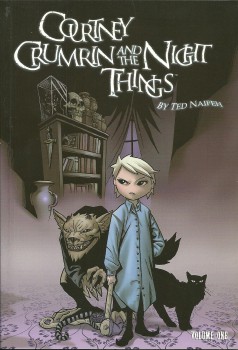
courtney-crumrin-1Be honest.  If you had magical powers when you were a teenager, what would you have done?  How long would you have walked the path of righteousness before cursing the school bullies?  Before casting a spell to make yourself popular?  Before just flat-out killing bad people?  Would you have made friends with elves … or goblins?
Ted Naifeh’s series of fantasy comics for young people (the back label says it’s appropriate for children ages 7 and up), introduces us to Courtney Crumrin on the day her vapid parents move in with her grand-uncle, Aloysius.  After a few restless nights, she discovers that her grand-uncle is more than simply a curmudgeonly hermit.  He’s also a wizard, more feared than respected by his fellow magicians, occasionally called upon to handle those supernatural problems that others don’t want to handle.  Going through his collection of grimoires, she begins her own self-guided education in the magical arts.  In the first volume, she traps a child-eating goblin, enchants herself to become the most popular girl in school, travels to the faerie kingdom to swap out a changeling for a human infant, and gets replaced by a doppelganger who turns out to be nicer than her.

Courtney is an intelligent young woman who’s just naturally drawn to the darker parts of this world, a cynical yet moral protagonist.  These early stories tend to rely a bit much on the “and then her uncle saved her and put everything right” solution; but they effectively convey a child going through those early learning stages, both of magic and of the harsh truths about life.  I’m glad that, after years out of print, the original volumes are being reprinted, even as a new series of adventures begins.

Art of the Genre: Art of the Iconic Female #3: Wonder Woman

Art of the Genre: Art of the Iconic Female #3: Wonder Woman

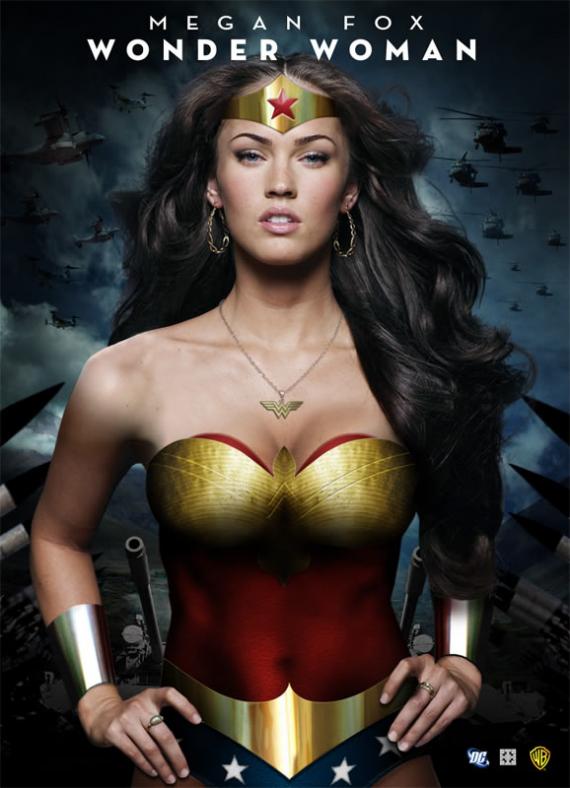
megan-fox-wonder-womanI have no memory of the first time I saw Wonder Woman, although I’d assume it wasn’t the comic but the live action 70s TV version with Linda Carter. Recollections of those shows were certainly something that stuck with me as they sparked something in my prepubescent state that would certainly lead to a grander appreciation of the female form as I grew up. Remember, this was circa 1975-1979, so I was only a max of 8 years old when watching them and yet the name Linda Carter still quickens my heart rate to this day. Something about that just isn’t right… or I guess in the case of DC Comics bottom line is exactly right.

Perhaps that reaction today isn’t such a good thing, as my wife is wont to remind me, but the ability of the American propaganda and marketing machine was certainly gearing up to a fevered pitch in that glamorous disco-tropic decade concerning how women should look and what they should wear.

Wonder Woman, for all her powerful beginnings, finds herself cast in the role of sex object just as 95% of all other super heroines, and that is a tragedy.

Silly side note here, my mother has always watched The Young and the Restless, and therefore I’ve always watched The Young and the Restless. It humors me greatly that the twenty odd characters in the show must always get together, break up, and then get together with someone else again and again and again. After several decades, relationship trees become so convoluted that I get great joy at having a running dialogue as I watch the show detailing just how inherently creepy each new relationship has become when I get to count how many people in each scene have slept together. In essence, comic books are the same beast, and with only a very limited number of super heroines to go around, I’ve always been intrigued by covers depicting them in the arms of an iconic super hero, my favorite being those with Wonder Woman and Superman thusly portrayed. I mean seriously, if you put in the words ‘Wonder Woman Kissing’ into Google, the first four default options are Nightwing, Superman, Batman, and Jean Grey [wowza!].

Read More Read More

Black Gate Goes to the Summer Movies: Brave

Black Gate Goes to the Summer Movies: Brave

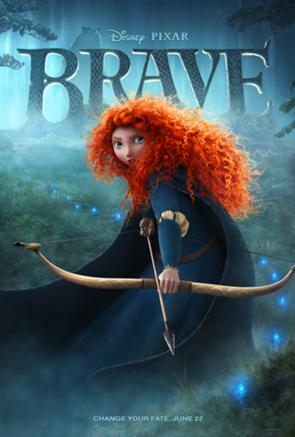
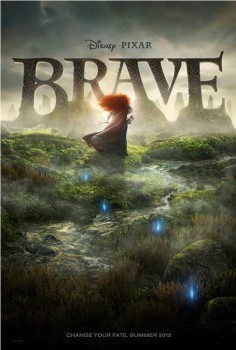
brave-posterWho would think at the start of the summer that Brave was concealing more of its plot and themes than Prometheus? Strange days, my friends.
Ninety percent of the trailer for Brave comes from the first twenty-five percent of the movie. And to continue with percentages, fifty percent of Brave is a great film, and worthy to stand beside earlier Pixar classics. But except for a few flashes in the trailer, Disney and Pixar have revealed nothing of this later-running time greatness to you. The marketing department and directors Andrew Jones and Brenda Chapman have even specifically asked reviewers to hide what the center of the movie is about.

This is not a case of concealing a twist ending or a mid-movie shocker, but disguising the core of the film. Imagine a trailer for Pinocchio that never reveals that the puppet comes to life: it’s the story of a sad woodcarver and his pets who meet a blue fairy, and later on an enormous whale may peep into the plot. Or a trailer for King Kong that not only never shows the eighteen-foot gorilla, it never hints that there might be a giant monster of any sort in the film. According to this trailer, King Kong looks like the tale of a young woman who goes on a voyage with a film crew, possibly to find (dinosaur- and gorilla-free) adventure and romance away from dreary Depression Era New York.

Brave is the story of Merida (voice of Kelly Macdonald), a Scottish princess who hates that her parents King Fergus (Billy Connolly) and Queen Elinor (Emma Thompson) are trying to marry her off to a dullard in a political alliance when all she wants is her freedom — like any good Disney Princess™ — and the chance to choose her own destiny. While exploring, Merida discovers magic in the forest after following a trail of Will-‘o-the-Wisps. The rest of the story follows the standard princess adventure: she’ll go out on her own, fight some monsters, discover a handsome and roguish fellow who likes her for who she is, and her parents will finally let their daughter be herself and marry the man she loves.

Except, after the words “The rest of the story…” that is not actually the plot of the film. At all. It isn’t the main character conflict or the thematic center. I made it up. Don’t expect some sort of Sixth Sense twist, such as Merida discovering she’s actually trapped inside a giant video game or Mars invading medieval Scotland, but the story does pick a different and better way than the second half of my Disney-influenced outline. A very average opening gives way to a film that has much more to say, in the vaunted Pixar fashion.

I will reveal at least this: expect a helluva a lot more “bear” than you’ve seen in the trailers. This is a good thing. I like Big Bears and I cannot lie!

Read More Read More

Vintage Treasures: George R.R. Martin’s “Nightflyers”

Vintage Treasures: George R.R. Martin’s “Nightflyers”

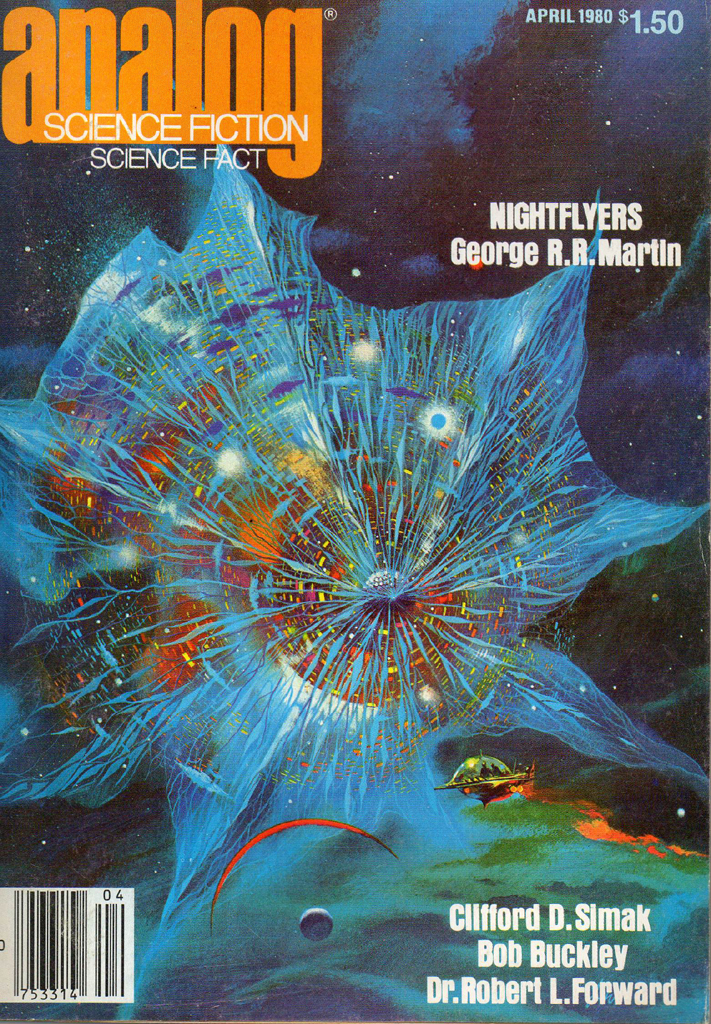
analog-april-1980-smallOver the weekend I put away a collection of 80s magazines I purchased a few months ago. In the process I discovered the April 1980 issue of Analog, which I read as a junior in high school in Ottawa, Canada.

There’s a lot to like about this issue, from the gorgeous cover by Paul Lehr — perhaps my favorite SF artist — to a famous short story by one of my all-time favorite SF writers: “Grotto of the Dancing Deer,” by Clifford D. Simak, which won both the 1980 Nebula Award and 1981 Hugo Award for Best Short Story. Even the ads reflect those things I personally found most exciting and fresh about SF and fantasy at the time: a full page ad from TSR for D&D, “The Ultimate in Adventure Games;” an ad for six microgames from Metagaming (the company that introduced me to role playing games), including the classic Ogre; and a subscription form for Ares, the short-lived SF gaming magazine from SPI.

This issue is an intriguing cultural artifact for other reasons. There’s an editorial from Stanley Schmidt in response to the recent kidnapping of 50 Americans at the US embassy in Iran, both a fascinating snapshot of a critical moment in American history, and a typical science fiction response:

What the Iranian crisis really demonstrates, at least as dramatically as any incident so far, is that if we want real freedom, we must produce our own energy… Technologies which can do this are possible, and we should not willingly settle for less. Readers of this magazine are well acquainted with the role space can play, but many people are not — and we need to get the action under way now.

If you read Analog in the 20th Century, you got used to this. Exploring space was pretty much the answer to everything — the energy crisis, the hole in the ozone, foreign policy crises, and crappy network television programming — and the magazine’s self-congratulatory tone clearly told its readership (including 15-year-old readers in Ottawa) that they were smarter and more informed than everyone else, especially on science and technology, topics far more important than cars, sports, and other things kids our age obsessed about. Analog told its readers they were destined for success. The future was ours.

But the real reason this issue is remembered is its cover story, George R.R. Martin’s novella of horror in deep space, the chilling classic “Nightflyers.”

Read More Read More

Brave: Pixar Improves Disney’s Fantasy Princess

Brave: Pixar Improves Disney’s Fantasy Princess

295px-brave-apple-posterThe Disney/Pixar partnership has always been willing to take some risks. Let’s face it, these are the people who turned a lost fish, talking cars, and Ed Asner in a floating house into deeply rich character-driven stories about the human condition. It’s really a wonder if there’s anything they can’t do well!

But one thing that they have avoided, until now, is even trying to dip their toes into the genre that Disney has mastered: the fairy tale.

From my perspective, with Brave they’ve blown pretty much every Disney fairy-tale-themed film out of the water. I won’t get much into the plotline, because Pixar’s done a really good job of not spoiling it too much. (I had a guess about what was going to happen, based largely on the Subway restaurant promotional campaign materials, and that guess was pretty much on the mark.)

But, even with no idea what happens in the film, there are a lot of things that the film is about which I can discuss…

Read More Read More