Fiction Excerpt: “Welcome to the Underworld”
By Iain Rowan
Illustrated by Bernie Mireault
from Black Gate 10, copyright © 2007 by New Epoch Press. All rights Reserved.
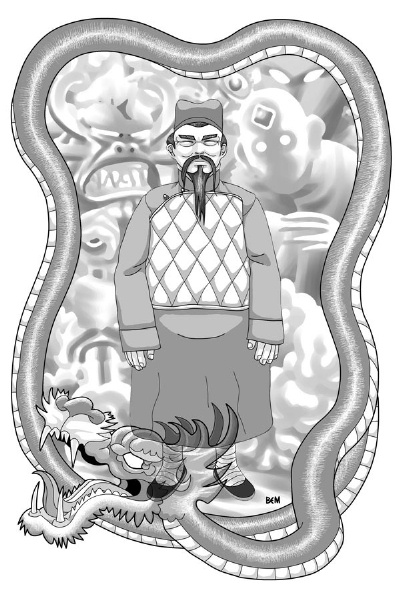 Imagine this. You tremble in fear of your life. The greatest empire the world has ever seen wants you dead. Its enemies also want you dead. You are scurrying around your humble home trying to decide what of your life you can fit into a bag. Your favorite silken under-robe? You must take the small pot your son made, a shrunken, drunken pot that could not hold a thimble of water, but which is more dear to you than gold, because it is all that you have left of him.
And then you hear whispers in the street.
Maybe they are walking past. But they are talking very softly. As if they don’t want to be heard.
You freeze, half a loaf of bread in your hand. Do you gently place the bread down, reach for anything that could serve as a weapon, and steal into the shadows by your front door, ready to give up your life in defense of your home, your liberty?
I am impressed by your courage and obvious desire to die. I stuffed the bread into my bag, and squeezed through the narrow side-window that overlooked a rubbish strewn alleyway. I picked my way through the noisome gutters, and was halfway down the alley when I heard my front door crash into splinters. At that point I abandoned all stealth, firstly because whoever was breaking into my house was making so much noise that I could have fled down the alleyway blowing ceremonial trumpets and not been heard, and secondly because if I did not run they would catch me anyway. I came out on a deserted side street, plunged on wheezing into a maze of twisting passages through which I hoped no pursuer could follow, all the time heading in the general direction of the east.
I had set a demon to kill one of the emperor’s chosen men, and would be regarded as a traitor in league with those who conspired to overthrow the Imperial Throne of the Endless Waters. Ordinarily in that situation it would have been prudent to seek shelter with the conspirators. Unfortunately I had also freed and banished the demon that those conspirators had wished me to enslave for their own ends. So even the traitors regarded me as guilty of treachery. The mangy street cats flattened their heads against the walls and regarded me through narrowed eyes as I huffed and puffed past them. All around me were enemies. I could not stay in this city another night. And there was only one way to leave it in a hurry. The docks.
I smelled them before I reached them. The salt of the sea, the ripe stench of the river, the fetid stink of the gutting halls. The smell was my guide, as I stumbled past houses that became narrower and narrower, every fifth building an inn, every sixth a whorehouse. Then I came out onto the docks.
I hurried to the edge of the water, walking as briskly as I could without drawing attention to myself. The crew of a large ship swarmed over its decks, coiling and uncoiling ropes, moving boxes to the back, and spitting over the side a great deal. A stout lady was supervising the transfer of a number of boxes from the quayside. Whatever was in the containers must have been precious and delicate, judging by the way she screamed insult after threat to her beleaguered servants. A short man lounged on the deck looking on, his hands stuffed in his pockets, whistling at nothing in particular. He was too scruffy to be the owner or the captain, and too idle to be one of the crew, so I reckoned him for another passenger. If this vessel sailed soon, it would be ideal. I would be anonymous among the other travelers. I stopped one of the servants as he trudged back for another box.
“Excuse me, what is the destination of this ship?”
“Away from here, thank all the gods,” he muttered, “away from here and I’m not on it.”
I was about to reply that much as I delighted in his good fortune, this information was less than useful, but I was interrupted by the stout — and increasingly florid — woman bawling down at the servant.
“If you louts spent less time in conversation and more doing the duty I pay you for, you could take better care of the boxes, you ignorant oaf.”
The servant hurried on his way. The woman swiveled her glare on to me. “And you there, my servants would do a better job if they were not subject to continual distractions and interruptions. When you start paying them, then you can start talking to them and keeping them idle. I have had to pay good money for the doubtful privilege of traveling on this filthy brig and I would not wish to delay the happy day when I can disembark it by a moment.”
I wondered whether risking my life in the city might not be preferable to sharing several days voyage with this demon in human form. As the servant crept back past, cradling a small wooden box with air holes drilled in the sides and something fluttering within it, he mumbled “Quishen” without moving his lips.
Perfect. Quishen was a good four days sail up river, a large city with no great claims to fame and not a soul who knew me. From there I could take another boat down the great canal to Shushon, or I could join a caravan towards the mountains. No one would think to look for me in Quishen. I approached one of the crewmen.
“I wonder if you have a berth on your boat, I — ”
“See captain,” he mumbled, still wrapping one bit of rope around another bit of rope for no discernable reason.
“Thank you.”
There was a pause.
“And where…”
He jerked his head towards the back of the ship. I picked my way between boxes and coils of rope, getting a pleasant nod from the short scruffy man who was still whistling to himself. At the back of the boat an old man with a straggly beard and a resigned expression was being harangued by a thin man whose hawk like face immediately made me think he was a lawyer.
“…and I have paid good money for this and I certainly expect more comfortable accommodation than that which I have been given. I would refer you to the wording of the specification of passage hung outside the offices. It said in part…”
And so on. I stood waiting patiently, guessing that the elderly man was the captain. He stood impassively, waiting for the other man to finish, or to at least take a breath. Eventually hawkface ran out of steam, finishing with a promise that if things were not changed that he would be taking it up at the highest level.
“You have the best accommodation The Jewelled Swift can offer,” the captain remarked. “Should have booked sooner.”
“Well it’s simply not good enough.”
“Can’t do better than what we have. The Blue Peacock has comfortable cabins on board, spent real money on that, they did. Very comfortable.”
“Ah, progress. So when does this Blue Peacock depart for Quishen?”
“Blue Peacock don’t go to Quishen.”
Hawkface made a sound as if he were choking on his tongue. “You waste my time. I must be in Quishen this week, I have very important clients that I must meet.”
“Well you have the most comfortable berth on this vessel. If it’s not to your standards then you could look for another vessel that sails to Quishen this week. I’ll give you your money back if you find one.”
“Excellent, then that is what I shall do. What other boats are due to leave for Quishen this week?”
“Just this one. No others.”
Again, the choking sound. “I shall take this up, you know. With your shipping agents. They shall hear from me. This is not satisfactory.” With that hawkface strode back down into the bowels of the ship.
The Captain watched him leave with impassive indifference, and then noticed me waiting and raised a weary eyebrow.
“Captain, I understand you are sailing to Quishen. I wish to buy passage, and if you can get me to Quishen, I do not care if I sleep in a barrel. I will not complain.”
A flicker of a smile appeared on his face and then vanished as he mastered it.
“You’d be the first. You’re in luck, there’s a berth, but you don’t have much time, we sail within the hour.”
A surly looking man thumped down from a ladder and joined us. Or rather, joined the captain, he ignored me.
“That aft spontoon’s never going to last without thrum-wrappling,” he complained. Or words to that effect. “For’ard stanchions’ll splice up but the mizzoon is feckled. Cheated on that by the bastards back there. Settle with them next time we’re back, that I will. What’s this?”
“Another addition to our manifest,” the captain said, then turned to me. “My first mate will take your payment.”
“We can’t be waiting for any luggage,” the first mate observed sourly. “We sail now.”
“That does not concern me,” I replied airily, “I travel with everything that I need.”
He shrugged, glared at me, and spat over the side. I have had bigger victories.
My accommodation was a hammock slung between beams that only a dwarf could walk under without braining himself, in a cramped space shared by at least seven other hammocks that I could count. The stinking darkness hid more from view. I did not care, because it was better than the accommodation I would have been granted had I stayed any longer. I went back to the deck as the crew cast off, and watched the city slip past, slowly at first, and then with increasing pace.
I wondered whether what I felt was regret. I would miss the city that I knew so well, its bustle and filth, the whole shouting, stinking row that was the only world I knew. I would miss Mama Shen’s, I would miss the bars on the Golden Walk, I would miss the sound of the late night revelers falling and laughing down the alleys while I lay in the arms of one of Mama Shen’s girls, full and sated and warm and not having to be anything other than myself.
I had met my wife in the Long Park, had courted her with walks along the banks of the river I now sailed down, courted her while strings of colored lanterns bobbed with grace in the evening breeze, and a lovely, haunted music drifted from somewhere behind the trees. We had married in the city, lived in two rooms but needed no more because we were world enough for each other.
And it was in this city, with me holding her hand because I could think of nothing else to do, that she screamed and shook, and held on to me so tight that my hand bled. My blood mixed on the floor with her blood and my tears as she brought new life into this hard world and then left it herself. It was this city that I walked, alone in the world apart from the small bundle of warmth that slept quiet and happy in my arms as long as I walked, walked, not following any map of the city, just the map of two short year’s memories, the map of my heart.
So life went on, and I worked my trade deceiving the gullible and the pompous because it was the only talent I had that would provide for my son. He grew up in the city, screaming through its alleys with his allies, tipping market stalls and stealing apples and occasionally getting a beating or a blow on the head from a particularly well-aimed root vegetable. By the time he was ten he knew the streets better than I did, every short cut, every hiding place. I was all the family he had, and he was all that I had. And he sent me mad in the head and I sent him skulking and sulking at my restrictions and my lecturing, and we loved each other more than I thought I would ever be able to love again.
And then he listened to the Emperor’s call, and he went to fight in the mountains. When he died, the city died for me too. I realized that I did not regret leaving it, even if it was forever, not one bit. The only things of the city that were important to me I carried wherever I went, and I could see them any time I chose to close my eyes.
Soon the city was gone, and the Jewelled Swift drifted through fields and woodland, into another world. My traveling companions were a strange assortment, dominated by the large and fierce woman I had encountered when first boarding the ship. Around her orbited those who thought themselves of some status amongst the passengers, or who at least sought to give off that impression.
Chief amongst them was the thin man with a face like a bird of prey. I had marked him early on as being in the legal profession. Another in this group was a man taking a cargo of fine silk prints to Quishen, where he was going to impress some other merchant with his samples to the point at which fortunes would be made. He could then travel on his own ship, without having to mix with the likes of us. He impressed this upon us many times, until I was sure I was not alone in wishing he would begin his independent travel immediately by falling over the side and being eaten by some river creature with spiny teeth.
Those excluded from this group formed another of more lowly station. The two congregated on the decks only a spit and a lifetime away from one another. I was too well-spoken for the latter group, who viewed me with some suspicion, and I was too lacking in trade or social connections for the first group – who also, it must be said, viewed me with some suspicion. So I spent much time alone.
The short, scruffy whistler who had nodded at me pleasantly when I first boarded was another loner. In his case, I think it was simply through inclination. It was obvious by his dress and speech that he belonged to the second group, but he did not seem interested in joining their gossip and surly sniping at the first group. So he and I strolled around the ship, alone. We did not walk together, but were united by our solitude. When our paths crossed we nodded and smiled and exchanged companionable words that never quite gave birth to conversation. I was happy with that and so, I suspect, was he.
The captain kept himself to himself. Having to deal with the passengers appeared to cause him physical pain. This was an unfortunate voyage for him, as the dragon woman lost no opportunity to complain to him about — well, about everything. She was invariably followed by the lawyer, who would swoop down on the captain and make reference to various arcane legal precedents, and by the stout silk print merchant who contributed nothing more than his voice, the sounds of which pleased him greatly and made him look as smug as if he had just bestowed the riches of the world on all who had heard him.
The crew followed the captain’s example where they could. This was not choice on their part, but was enforced by the hard words and the harder knotted rope of the first mate. He was a deeply unpleasant man with a cold smile and dead fish eyes, neither of which hid the fact that nothing would please him more than to treat the passengers as he did the crew.
A day passed in gentle motion, and then another, and the city seemed to belong to another time, another life. I spent as much time as I could on the deck, watching the dark green water slide past the wooden hull. The river was so wide that at first it felt as if we were at sea, the distant banks some far-off shore, but now it began to narrow, still spacious enough that a dozen ships like ours could have sailed past without colliding, but close enough for us to feel that we were truly cutting our way through the land.
As dusk fell, and a mist began to rise from the river, the captain gave the order to drop the anchor. The crew bustled around doing complicated crew things involving knots and shouting, and the passengers gathered on the deck, stretching their legs and trying to fill the time until it was time to eat. The mist gathered close around us, so thick that we could not even see the water. It was as if we were floating in a large white cloud. I leant on the railing, and gazed out at nothing. A large fish leapt mid-stream; I heard the splash.
It must have been a very large fish indeed, as a few seconds later it bumped the side of the boat with a dull thud. And then I thought maybe not a fish after all, unless this part of the river plays host to the remarkable climbing fish. My mind started to put the facts together and come to a conclusion, just in time for the conclusion to climb over the rail of the ship, all laughable moustaches and swords which made it prudent to hold the laugh in.
“What? Who? Why?” The dragon lady stuttered.
Fortunately a shout from a crewman made it all clear to her. “Pirates! Pirates!”
One of the men ran forward and clubbed the crewman to the deck with the hilt of his sword. Another advanced on the passengers, sword waving from side to side, the luxurious moustache not hiding his leer.
“Do something!” the dragon lady commanded. “You men, do something!” But the crew that we could see backed away, holding their hands above their heads.
“Not pirates,” said one of our visitors. “More like bandits, mmmm? But for you all, it amounts to much the same.” And he grinned, and the dragon lady shrieked, either from fear of his words or the state of his teeth. The man who had spoken was obviously the leader, as he stood idly in the center of the deck while his men rounded up the crew, and kept us passengers pinned back in the corner.
The first mate came staggering up from below deck, his hands already held in the air. “Don’t kill us,” he said. “We’re only humble sailors, we have nothing. Them, they’re the ones with the money.” And he nodded towards us, before one of the bandits shoved him to his knees with the rest of the cowering crew.
Then the captain walked out from below deck, his back very straight, a sword in his hand that looked as if it had not seen use for a very long time. “Get off my ship,” he said.
The bandits laughed.
The captain walked towards the leader, the bandits parting to let him pass. I felt a sour heat in my stomach.
“Captain,” I said. “There are many of them. Too many of them. There’s no dishonor. Please, join your crew.” Some of the other passengers joined in with my cries. Others did not. A couple of the bandits moved closer to us, swords drawn, a clear warning not to get involved.
“Captain,” I implored.
“Kill the villain!” the dragon lady shouted. “Stick him through! The others will run like the dogs they are.”
One of the bandits watching us barked; the other laughed. The captain stood in front of the leader, his sword wavering in his hand. I looked away into the mist.
“I said, get off my ship.”
There was a moment of silence.
“Make me, old man.”
There was a desperate cry, a brief sound of feet thumping on the wooden deck, and then a laugh and the passengers around me all let out their breath in a sad, long sigh. Then the sound of something dragging on the deck. And then a splash.
“Now,” the leader said. “To business.”
One thought on “Fiction Excerpt: “Welcome to the Underworld””