Edgar Rice Burroughs’s Mars, Part 4: Thuvia, Maid of Mars
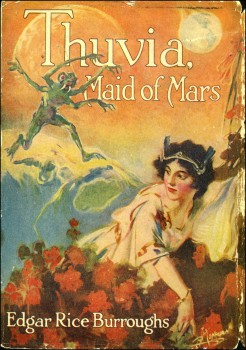 John Carter’s story appeared finished with The Warlord of Mars. But readers wanted more, and Burroughs was fired with productive energy. Less than a year after “ending” the Martian novels, he launched into the second phase of the series, with a new hero, new heroine, and new point-of-view style.
Our Saga: The adventures of earthman John Carter, his progeny, and sundry other native and visitors, on the planet Mars, known to its inhabitants as Barsoom. A dry and slowly dying world, Barsoom contains four different human civilizations, one non-human one, a scattering of science among swashbuckling, and a plethora of religions, mystery cities, and strange beasts. The series spans 1912 to 1964 with nine novels, one volume of linked novellas, and two unrelated novellas.
Today’s Installment: Thuvia, Maid of Mars (1916)
Previous Installments: A Princess of Mars (1912), The Gods of Mars (1913), The Warlord of Mars (1913-14)
The Backstory
Burroughs wrote the fourth Barsoom novel in April–June of 1914 under the stunningly uninspired working title of “A Carthoris Story.” But it wouldn’t appear in magazine form until two years later, where it ran in All-Story in three installments in April 1916. Burroughs was deep in the middle of the busiest period of his life, and he spent most of 1915 trying to sell his new properties to Hollywood, all without success. The delay getting Thuvia, Maid of Mars to market may reflect how crazy the author’s life was getting — and that he realized that Tarzan was going to be his big franchise.
In the fourth installments of both the Tarzan and Mars series, ERB took a risk to expand beyond his original heroes and infuse new blood into the sagas. He demoted his original heroes to bit parts and made their sons into the leads. Tarzan stepped aside for Korak the Killer. John Carter, now settled into his role as the Warlord of Mars, let his son Carthoris take the limelight.
The experiment in The Son of Tarzan (1915) failed, and Lord Greystoke returned in the next novel and all the ones to follow. But on Barsoom, Thuvia, Maid of Mars signaled the beginning of the second phase of the series, with different heroes in each book, including native red Martians and a new traveler from Earth. Barsoom Mark II had arrived. How does it stack up to Mark I?
The Story
Thuvia, Princess of Ptarth, rebuffs the advances of both Carthoris, John Carter’s son, and Astok, Prince of Dusar, because she is already in a political engagement to Kulan Tith, Jed of Kaol. (There’s going to be a test on this later, so please pay attention.) Astok does what any villain in an ERB novel would do in this situation: he kidnaps Thuvia. Carthoris, afraid guilt will point toward him and his father’s city of Helium, flies to Ptarth to speak with Thuvia’s father and clear up the mess. But a Dusarian spy in his household tampers with the compass on Carthoris’s flier, and the prince ends up lost in one the dead cities.
But it happens to be the same dead city where Thuvia’s captors have landed. Before Carthoris can rescue her, a lone Thark warrior from the hostile tribe of Torquas seizes the princess and rides off. And the “Save the Princess” chase is on…
Carthoris must find Thuvia while facing a violent tribe of green men, a more intelligent strain of white apes, a bizarre city of men who can create deadly thought projections, and the scheming of Astok to claim Thuvia. While this happens, the great cities of Mars prepare to go to war against Helium, believing that it was Carthoris who kidnapped the Princess of Ptarth.
Now the test: To whom was Thuvia originally engaged?*
 The Positives
I understand why ERB wanted to make a change to his two popular franchises. After three novels each for Tarzan and John Carter, Burroughs must have been afraid of recycling his heroes, or else worried he would get bored writing about them. Changing protagonists to the heroes’ youthful sons sounded like a smart decision.
And it was for Barsoom; the fantastic setting makes it easier to explore using a new character. But Tarzan is too essential a part of his world, and Son of Tarzan was a one-off.
But the change from first-person to third-person narration makes the biggest difference: Thuvia, Maid of Mars feels substantially unlike the previous trilogy; the world is familiar, but now we are seeing it through the eyes of its inhabitants. And more than one inhabitant. Burroughs’s writing takes on a more cinematic feel, switching between characters and locations, pacing the story in a new way. He already knew how to handle third person from the Tarzan books, so Thuvia, Maid of Mars doesn’t suffer from a learning curve. ERB could play the multiple viewpoint game well, and shows it here.
The result is that Thuvia, Maid of Mars is a fresh book. Reading the novels in order, it comes across as a new experience and re-ignites reader interest in continuing with the rest of the series. If Barsoom was going to stall, it would be on the fourth book. Burroughs made the right choices, and executed them with his writing abilities at their peak.
The fluid POV works best in the second half, when the scenes shift between Carthoris, Thuvia, Astok, and the approaching war between the cities. Burroughs plays well with the suspense possibilities, letting the readers know about key events while Carthoris remains ignorant of them. The weaving of the different perspectives together during the finale is seamless.
What readers take away from Thuvia and remember long after the other details have slipped away is the city of Lothar. This is “That book with the phantom archers and the city of people who don’t know what is real.” Lothar almost overwhelms the novel: it’s creative, bizarre, and thought-provoking; everything that Edgar Rice Burroughs is at his very best.
ERB sometimes bungled his great ideas, but in the mid-teens he wasn’t going to muck up something as fantastic as the mental projectionists of Lothar. It feels that he took one idea, then kept pushing it up to the next realm of the fantastic until he reached an apex. Lothar is a lost Martian city that believes it is the last city. Not only that, but the people of Lothar protect themselves using mentally created bowmen. Not only that, but they survive entirely on using mental projections. Not only that, but they’ve divided into philosophical camps, the “etherealists” and the “realists,” over the nature of reality. Not only that, but they believe in a super “essence” that must be the start of the belief in substance even if no substance exists … and they sacrifice people to it!
Now how much would you pay? Plus, If You Act Now, one of the bowman, Kar Komak, will manage to become permanently material and join forces with our hero, Carthoris.
Lothar is just awesome. An overused adjective, but Lothar deserves it. The city makes the whole book. It provides action and adventure for Thuvia and Carthoris and fodder for ERB discussion groups. The phenomenological philosophy is wild, especially for a science-fiction adventure:
“The etherealists maintain that there is no such thing as matter — that all is mind. They say that none of us exists, except in the imagination of his fellows, other than as an intangible, invisible mentality…
“Komal is the essence … Even the etherealists admit that mind itself must have substance in order to transmit to imaginings the appearance of substance. For if there really was no such thing as substance it could not be suggested — what never has been cannot be imagined … So the essence must be substance … Komal is the essence of the All, as it were. He is maintained by substance. He eats. He eats the real. To be explicit, he eats the realists.”
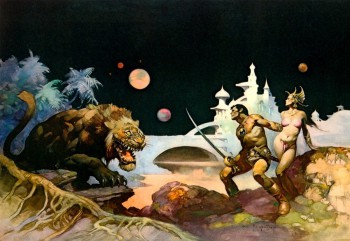 You didn’t expect phenomenology in your 1914 Martian pulp thriller, did you? Weren’t expecting Edmund Husserl to pop up on Barsoom, right? Oh, by the way, we’re going to feed Thuvia to Komal, so better get your swordsman on.
This is the first Martian novel to explore everyday life in the cities. John Carter moved in the circles of the great, but away from his POV the reader now sees what civic life in Helium is like: the public transportation, the markets, law enforcement. Mars already had a complex weave of cultures to give a sense of being a real place, but now it starts to feel “realistic.”
The same is true of the politics between the red Martian governments. Intrigue and espionage are at the forefront, where before the conflicts between the cities were painted in with a broad brush and only as a blurry backdrop to John Carter’s adventuring.
Most of the intrigue swirls around Astok, the Jed of Dusar who sets the story in motion. Astok benefits from the third-person: he’s the first villain in the series that readers get to experience from his perspective. Astok is brazen in kidnapping Thuvia, but he’s also cowardly and realizes that he has touched off events that are flying out of his control. Much of the energy in the last few chapters comes from watching Astok scramble to rectify the mess he caused without having to murder Thuvia to cover it up. He’s a perfect weasel.
Burroughs’s writing is a touch overwrought in the first few pages, but once he settles down he shows how much he advanced in his prose since 1912, crafting Romantic, lush descriptions that are a perfect fit for his grand tales:
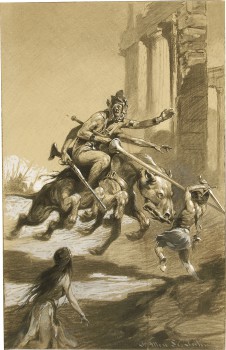
As Thar Ban rode noiseless up the broad avenues which leads from the quays of Aaanthor to the great central plaza, he and his mount might have been mistaked [sic] for specters from a world of dreams, so grotesque the man and beast, so soundless the great thoat’s padded, nailless feet upon the moss-grown flagging of the ancient pavement.
The man was a splendid specimen of his race. Fully fifteen feet towered his great height from sole to pate. The moonlight glistened against his glossy green hide, sparkling the jewels of his heavy harness and the ornaments that weighted his four muscular arms, while the upcurving tusks that protruded from his lower jaw gleamed white and terrible.
Writers can’t get away with this writing style today; that’s why we need to treasure morsels like this from the past.
The Negatives
Thuvia, Maid of Mars seems better in my memory of it from a decade past. Before returning to it for this review, I thought it was one of the best — perhaps the best — of the Barsoom novels. Looking at it now, it’s the power of Lothar that casts this illusion. The fourth Martian novel is a good adventure story with a superb central section; but it’s certainly not the best book in the series, although I might place it in the top third. (Which, if you do the math, means it is among the three and two-thirds best books. Maybe the Lothar section is the two-thirds.)
There isn’t anything terribly wrong with Thuvia, Maid of Mars, but there are a few elements that keep it from reaching the level of, say, The Gods of Mars.
 The third-person POV allows Burroughs to create broader and more interlaced stories. But it hampers his ability to craft a distinctive voice, and Carthoris isn’t interesting enough as a hero to make up for the change. I find myself evenly split about whether Burroughs wrote better in first person or third person; it depends on the material. In this novel, the characters of Thuvia and Astok benefit from the perspective, while Carthoris suffers from it.
The relationship between Carthoris and Thuvia is boilerplate Burroughs: love thwarted (until the concluding page) due to misunderstandings and mutual pride. Of all ERB’s tropes, this is the one I find most tiresome and predictable — and it’s no different here than anywhere else.
At 45,000 words, this is the shortest installment yet in the Barsoom series, and it feels a bit slight in spots. Although the confrontation between the red Martian cities in the conclusion explodes the story of Carthoris and Thuvia into one with planet-wide consequences, the rest of the book is on a smaller scale than anything seen in previous volumes. If Burroughs didn’t have all those imaginative ideas rocketing around to keep readers entertained, the story of Thuvia, Maid of Mars would have been a major disappointment compared to the gigantic scope of the “John Carter Trilogy.” As it is, there’s still a touch of disappointment in the wake of the epic events of The Gods of Mars and The Warlord of Mars.
Once again, no framing device. How did this story get back to Earth for the fictional ERB to write it? Yes, we don’t need this sort of set-up today, but these odd meta-moments always add an extra kick to the stories.
The dead city where Carthoris finds Thuvia is named “Aaanthor.” That one “a” too many, even for ERB.
Craziest bit of Burroughsian Writing: “Among them his warrior trappings were no more remarkable than is a pair of trousers upon Broadway.”
Best Moment of Heroic Arrogance: Carthoris charging a horde of green Martians on his own.
Times a “Princess” (Female Lead) Gets Kidnapped: 4
Best Creature: The new, improved, intelligent white apes.
Most Imaginative Idea: Lothar — a thousand times Lothar!
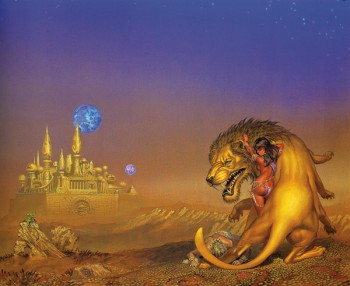
Michael Whelan Gets a Cover Idea: “Then he turned to Carthoris, but ever his gaze wandered to the perfect lines of Thuvia’s glorious figure, which the harness of a Barsoomian princess accentuated rather than concealed.”
Should ERB Have Continued the Series? The new third-person style works, and he isn’t out of great ideas. Keep ‘em coming, Ed!
Next: The Chessmen of Mars
*Answer: Who cares? Lothar forever!
Ryan Harvey is a veteran blogger for Black Gate and an award-winning science-fiction and fantasy author. He received the Writers of the Future Award in 2011 for his short story “An Acolyte of Black Spires,” and has two stories forthcoming in Black Gate, as well as a currently available e-book in the same setting. He also knows Godzilla personally. You can keep up with him at his website, www.RyanHarveyWriter.com, and follow him on Twitter.
For me, the lack of a framing story in Warlord wasn’t a big deal since that book was a direct continuation of Gods of Mars — I just assumed it was the rest of the manuscript John Carter gave to ERB in the opening of Gods. For Thuvia, though, yes, it was jarring.
On a semi-related note, I was looking at the new three-volume collection of all eleven Mars books from Disney and was very disappointed to discover that they’d left out the forewords. At least, they’re missing from Princess and Fighting Man; I’m guessing they were dropped any time they stood outside of the numbered sequence of chapters. Won’t be buying those editions, I guess.
Ryan, Lothar also sticks out in my mind. The other aspect of ‘Thuvia’ that I most remember is, well, Thuvia. Despite needing rescuing, as with all ERB love interests, she is more proactive than I recall Dejah being. Thuvia sticks a few foes with her dagger along the way.
Joe H. – that is disappointing. The framing device is quaint but a lot of fun. And, double-checking on Gutenberg, it’s not even that long. It wouldn’t have been hard for them to include the forwards.
Come to think of it, the framing device is in the movie. So, even more perplexing why it was dropped from the omnibus.
Joe, I went to check on those Disney volumes (here’s the first one) the moment I read your comment. And, yes, if the “Look Inside!” feature on Amazon is accurate, Disney cut off the prologues and epilogues from A Princess of Mars and The Gods of Mars.
This makes these editions worthless, in my opinion. Can the stories be understood without them? Yes, but—but they lose an important depth. And, of course, the author put them there, so they should be kept there.
There are many editions of ERB on the market, so do not buy the Disney volumes! The series goes under the title “The Collected John Carter.” Avoid.
Thanks for the tip, Joe.
Here a volume I recommend, containing the five public domain books for 99¢ on Kindle, along with J. Allen St. John’s frontispieces: John Carter of Mars: A Collection
I’m not sure how anyone else feels, but the thing I remember finding disappointing about Son of Tarzan is that, while I don’t mind Korak as a character, it felt like a straight regurgitation of Tarzan of the Apes – once Korak unlearns his civilized ways, he pretty much goes through the same jungle education Tarzan went through. Thuvia is the fourth novel that is much more satisfying to me because it’s free to be just another adventure that lets us travel to new parts of Barsoom.
You’re right, Andy. Son of Tarzan is just Tarzan of the Apes redux, and it’s plain boring. Burroughs thought he could restart everything with a younger hero, but if wanted to change anything, he should have looked back to The Return of Tarzan, the second book, which had Tarzan adventuring in civilization as well as the jungle. It was a great opportunity, to make him a global adventure character, but audiences didn’t react well to it. Son of Tarzan is Burroughs trying to make a change, yet play it safe . . . and it didn’t work either. The best of the later Tarzan novels are ones like Tarzan and the Ant Men, where ERB used crazy fantasy elements to enliven the jungle adventures. But for the most part, later Tarzan is just the same-damn-thing. Thuvia manages to give readers something new without going too far out of the comfort zone.
Isn’t Son of Tarzan the one that (if you pay attention to those kinds of things) also mucks up the timeline beyond repair?
I’m really disappointed about the Disney volumes (and I checked physical copies as well as the electronic editions) — I was hoping to get all 11 books onto my Kindle. Instead I guess I’ll be sticking with the Del Rey reprints (love those Whelan covers!) for now.
(I would gladly pay $50 or $100 for a complete set of textually-accurate Burroughs books were such a thing to be offered.)
[…] Black Gate (Ryan Harvey) on Edgar Rice Burroughs’s Mars, Part 4: Thuvia, Maid of Mars. […]
[…] Edgar Rice Burroughs pulled the Martian novels in a different direction with Thuvia, Maid of Mars, he retreated from Barsoom for a time to concentrate on other projects. Eight years passed between […]
[…] Installments: A Princess of Mars (1912), The Gods of Mars (1913), The Warlord of Mars (1913-14), Thuvia, Maid of Mars (1916), The Chessmen of Mars […]
[…] Installments: A Princess of Mars (1912), The Gods of Mars (1913), The Warlord of Mars (1913–14), Thuvia, Maid of Mars (1916), The Chessmen of Mars (1922), The Master Mind of Mars […]
[…] Installments: A Princess of Mars (1912), The Gods of Mars (1913), The Warlord of Mars (1913–14), Thuvia, Maid of Mars (1916), The Chessmen of Mars (1922), The Master Mind of Mars (1927), A Fighting Man of Mars […]
[…] Installments: A Princess of Mars (1912), The Gods of Mars (1913), The Warlord of Mars (191314), Thuvia, Maid of Mars (1916), The Chessmen of Mars (1922), The Master Mind of Mars (1927), A Fighting Man of Mars (1930), […]
[…] Installments: A Princess of Mars (1912), The Gods of Mars (1913), The Warlord of Mars (1913–14), Thuvia, Maid of Mars (1916), The Chessmen of Mars (1922), The Master Mind of Mars (1927), A Fighting Man of Mars (1930), […]
[…] Installments: A Princess of Mars (1912), The Gods of Mars (1913), The Warlord of Mars (1913–14), Thuvia, Maid of Mars (1916), The Chessmen of Mars (1922), The Master Mind of Mars (1927), A Fighting Man of Mars (1930), […]